
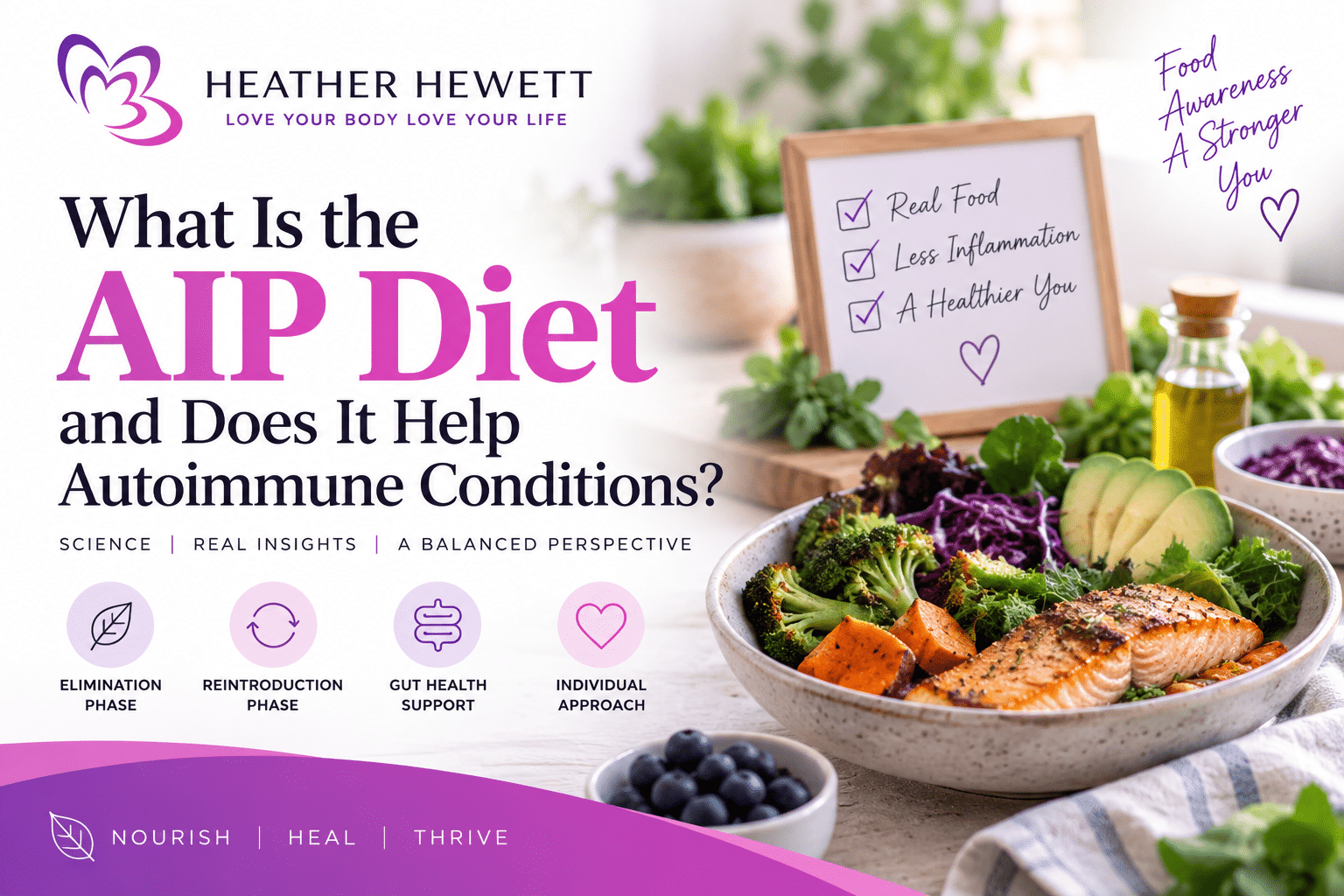
The AIP diet, short for the Autoimmune Protocol diet, is an elimination-style eating approach designed to identify foods that may contribute to symptoms while emphasizing nutrient-dense whole foods.
It has become popular among people with autoimmune conditions because of its focus on inflammation, food triggers, gut health and individual tolerance. But there is an important distinction between the theory behind AIP and what research has actually established.
Current evidence suggests that AIP may help some people with certain autoimmune conditions, particularly with symptoms or quality of life, but the evidence is still limited and does not establish AIP as a universal treatment or cure for autoimmune disease. The American College of Rheumatology describes the evidence as limited, while recent reviews call for more rigorous research.
So before removing dozens of foods, it helps to understand what AIP is actually trying to accomplish, what happens during the process, and why the individual response matters.
What Is the AIP Diet?
The Autoimmune Protocol diet is a structured elimination diet that temporarily removes a broad range of foods and then gradually reintroduces them.
It grew out of the Paleo dietary framework but is generally more restrictive during its elimination phase. Foods commonly excluded include grains, legumes, dairy, eggs, nuts, seeds and nightshade vegetables, along with highly processed foods and refined sugars.
The basic idea is straightforward:
Remove a group of potential dietary triggers → observe changes → reintroduce foods individually → identify what you personally tolerate.
That is different from simply following a permanent “autoimmune food list.”
A 2025 review in Nutrients describes AIP as a personalized elimination diet intended to identify foods that may be associated with symptoms and emphasizes the need to critically evaluate the current evidence.
AIP vs. Paleo
AIP is often described as a stricter version of Paleo.
There is overlap between the two approaches, particularly around whole foods and minimizing highly processed foods. But AIP removes additional foods during the elimination phase because the protocol is specifically designed around identifying possible triggers in people with autoimmune conditions. Cleveland Clinic describes AIP as an elimination diet that builds on the Paleo framework.
The important part is not the label.
It is the purpose.
AIP is supposed to be an investigative process, not simply another permanent diet.
How Does the AIP Diet Work?
AIP generally follows two major dietary stages: elimination and reintroduction. Some descriptions also distinguish a longer-term maintenance phase after foods have been tested.
Phase 1: Elimination
During elimination, foods considered potential triggers are removed.
Depending on the version of AIP being used, this can include:
- Grains
- Legumes
- Dairy
- Eggs
- Nuts
- Seeds
- Nightshade vegetables
- Refined sugars
- Highly processed foods
- Alcohol
- Coffee
- Certain food additives
At the same time, the diet emphasizes foods such as vegetables, fruit, fish, meat, poultry and other minimally processed foods.
This is where AIP can become challenging.
Removing several major food groups at once requires careful planning to maintain sufficient calories, protein, fiber, vitamins and minerals.
Cleveland Clinic specifically recommends professional guidance because restrictive elimination diets can increase the risk of nutrient deficiencies if they are poorly planned.
Phase 2: Reintroduction
The reintroduction phase is arguably the most important part of AIP.
Instead of remaining on a restricted diet indefinitely, foods are gradually brought back one at a time while the individual observes their response.
The American College of Rheumatology explains that the goal is to identify which foods appear to contribute to symptoms while returning foods that are tolerated so that dietary variety can be maximized.
This matters because a diet that leaves out too many foods forever can become unnecessarily restrictive.
The point of a thoughtful elimination process is not to end up afraid of more and more foods.
The point is to learn what you can comfortably include.
Phase 3: Your Individualized Long-Term Pattern
After foods have been tested, the long-term goal should generally be a sustainable eating pattern based on what you actually tolerate and what your body needs.
That can look different from one person to another.
One person may find that certain foods consistently create problems. Another may eventually reintroduce most of the eliminated foods without a meaningful symptom response.
There is no requirement that two people with the same autoimmune diagnosis end up eating exactly the same way.
What Foods Are Eliminated on AIP?
The exact food list can vary somewhat between versions of the protocol, but the elimination phase commonly removes several categories.
Foods commonly eliminated
| Food group | Examples |
| Grains | Wheat, rice, oats and other grains |
| Legumes | Beans, lentils, peas |
| Dairy | Milk, cheese, yogurt |
| Eggs | Chicken and other eggs |
| Nightshades | Tomatoes, peppers, eggplant, potatoes |
| Nuts and seeds | Almonds, walnuts, chia, sunflower seeds |
| Highly processed foods | Many packaged and ultra-processed foods |
| Refined sugars | Candy, sugary foods and beverages |
| Alcohol | Beer, wine and spirits |
| Coffee | Coffee and caffeinated preparations in some versions |
Cleveland Clinic and the American College of Rheumatology both describe similar categories of foods removed during the elimination phase.
What can you eat on AIP?
Foods commonly emphasized include:
- Vegetables that are allowed within the protocol
- Fruits
- Fish and seafood
- Meat and poultry
- Certain healthy fats and oils
- Herbs and spices that fit the protocol
- Minimally processed foods
The emphasis is on building meals from foods that provide substantial nutrition rather than simply thinking about everything that has been removed.
Still, a food being allowed by the protocol does not automatically make it appropriate for every individual.
That is an important distinction.
Does the AIP Diet Actually Help Autoimmune Conditions?
This is the question that deserves the most caution.
There is some encouraging evidence, but not enough to say that AIP works universally for autoimmune disease.
The American College of Rheumatology says scientific evidence is currently limited, although some studies suggest AIP may reduce inflammation or symptoms in a subset of people with certain autoimmune disorders.
A recent scientific review similarly describes AIP as promising but notes important limitations in the available evidence and the need for better clinical trials.
Healthline’s June 2026 evidence-based review reaches a similar conclusion: some people report symptom relief, but research into the effectiveness of AIP remains limited.
That means the most accurate description is:
AIP is an intervention worth studying, not a proven universal autoimmune treatment.
Why Might Some People Feel Better on AIP?
There are several possible explanations, but they should not automatically be treated as proof that AIP has changed the underlying autoimmune disease.
First, the diet removes many highly processed foods and emphasizes nutrient-dense whole foods.
Second, someone may discover that a particular food does not agree with them.
Third, a person may become more aware of meal patterns, digestion, food quality and symptom changes.
Fourth, reducing the overall burden of dietary choices may lead someone to develop a more consistent eating routine.
And finally, individual autoimmune conditions are complex. A symptom can have multiple contributors.
The scientific literature proposes relationships among diet, the gut environment, immune regulation and autoimmune disease, but these mechanisms are still being studied and should not be turned into simplistic claims about “healing a leaky gut” or curing autoimmunity through food.
Has AIP Been Studied for Specific Autoimmune Conditions?
Research has included conditions such as inflammatory bowel disease and Hashimoto’s thyroiditis, among others, but the amount and quality of evidence vary substantially.
AIP and inflammatory bowel disease
IBD is one area where AIP has attracted research interest.
A recent review identifies inflammatory bowel disease among the conditions studied in the AIP literature.
However, symptom improvement should not automatically be equated with elimination of the underlying inflammatory disease process.
For someone with Crohn’s disease or ulcerative colitis, for example, nutrition needs to be considered alongside disease activity, medication, nutritional status and individual tolerance.
AIP and Hashimoto’s thyroiditis
Hashimoto’s is another condition frequently discussed in relation to AIP.
There is broader evidence that nutrition may play a complementary role in Hashimoto’s, but researchers have not established one dietary strategy as universally optimal.
A systematic review of nutritional interventions in Hashimoto’s concluded that diet can be complementary to treatment but that it remains unclear which dietary strategy is most beneficial. The review also found substantial variation between studies and participants.
That is one reason Heather’s approach does not treat AIP as a mandatory answer.
Her own published Hashimoto’s nutrition guidance describes a balanced, nutrient-dense, Mediterranean-style approach as a practical starting point and says that elimination strategies should have a clear purpose, defined strategy and thoughtful reintroduction phase.
What Are the Downsides of the AIP Diet?
AIP can look attractive because it offers a clear framework.
But clarity and simplicity are not the same thing.
It can be highly restrictive
Removing grains, legumes, dairy, eggs, nuts, seeds and nightshades at the same time dramatically reduces food choices.
That may be manageable for a short period for some people, but difficult for others.
It can create nutritional gaps
The more foods you remove, the more carefully you need to plan the replacement foods.
Cleveland Clinic specifically warns about possible vitamin and mineral deficiencies with elimination diets when dietary variety is not maintained.
It can make social eating harder
Restaurants, family meals, travel and celebrations can become complicated.
A nutrition plan that cannot survive real life may not be sustainable.
It can increase food fear
This is an issue that deserves more attention.
When someone is already worried about their health, a long list of foods labeled as “bad” can make eating feel stressful.
A protocol intended to create clarity can accidentally create more anxiety if every symptom is interpreted as evidence that another food must be eliminated.
That is why the reintroduction phase matters so much.
Is AIP Right for Everyone With an Autoimmune Condition?
No.
An autoimmune diagnosis alone does not automatically mean you need AIP.
You may have a legitimate reason to experiment with a specific elimination strategy, but you may also benefit more from improving the quality of your overall diet without taking on a highly restrictive protocol.
The right starting point depends on several factors:
- Your autoimmune condition
- Your current diet
- Your symptoms
- Your digestive health
- Existing food restrictions
- Nutritional status
- Lifestyle and schedule
- Relationship with food
- Other medical considerations
This is where personalized care becomes more valuable than following a generic protocol from the internet.
A More Personalized Way to Think About AIP
Heather M. Hewett’s approach begins with the person rather than the protocol.
She describes her nutrition work as personalized whole-food nutrition that considers the individual’s body, goals and broader circumstances. Her clinical nutrition service also incorporates stress, nervous-system regulation, emotional patterns, gut health and autoimmune-focused nutrition.
That perspective is especially relevant when someone is asking, “Which foods should I eliminate?”
A better question may sometimes be:
What is the smallest, most useful change we can make that gives us meaningful information without unnecessarily shrinking your diet?
That does not mean elimination diets are never useful.
It means they should have a purpose.
Heather also brings lived experience to this subject. She has publicly shared her history with Hashimoto’s thyroiditis and other autoimmune diagnoses and describes how her own experience changed the way she thinks about nutrition and healing.
Her stated philosophy is that real support extends beyond food alone and considers the whole person.
That is an important distinction in a space where “just follow this food list” is often presented as the complete answer.
When Might a Structured Elimination Approach Make Sense?
A structured approach may make sense when:
- You have a recurring pattern of symptoms that seems connected to particular foods.
- You need a systematic way to test dietary changes.
- You have already addressed the basics of a balanced diet and want to investigate specific triggers.
- You can maintain adequate nutrition while eliminating foods.
- You have a clear plan for reintroduction.
It may make less sense when you are already following an extremely restrictive diet, have difficulty meeting nutritional needs, or are becoming increasingly fearful of food.
In those situations, adding more restrictions without a clear strategy may make the problem harder rather than easier.
What Should You Do After the AIP Elimination Phase?
Do not assume that everything removed needs to stay out forever.
The purpose of reintroduction is to identify what you can tolerate and bring appropriate foods back into your diet.
A broader diet can provide more nutritional variety, more flexibility and a healthier relationship with food.
The American College of Rheumatology specifically describes reintroduction as a way to identify problematic foods while reintroducing foods that do not trigger symptoms.
That makes reintroduction more than a final step.
It is part of the learning process.
The Bottom Line
The AIP diet is best understood as a structured elimination and reintroduction approach, not a magic autoimmune cure.
There is a reasonable scientific basis for studying how diet, gut health and immune regulation may interact, and some early research is encouraging. But the current evidence is still limited, and there is not enough evidence to recommend AIP as the universal diet for people with autoimmune disease.
For some people, a carefully planned elimination process may provide useful information.
For others, a less restrictive whole-food approach may be a better starting point.
The most important question is not simply, “Does AIP work?”
It is:
“What approach makes sense for my body, my health history, my symptoms and my life?”
That is the foundation of Heather M. Hewett’s whole-person nutrition approach. Rather than treating one protocol as the answer for everyone, she focuses on personalized whole-food nutrition while considering the broader factors that can affect how someone feels, including digestion, stress, emotional patterns and nervous-system regulation.
For people looking for individualized support with autoimmune nutrition, you can learn more about Heather’s approach here:
Personalized Online Autoimmune Nutrition Support
Frequently Asked Questions
What is the AIP diet?
The AIP, or Autoimmune Protocol diet, is an elimination-style diet that temporarily removes a range of foods before gradually reintroducing them to evaluate individual tolerance. It emphasizes minimally processed, nutrient-dense foods while investigating whether certain dietary factors may be associated with symptoms.
How does the AIP diet work?
AIP generally begins with an elimination period followed by gradual food reintroduction. The goal is to identify foods that may be associated with symptoms while returning foods that are tolerated and maintaining as much dietary variety as possible.
Does the AIP diet cure autoimmune disease?
No. Current evidence does not establish AIP as a cure for autoimmune disease. Research is limited, although some studies suggest possible benefits for symptoms or inflammation in subsets of people with certain conditions.
Is AIP good for Hashimoto’s?
AIP may be helpful for some individuals, but there is not enough evidence to say that it is the best diet for everyone with Hashimoto’s. Research on nutrition in Hashimoto’s remains mixed, and a personalized approach may be more appropriate than automatically following a highly restrictive protocol.
How long should you follow the AIP diet?
There is no single evidence-based duration that applies to everyone. AIP is generally intended as a temporary elimination and reintroduction process rather than an automatically permanent diet. The appropriate timeline depends on the individual approach, symptoms, nutritional needs and professional guidance.
Can the AIP diet cause nutritional deficiencies?
It can if it is poorly planned. Because AIP removes many food groups, maintaining adequate energy, protein, fiber, vitamins and minerals requires attention to food variety and nutritional balance. Cleveland Clinic recommends professional guidance for this reason.
Do you have to stay on AIP forever?
No. The purpose of the protocol is generally to identify individual tolerances and build the broadest nutritious diet that works for you. Staying unnecessarily restricted may reduce dietary variety and make eating more difficult.