
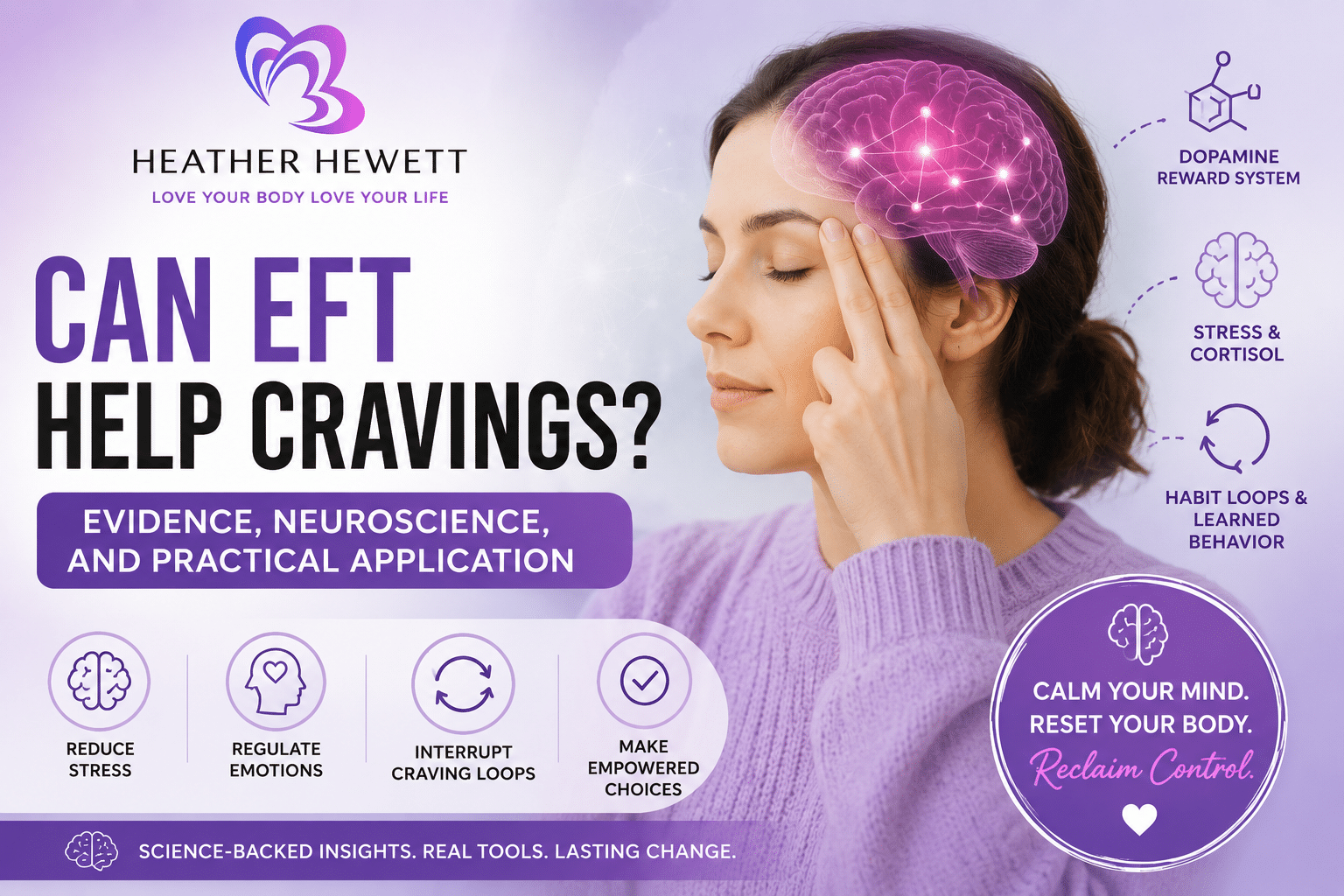
Emotional Freedom Techniques (EFT) is a structured mind-body intervention that combines cognitive focus with somatic stimulation through tapping on specific acupressure points. It is commonly used for emotional regulation, stress reduction, and behavioral habit management.
So, can EFT help cravings?
EFT may help reduce cravings indirectly by lowering stress activation, regulating emotional responses, and interrupting learned habit loops. Cravings are not purely psychological experiences. They are driven by neurobiological systems including the dopamine reward circuit, cortisol stress response, and conditioned behavioral pathways.
Cravings such as sugar urges, emotional eating episodes, and stress-driven snacking are often reinforced through repeated emotional reinforcement cycles.
This article provides a detailed breakdown of how EFT interacts with craving mechanisms, what scientific evidence suggests, and how it can be applied in real-world scenarios.
What Are Cravings?
Cravings are intense motivational states that arise from the interaction between brain chemistry, emotional processing, and learned behavior.
1. Dopamine reward system and craving reinforcement
The dopamine system is responsible for motivation and reward prediction. When a person consumes highly palatable food such as sugar or processed carbohydrates, dopamine is released in the brain’s reward centers.
Over time, the brain begins to anticipate the reward before consumption occurs. This creates:
- anticipatory desire
- compulsive seeking behavior
- reinforcement of repeated eating patterns
This is why cravings often feel automatic and difficult to resist.
2. Habit loop psychology
Cravings follow a neurological loop:
- Cue (emotion, environment, stress trigger)
- Craving (urge activation)
- Response (eating behavior)
- Reward (temporary relief or pleasure)
Once reinforced repeatedly, this loop becomes unconscious. This is why cravings often occur without deliberate decision-making.
3. Cortisol and stress-driven cravings
Stress activates the hypothalamic-pituitary-adrenal axis, leading to increased cortisol production.
Elevated cortisol is associated with:
- increased appetite
- preference for high sugar and high fat foods
- reduced impulse control
- emotional eating behavior
This explains why cravings often intensify during stressful periods.
4. Emotional and psychological triggers
Cravings are strongly influenced by emotional states such as:
- anxiety
- boredom
- loneliness
- frustration
- fatigue
These emotional states activate reward-seeking behavior as a form of psychological relief.
Reference: MAYO CLINIC
What is EFT (Emotional Freedom Techniques)?
Emotional Freedom Techniques (EFT) is a structured psychological method combining cognitive focus with physical tapping on meridian points.
Core components
- Focused attention on emotional triggers
- Tapping on specific acupressure points
- Verbal cognitive reframing statements
Mechanism of action
1. Nervous system regulation
EFT is believed to activate the parasympathetic nervous system, which reduces physiological stress arousal and supports emotional stabilization.
2. Amygdala deactivation response
The amygdala is responsible for emotional threat detection. EFT may reduce overactivation during craving episodes.
3. Cognitive interruption process
The combination of tapping and verbal repetition disrupts automatic thought loops associated with cravings.
Scientific context
EFT is classified as a complementary mind-body intervention. It is not a replacement for clinical treatment but is used in stress and emotional regulation frameworks.
Research database: National Library of Medicine
Related resource: Emotional Resilience
Can EFT Help Cravings?
EFT does not directly suppress cravings. Instead, it modifies the emotional intensity and physiological drivers behind them.
1. Emotional intensity reduction
Cravings often feel overwhelming due to heightened emotional arousal. EFT may reduce this emotional intensity, making cravings more manageable.
2. Stress system regulation
By reducing stress activation, EFT may indirectly reduce cortisol-related craving intensity. This is especially relevant for stress eating and sugar cravings.
3. Habit loop interruption
EFT introduces a conscious pause in the craving cycle. This interruption allows cognitive control systems to re-engage before automatic behavior occurs.
4. Awareness enhancement
Users often report increased awareness of emotional triggers, which is critical for long-term behavior change.
Scientific limitations
- Evidence base is still developing
- Many studies are small scale
- Outcomes vary across individuals
- Relaxation response may partially explain results
Reference: American Psychological Association
Step-by-Step EFT for Cravings
Step 1: Setup statement
“I acknowledge this craving, and even though I feel it strongly, I accept myself completely at this moment.”
Step 2: Tapping sequence
- Karate chop point
- Eyebrow
- Side of eye
- Under eye
- Under nose
- Chin
- Collarbone
- Under arm
- Top of head
Step 3: Sugar craving protocol
- This intense sugar craving
- My brain is seeking dopamine reward
- I feel stress and want relief
- I choose calm regulation instead
Step 4: Emotional eating protocol
- This emotional discomfort
- I am seeking food for comfort
- This learned coping mechanism
- I can feel safe without eating
Step 5: Stress craving protocol
- This stress in my body
- My cortisol feels elevated
- This urge to eat for relief
- I allow this feeling to pass naturally
Step 6: Nighttime craving system reset
Night cravings are often linked to fatigue and emotional depletion.
Use:
- “I am safe without food right now”
- “This craving will pass like a wave”
- “My body is resting and recovering”
EFT vs CBT for Cravings
| Factor | EFT | CBT |
| Primary mechanism | Emotional regulation | Cognitive restructuring |
| Evidence strength | Emerging | Strong clinical validation |
| Speed of effect | Fast emotional relief | Gradual long-term change |
| Target system | Nervous system response | Thought-behavior patterns |
Key interpretation
EFT provides rapid emotional stabilization. CBT provides long-term behavioral restructuring. They operate at different levels of the psychological system and can be complementary.
Reference: American Psychological Association
Scientific Evidence on EFT
Research indicates EFT may contribute to:
- reduced anxiety levels
- improved emotional regulation
- reduced physiological stress markers
- decreased intensity of emotional cravings
Evidence limitations
- limited large-scale randomized trials
- variability in study quality
- overlapping placebo and relaxation effects
- need for more longitudinal research
Who Should Use EFT for Cravings?
Suitable for:
- emotional eating patterns
- stress-based cravings
- habitual snacking behavior
- mild impulse regulation issues
Not sufficient for:
- clinical eating disorders
- severe addiction conditions
- psychiatric disorders requiring structured treatment
Related programs: Coaching Programs
Limitations of EFT
While EFT can be effective for emotional regulation, it has limitations:
- not a standalone treatment
- requires consistent practice
- best combined with CBT or mindfulness
- evidence base still evolving
Final Takeaway
EFT may help cravings by reducing emotional stress response, regulating physiological arousal, and interrupting habit loops that drive impulsive eating behavior.
Its strongest contribution lies in emotional regulation rather than elimination of cravings.
For best outcomes, EFT should be combined with CBT, mindfulness-based practices, and lifestyle interventions that address behavioral patterns.
Frequently Asked Questions
Can EFT really help with cravings?
EFT may reduce craving intensity by calming emotional stress responses, but it does not eliminate cravings entirely.
How quickly does EFT work for cravings?
Some users experience immediate relief, while others require repeated practice for consistent results.
Is EFT scientifically proven for cravings?
Evidence is emerging but not yet conclusive.
Can EFT stop sugar addiction permanently?
No. It may reduce emotional triggers but does not cure addiction.
EFT vs CBT which is better for cravings?
CBT has stronger evidence support, while EFT provides faster emotional relief.