If you’ve searched for Emotional Freedom Techniques vs Emotionally Focused Therapy, you’re not alone in feeling confused. Both approaches use the abbreviation EFT, yet they are completely different. One focuses on gentle tapping as a wellness practice, while the other is a structured form of psychotherapy often used to improve relationships.
Adding to the confusion, there is also Emotion-Focused Therapy, another approach with a similar name but a different purpose. As a result, it’s easy to end up reading about the wrong type of EFT or booking a service that doesn’t match your needs.
Understanding these differences can help you choose the type of support that best aligns with your goals. Whether you’re looking for a self-regulation practice, relationship counseling, or simply trying to understand what “EFT” means, this guide explains each approach in clear, practical language.
By the end of this article, you’ll understand:
- Why does the acronym “EFT” have multiple meanings?
- How Emotional Freedom Techniques differs from Emotionally Focused Therapy.
- Where Emotion-Focused Therapy fits into the picture.
- What current research says about each approach.
- How to decide which type of support may be right for your situation.
The goal is not to suggest that one approach is better than another. Instead, it’s to help you make an informed decision based on your personal needs and circumstances.
What Is the Difference Between Emotional Freedom Techniques and Emotionally Focused Therapy?
The biggest difference is that Emotional Freedom Techniques and Emotionally Focused Therapy serve different purposes.
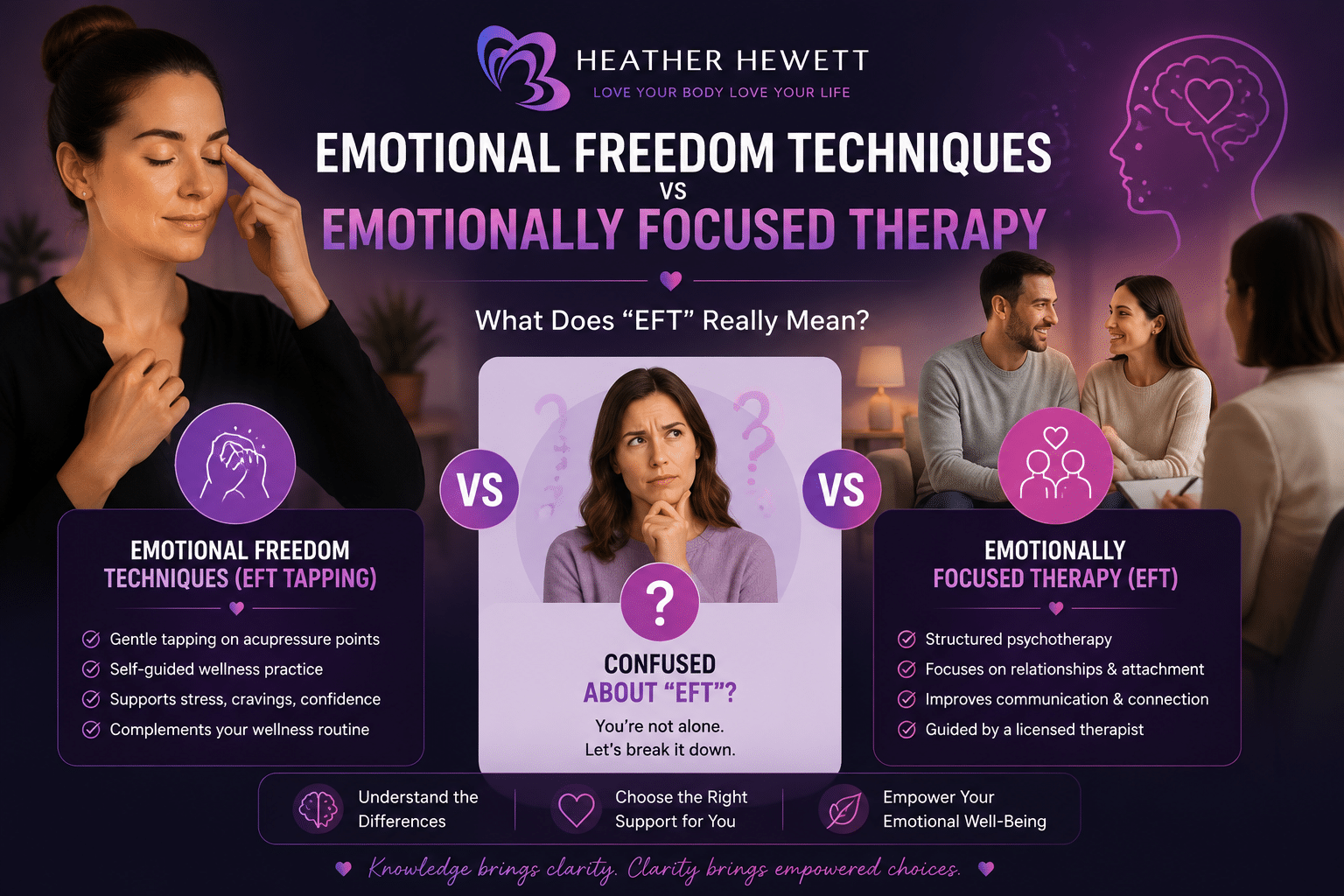
Emotional Freedom Techniques (EFT tapping) is a wellness practice that combines gentle tapping on specific acupressure points while focusing on a current thought, feeling, or stressful experience. Many people use it as part of a broader approach to emotional well-being and self-regulation.
Emotionally Focused Therapy (EFT) is a structured psychotherapy based on attachment theory. Rather than using tapping, it helps people explore emotions, strengthen relationships, and improve communication through guided conversations with a licensed therapist.
Although both approaches involve emotions, they differ in their methods, goals, and professional settings.
Emotional Freedom Techniques at a Glance
Emotional Freedom Techniques, often called EFT tapping, combines gentle tapping with focused attention on emotions, thoughts, or physical sensations.
People commonly explore EFT tapping to support:
- Everyday stress
- Emotional overwhelm
- Food cravings
- Emotional eating patterns
- Difficult self-talk
- Confidence building
- Emotional awareness
Many people practice tapping on their own after learning the technique, while others prefer working with an EFT coach for guidance and accountability.
Current research suggests EFT tapping may help some people manage stress and emotional distress. However, the evidence is still developing, and results vary from person to person. It should be viewed as a complementary wellness practice rather than a replacement for medical care or psychotherapy.
Emotionally Focused Therapy at a Glance
Emotionally Focused Therapy is an evidence-informed psychotherapy that focuses on emotional experiences and attachment patterns.
It is commonly used to help people:
- Improve communication
- Strengthen emotional connection
- Address recurring relationship conflict
- Understand attachment needs
- Build healthier relationship patterns
Sessions are led by licensed mental health professionals with training in the model. Unlike EFT tapping, Emotionally Focused Therapy does not involve tapping on acupressure points or self-guided exercises.
What Are Emotional Freedom Techniques (EFT Tapping)?
Emotional Freedom Techniques, commonly known as EFT tapping, is a mind-body wellness practice that combines gentle tapping on specific points of the face and upper body while focusing on a current emotion, stressful event, or unwanted thought.
The practice is based on a simple idea. Instead of trying to ignore difficult emotions, you intentionally acknowledge what you’re experiencing while following a sequence of tapping points. Many people describe this process as helping them slow down, become more aware of their emotional responses, and create space before reacting automatically.
Some people use EFT tapping independently after learning the technique, while others choose to work with a qualified coach who provides structure and guidance.
People often explore EFT tapping for concerns such as:
- Stress and emotional overwhelm
- Worry and anxious thoughts
- Food cravings
- Emotional eating
- Self-criticism
- Performance pressure
- Building emotional resilience
It’s important to have realistic expectations.
EFT tapping is not designed to eliminate every uncomfortable emotion or replace professional mental health care. Instead, many people use it as one part of a broader wellness routine that may also include exercise, mindfulness, healthy sleep, balanced nutrition, and professional support when appropriate.
Research into EFT tapping continues to grow, but study quality varies. While some research suggests it may help certain individuals manage stress and emotional distress, more high-quality studies are needed to better understand when it is most effective and for whom.
What Is Emotionally Focused Therapy?
Emotionally Focused Therapy (EFT) is a structured form of psychotherapy that helps people understand their emotions, improve communication, and build stronger relationships. Unlike EFT tapping, it does not involve tapping on acupressure points.
Developed by Dr. Sue Johnson and grounded in attachment theory, Emotionally Focused Therapy is based on the idea that secure emotional connections are essential for healthy relationships and overall well-being.
Although it is best known as a couples therapy approach, Emotionally Focused Therapy can also be adapted for individuals and families. The goal is to identify unhelpful emotional patterns, understand the needs beneath those emotions, and create healthier ways of responding to one another.
A typical session focuses on guided conversations rather than exercises or self-help techniques. The therapist helps clients recognize recurring interaction patterns, express emotions more openly, and develop greater emotional security.
People commonly seek Emotionally Focused Therapy for:
- Ongoing relationship conflict
- Emotional distance from a partner
- Communication difficulties
- Trust concerns
- Attachment-related challenges
- Repeating unhealthy relationship patterns
Emotionally Focused Therapy should be provided by a licensed mental health professional with appropriate training. It is not a self-guided practice and should not be confused with Emotional Freedom Techniques.
How Is Emotionally Focused Therapy Different From EFT Tapping?
Although both approaches use the abbreviation EFT, they are designed for different purposes.
EFT tapping is a wellness practice that combines gentle tapping with focused attention on thoughts and emotions. It is often used as a complementary approach to emotional well-being and stress management.
Emotionally Focused Therapy is a form of psychotherapy that explores emotional experiences and relationship dynamics through structured conversations with a licensed therapist.
The main differences include:
Emotional Freedom Techniques (EFT Tapping)
- A mind-body wellness practice
- Uses gentle tapping on specific acupressure points
- Often practiced individually
- May support emotional regulation and stress management
- Can be self-guided or coach-guided
Emotionally Focused Therapy
- A licensed psychotherapy
- Does not involve tapping
- Focuses on attachment and relationships
- Delivered by trained mental health professionals
- Commonly used with couples, individuals, and families
Although both approaches involve emotions, they are not interchangeable.
What Is Emotion-Focused Therapy?
Another source of confusion is Emotion-Focused Therapy.
Despite the similar name, Emotion-Focused Therapy, Emotionally Focused Therapy, and Emotional Freedom Techniques are three different approaches.
Emotion-Focused Therapy is a psychotherapy model developed primarily through the work of Dr. Leslie Greenberg. It focuses on helping people recognize, understand, and work through emotional experiences so they can respond in healthier ways.
Like Emotionally Focused Therapy, it is delivered by trained mental health professionals. However, the two therapies have different theoretical foundations and treatment methods.
In simple terms:
- Emotional Freedom Techniques is a wellness practice that uses tapping.
- Emotionally Focused Therapy is an attachment-based psychotherapy.
- Emotion-Focused Therapy is another psychotherapy model that focuses on processing emotions.
Understanding these distinctions can help you choose the type of support that best matches your needs.
Why Does “EFT” Mean Different Things?
The confusion exists because different professionals adopted the same abbreviation over time.
In wellness settings, EFT usually refers to Emotional Freedom Techniques, also known as EFT tapping.
In psychology and counseling, EFT often refers to Emotionally Focused Therapy.
Some people also shorten Emotion-Focused Therapy to EFT, even though it is a separate psychotherapy model.
Because of this overlap, searching for “EFT therapy” can produce very different results depending on the source.
Instead of searching only for “EFT,” try using the full name of the approach you’re interested in. For example:
- Emotional Freedom Techniques
- EFT tapping
- Emotionally Focused Therapy
- Emotion-Focused Therapy
Using the complete name can help you find more accurate information and the right type of professional support.
Which Type of EFT Is Right for You?
There is no single approach that is right for everyone.
The best choice depends on what you’re hoping to achieve, the challenges you’re facing, and whether you need a wellness practice or licensed psychotherapy.
EFT Tapping May Be Worth Exploring If…
You may find EFT tapping helpful if you:
- I want simple practice for managing everyday stress.
- Experience emotional eating or food cravings.
- I want to become more aware of emotional triggers.
- Are looking for practical tools to support emotional regulation.
- Prefer a complementary wellness practice alongside healthy lifestyle habits.
- I want guidance from an EFT coach rather than psychotherapy.
Many people include EFT tapping as part of a broader wellness routine that also includes exercise, mindfulness, healthy sleep, and balanced nutrition.
Emotionally Focused Therapy May Be More Appropriate If…
Emotionally Focused Therapy may be a better choice if you:
- Feel emotionally disconnected from your partner.
- Keep having the same unresolved arguments.
- I want to improve communication in your relationship.
- Are interested in understanding attachment patterns.
- I want support from a licensed mental health professional.
Because this approach focuses on relationships, it is often recommended for couples who want to strengthen emotional connection and develop healthier communication patterns.
When Should You Seek Licensed Mental Health Care?
Wellness practices have an important role, but they are not appropriate for every situation.
Professional mental health care is generally the better choice if you experience:
- Persistent anxiety or depression
- Frequent panic attacks
- Trauma-related symptoms
- Thoughts of self-harm
- Active eating disorder symptoms
- Substance dependence
- Emotional distress that affects work, relationships, or daily life
- Feeling unsafe in a relationship
- Abuse, threats, or coercive control
Seeking professional support is not a sign of failure. It is a positive step toward receiving the level of care that best matches your needs.
If you are already working with a healthcare or mental health professional, talk with them before adding any new wellness practices to your care plan.
Key Takeaway
Choosing between Emotional Freedom Techniques and Emotionally Focused Therapy begins with understanding that they are different approaches with different purposes.
If you’re looking for a self-guided or coach-supported wellness practice, EFT tapping may be worth exploring.
If you’re looking for relationship counseling or psychotherapy, Emotionally Focused Therapy is likely the more appropriate option.
The next section explores what current research says about both approaches and explains how they can fit into a broader plan for emotional well-being.
What Does Research Say?
Research on both Emotional Freedom Techniques (EFT tapping) and Emotionally Focused Therapy has grown over the years. However, the evidence for each approach comes from different fields and should not be compared directly.
Research on EFT Tapping
Research into EFT tapping is still developing. Some systematic reviews and clinical studies suggest it may help reduce stress, anxiety, emotional distress, and food cravings for some people. However, study quality varies, and more high-quality research is needed.
Current evidence suggests that EFT tapping may be a helpful complementary wellness practice for some individuals. It should not be viewed as a cure or a replacement for medical care or psychotherapy.
Like many wellness practices, results vary from person to person. Factors such as the individual’s goals, the quality of instruction, and the presence of other supportive habits may all influence outcomes.
Research on Emotionally Focused Therapy
Emotionally Focused Therapy has a separate body of research that primarily focuses on relationship functioning and attachment.
Studies have found that this psychotherapy may help improve relationship satisfaction, emotional connection, and communication for many couples. Researchers have also explored its use with individuals and families.
Because Emotionally Focused Therapy is a licensed psychotherapy, it should always be delivered by a qualified mental health professional.
Although both approaches involve emotions, they are supported by different research and are designed for different purposes.
Can EFT Tapping and Therapy Be Used Together?
Yes, in some situations they can.
Some people use EFT tapping as a personal wellness practice while also working with a licensed therapist. Others may begin with psychotherapy and later add tapping as one of several self-care strategies.
Using both approaches does not mean they serve the same purpose.
Psychotherapy focuses on assessment, treatment, and long-term emotional or psychological concerns. EFT tapping is generally used as a complementary wellness practice that may help some people manage stress and increase emotional awareness.
If you are currently receiving mental health treatment, talk with your healthcare provider before adding any new wellness practices to your routine. They can help you decide whether it fits your overall care plan.
What Type of EFT Does Heather M. Hewett Offer?
If you found this article through Heather M. Hewett’s website, you may be wondering which type of EFT she provides.
Heather offers Emotional Freedom Techniques (EFT tapping) as part of her trauma-informed, nervous-system-aware wellness coaching.
Her coaching is designed to support adults who want practical tools for:
- Stress management
- Emotional overwhelm
- Emotional eating
- Food cravings
- Self-criticism
- Emotional resilience
- Nervous system awareness
Depending on your goals, coaching may include guided EFT tapping, somatic awareness practices, emotional regulation strategies, and nutrition education where appropriate.
Heather’s services are educational and wellness-focused. They are not psychotherapy or mental health treatment.
Heather does not provide:
- Emotionally Focused Therapy
- Emotion-Focused Therapy
- Couples counseling
- Mental health diagnosis
- Licensed psychotherapy
- Psychiatric treatment
If your primary goal is relationship counseling or treatment for a mental health condition, a licensed mental health professional is the most appropriate source of support.
If you’re interested in learning how EFT tapping may fit into a holistic wellness approach, you can explore Heather’s educational resources, learn more about her EFT coaching, or book a free consultation to discuss whether her services are a good fit for your goals.
When to Seek More Support Than Self-Guided Tapping
Self-guided tapping can be a valuable wellness practice, but it is not appropriate for every situation.
Stop a self-guided tapping session if it becomes emotionally overwhelming or leaves you feeling more distressed than before. A qualified professional can help you determine the safest and most appropriate next step.
Seek professional support if you experience:
- Severe anxiety or depression
- Panic attacks
- Trauma symptoms
- Thoughts of self-harm
- Active eating disorder symptoms
- Substance dependence
- Emotional distress that affects daily life
- Abuse or violence in a relationship
- Concerns about your personal safety
If you ever feel that you are in immediate danger, contact your local emergency services or an appropriate crisis resource right away.
Final Thoughts
Understanding Emotional Freedom Techniques vs Emotionally Focused Therapy starts with recognizing that they are two completely different approaches that happen to share the same abbreviation.
Emotional Freedom Techniques is a mind-body wellness practice that combines gentle tapping with focused attention on thoughts and emotions. Some people use it as part of a broader approach to stress management and emotional well-being.
Emotionally Focused Therapy is an attachment-based psychotherapy that helps individuals, couples, and families improve emotional connection and relationship patterns through guided conversations with a licensed therapist.
Neither approach is universally better than the other. The right choice depends on your goals, your circumstances, and the type of support you need.
If you’re interested in learning more about EFT tapping, Heather M. Hewett offers educational resources and wellness coaching designed to help adults build practical skills for emotional regulation, stress management, and emotional resilience.
Disclaimer
This article is for educational and wellness purposes only. It is not medical advice, psychotherapy, diagnosis, or treatment. Heather M. Hewett’s coaching services do not replace care from a physician or licensed mental health professional. If you are experiencing severe emotional distress or are concerned about your safety, seek help from an appropriately qualified healthcare provider or emergency services.
Frequently Asked Questions
Are Emotional Freedom Techniques and Emotionally Focused Therapy the same?
No. Emotional Freedom Techniques is a tapping-based wellness practice, while Emotionally Focused Therapy is an attachment-based psychotherapy. They share the same abbreviation but are different approaches.
Why are both approaches called EFT?
Both use the same abbreviation for different names. EFT may refer to Emotional Freedom Techniques or Emotionally Focused Therapy. Some people also use it for Emotion-Focused Therapy.
Is EFT tapping a type of couples therapy?
No. EFT tapping is a wellness practice. It is not couples counseling or relationship therapy.
Does Emotionally Focused Therapy involve tapping?
No. Emotionally Focused Therapy uses guided conversations to improve emotional connection. It does not include tapping techniques.
Can EFT tapping replace therapy?
No. EFT tapping is not a replacement for psychotherapy or medical care. It may complement professional treatment for some people.
Is EFT tapping evidence based?
Research is growing and suggests potential benefits for some people, but more high-quality studies are needed. Results vary between individuals.
Is Emotionally Focused Therapy only for couples?
No. It is commonly used with couples but can also be adapted for individuals and families.
Can I practice EFT tapping on my own?
Yes. Many people learn EFT tapping and practice it independently. Others prefer guidance from an experienced coach.
Can EFT tapping bring up difficult emotions?
Yes. It can. If tapping becomes overwhelming, stop the practice and seek support from an appropriate healthcare or mental health professional.
Can EFT tapping and therapy be used together?
Yes. Some people use EFT tapping alongside psychotherapy. The two approaches serve different purposes and may complement one another.
What is the difference between EFT coaching and therapy?
EFT coaching focuses on education and wellness. Therapy is provided by licensed mental health professionals and is intended to assess and treat psychological concerns.
What type of EFT does Heather M. Hewett offer?
Heather offers Emotional Freedom Techniques (EFT tapping) as part of her wellness coaching. She does not provide Emotionally Focused Therapy or psychotherapy.
Does Heather M. Hewett offer couples therapy?
No. Heather does not provide couples counseling or licensed psychotherapy.
When should I seek professional mental health support?
Seek professional support if emotional distress is severe, persistent, affects daily life, or includes thoughts of self-harm, trauma symptoms, or safety concerns.
Is couples therapy appropriate when abuse is present?
Generally, no. When abuse or coercive control is present, individual safety and specialized support should take priority over couples counseling.
What is the difference between Emotion-Focused Therapy and Emotionally Focused Therapy?
They are different psychotherapy models with different theories and methods. Both are also different from Emotional Freedom Techniques.