
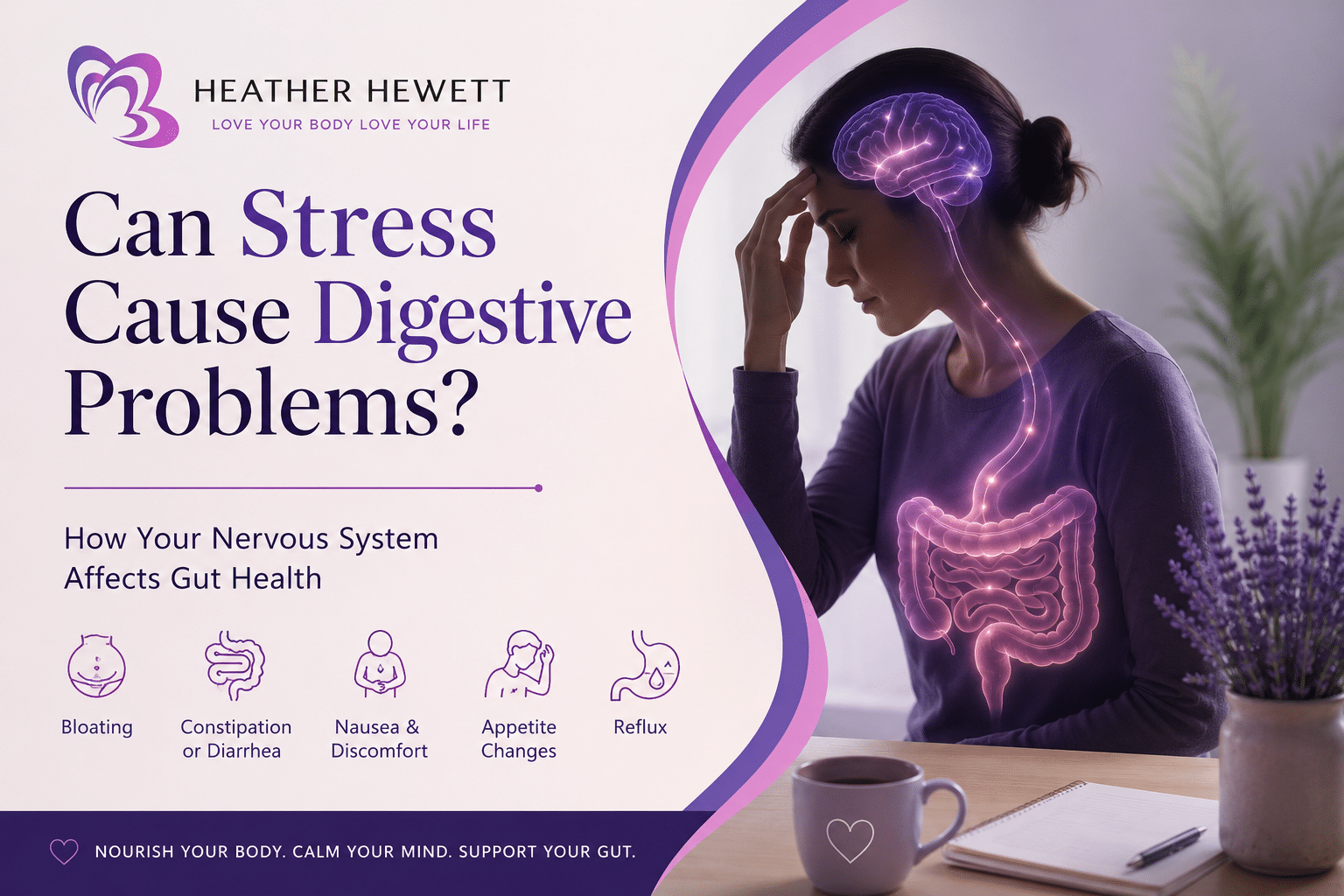
Yes, stress can affect digestion. Stress may influence gut movement, digestive sensitivity, appetite, bowel habits, and eating patterns through the connection between your brain, nervous system, and digestive tract.
That does not mean every digestive symptom is caused by stress.
Bloating, constipation, diarrhea, nausea, abdominal discomfort, appetite changes, and reflux can have many possible causes. But if you notice that your digestion tends to change during stressful periods, the connection is worth understanding.
The relationship is also more complicated than saying:
“Stress affects your stomach.”
Stress may affect the digestive system directly, but it can also change when you eat, how quickly you eat, your appetite, your cravings, your sleep, and your relationship with food.
That broader picture matters.
When I work with clients, I do not look at digestion as a food-only issue. Together, we can consider nutrition, digestive patterns, stress, nervous system responses, eating habits, and food tolerance when those factors are relevant.
Understanding how these pieces may interact can help you make more informed decisions without automatically blaming one food or restricting your diet unnecessarily.
How Does Stress Affect Your Digestive System?
Stress can affect your digestive system through the two-way communication between your brain, nervous system, and gastrointestinal tract.
During a stress response, changes in nervous system activity can influence gut movement, digestive sensitivity, appetite, and how your body responds to food.
Your digestive system does not operate separately from the rest of your body.
Harvard Health explains that the brain and gastrointestinal system are closely connected and that stress can affect movement and contractions within the digestive tract. Harvard Health’s gut-brain connection guide
Stress Can Change Gut Motility
Stress can change gut motility, which is the movement of food and waste through your digestive tract.
For some people, digestive movement may become faster. For others, it may slow down.
This may contribute to symptoms such as:
- Diarrhea
- Constipation
- Changes in bowel habits
- Bloating
- Abdominal discomfort
Two people experiencing similar stress can therefore have very different digestive responses.
Stress Can Increase Digestive Sensitivity
Stress may influence how strongly your nervous system processes signals coming from your digestive tract.
This means digestive sensations may feel more noticeable or uncomfortable for some people during stressful periods.
The discomfort is real.
It does not mean the symptoms are “all in your head.”
Harvard Health notes that psychological stress can affect the actual physiology of the gut and may make existing digestive discomfort feel more intense. Read the Harvard Health explanation
Stress May Influence the Gut Microbiome
Research suggests that stress may influence the gut microbiome and gut-brain communication, although this relationship is complex and still being studied.
Your gut microbiome is the community of microorganisms living within the digestive tract.
Many factors can influence it, including:
- Diet
- Medications
- Health conditions
- Sleep
- Environment
- Lifestyle
- Stress
I would be cautious with dramatic claims such as:
“Stress destroys your good gut bacteria.”
The science is much more nuanced.
A newer Harvard Health review explains that communication among the gut microbiome, immune system, nerve pathways, and brain is complex and continues to be actively researched. Harvard Health on the gut-brain axis and microbiome
Stress Can Change Appetite and Eating Patterns
Stress can change both appetite and eating behavior.
Some people lose interest in food when stressed.
Others may notice:
- Stronger cravings
- Emotional eating
- Skipping meals
- Long gaps between meals
- Eating later than usual
- Faster eating
- Distracted eating
- Changes in food choices
This is where the conversation about stress and digestion often needs to go further.
Stress may affect your gut directly.
But it may also affect how you nourish yourself.
If stress regularly leads to cravings or eating for comfort, you can learn more about my Emotional Eating & Food Cravings Coaching.
What Digestive Problems Can Stress Cause or Make Worse?
Stress may contribute to or worsen bloating, abdominal discomfort, diarrhea, constipation, nausea, appetite changes, and reflux symptoms in some people.
These symptoms can also have many other causes.
Stress should never become an automatic explanation for ongoing digestive problems.
Harvard Health identifies diarrhea, constipation, stomach pain, and heartburn among digestive problems that may appear or worsen during stress. Harvard Health’s gut health guidance
Bloating and Abdominal Discomfort
Yes, stress may contribute to bloating or abdominal discomfort in some people.
Possible contributors include changes in:
- Gut motility
- Digestive sensitivity
- Meal timing
- Eating speed
- Appetite
- Food choices
If bloating keeps returning, it can be more useful to look for patterns than immediately decide one food must be responsible.
Diarrhea and Changes in Bowel Habits
Stress can contribute to diarrhea or more frequent bowel movements in some people because the stress response can affect gut motility.
That does not mean every episode of diarrhea is caused by stress.
Persistent or unexplained bowel changes deserve appropriate medical evaluation.
Constipation
Stress may contribute to constipation for some people.
Stress can affect digestive movement, but stressful periods may also change your routine.
You may:
- Drink less water
- Skip meals
- Eat less consistently
- Sleep poorly
- Move less
- Change your usual food choices
Sometimes there is not one single explanation.
Several factors may overlap.
Nausea and Appetite Changes
Stress can contribute to nausea or appetite changes because the brain and digestive system communicate closely.
Some people find it difficult to eat when stressed.
Others feel hungrier or notice stronger cravings.
Neither response means you are lacking discipline.
It may simply be part of how your body responds to stress.
Heartburn and Reflux Symptoms
Stress may make heartburn or reflux symptoms worse for some people, although stress is not the only possible cause.
Eating patterns, meal size, food choices, underlying digestive conditions, and other health factors may also matter.
What Is the Gut-Brain Connection?
The gut-brain connection is the two-way communication network between your brain and digestive system.
This communication involves multiple pathways, including the nervous system, hormones, immune signaling, the enteric nervous system, and the gut microbiome.
This means the brain can affect the gut.
But the gut can also send information back to the brain.
Harvard Health describes this as a two-way relationship in which gastrointestinal distress can be either a cause or a result of stress and anxiety. Learn more about the gut-brain connection from Harvard Health
Why the Gut-Brain Connection Works Both Ways
The relationship is not simply:
Brain → Gut
It is:
Brain ↔ Gut
Stress may make digestive symptoms more noticeable.
Then digestive symptoms may create additional worry.
You may start asking:
- Why is my stomach doing this?
- Was it something I ate?
- Should I stop eating that food?
- What if this happens again?
That worry can increase your attention to digestive sensations and create more stress around meals.
This feedback loop is one reason I prefer looking at the whole pattern rather than separating nutrition, digestion, and stress into completely different boxes.
If nervous system stress feels like a major part of what you are experiencing, my Nervous System Regulation Coaching focuses more deeply on building regulation and resilience.
How Stress Can Change the Way You Eat
Stress does not only affect digestion directly. It can also change appetite, meal timing, eating speed, cravings, and food choices.
This part of the picture is often overlooked.
You may focus entirely on what you ate while missing what was happening around the meal.
Stress May Change Your Appetite
Stress can affect appetite differently from person to person.
You may notice that you:
- Lose interest in food
- Feel too busy to eat
- Forget meals
- Feel hungry more often
- Experience stronger cravings
- Want comforting foods
There is no single “stress appetite.”
Your response may also change depending on how long the stressful situation lasts.
Stress Can Disrupt Regular Meals
A stressful day may look like:
No breakfast
↓
Rushed morning
↓
Delayed lunch
↓
Strong hunger later
↓
Fast evening meal
↓
Digestive discomfort
If discomfort follows dinner, it may be tempting to conclude:
“Dinner caused the problem.”
But the full eating pattern may also matter.
That does not mean the food played no role.
It means one meal may not tell the entire story.
Stress May Lead to Faster or Distracted Eating
When you are overwhelmed, eating may become another task you need to finish.
You may:
- Eat while working
- Eat while standing
- Eat in the car
- Scroll during meals
- Rush through food
- Pay less attention to hunger and fullness
Eating more slowly will not solve every digestive problem.
But noticing how you eat can give you useful information.
Stress Can Influence Food Cravings and Emotional Eating
Stress can increase food cravings or emotional eating for some people.
Food may become a source of comfort during periods of pressure, especially when stress also affects sleep, appetite, or meal consistency.
A possible pattern might look like this:
Stress
↓
Appetite or meal routine changes
↓
Irregular nourishment
↓
Stronger hunger or cravings
↓
Faster or distracted eating
↓
Digestive discomfort
I call this the Stress, Eating, and Digestion Cycle.
It is not a diagnosis or a rule that applies to everyone.
It is simply a useful way to recognize how stress may influence digestion both directly and indirectly.
If cravings, comfort eating, or stress-related eating are the main challenge, my Emotional Eating & Food Cravings Coaching may be a better fit than focusing on digestion alone.
Is It Stress, Food, or Both?
Digestive symptoms after eating do not automatically prove that a particular food caused them. Stress, eating patterns, food tolerance, meal size, digestive conditions, and other factors can overlap.
This distinction matters.
When discomfort follows a meal, your first thought may be:
“What did I eat?”
That is understandable.
But timing alone does not always explain why something happened.
One Reaction Does Not Always Identify a Food Trigger
One uncomfortable experience after eating does not necessarily mean that food needs to be removed permanently.
Instead, consider whether the reaction happens consistently.
You may also ask:
- Was my stress unusually high?
- Had I gone a long time without eating?
- Was the meal much larger than usual?
- Was I already constipated?
- Did I eat quickly?
- Was my sleep different?
- Has the same reaction happened several times?
Looking at repeated patterns can provide more useful information than blaming one isolated meal.
Look for Patterns Before Restricting More Foods
When digestive symptoms are frustrating, restriction can feel like the fastest way to regain control.
But eliminating one food after another without a clear reason may create a narrower diet and more anxiety around eating.
My philosophy is simple:
Understand first. Restrict only when there is a clear reason.
Before asking:
“What else should I remove?”
consider asking:
“What pattern is my body showing me?”
If digestive symptoms keep returning and it is difficult to understand how food, stress, eating patterns, and food tolerance fit together, my personalized Gut Health Nutritionist support can help you look at the bigger picture.
Can Stress Make IBS Symptoms Worse?
Yes, stress can trigger or worsen IBS symptoms for some people, but stress is not considered the sole cause of IBS.
IBS involves complex interactions among:
- Gut movement
- Digestive sensitivity
- Gut-brain signaling
- Microbes
- Individual health factors
Harvard Health describes IBS as a condition involving both digestive and emotional dimensions, connected through the gut-brain axis. Harvard Health on IBS and the gut-brain axis
If you have IBS or think you may have it, appropriate medical evaluation matters.
Nutrition and stress support can sometimes complement a broader care plan, but neither replaces diagnosis or medical treatment.
How Can You Tell If Stress Is Affecting Your Digestion?
Stress may be playing a role if digestive symptoms repeatedly become more noticeable during stressful periods or appear alongside changes in appetite, sleep, meal routines, or bowel habits.
You might notice patterns such as:
- Bloating increasing during demanding weeks
- Bowel habits changing when you feel overwhelmed
- Appetite disappearing during acute stress
- Stronger cravings after several stressful days
- Meals becoming irregular when life gets busy
- Digestive sensations feeling more noticeable when anxious
- Symptoms changing when stress levels change
These patterns may suggest a relationship.
They do not prove that stress is the cause.
The purpose of noticing patterns is not to diagnose yourself.
It is to gather better information.
How to Support Your Digestion During Stress
Supporting digestion during stressful periods may include maintaining regular nourishment, staying hydrated, slowing down around meals when possible, getting adequate sleep, and supporting nervous system regulation.
There is no universal stress-and-gut protocol.
The most appropriate strategy depends on your health history, symptoms, nutrition, and individual food tolerance.
Keep Meals as Consistent as Possible
Stress can make regular eating difficult.
Try to avoid long, unintended gaps between meals simply because the day becomes busy.
You do not need a perfect schedule.
The goal is regular nourishment.
Avoid Automatically Eliminating Foods
A digestive symptom does not automatically mean you need to remove another food.
Before restricting your diet, consider:
- Whether the reaction has happened repeatedly
- Whether your stress level was unusually high
- Whether the meal was different in size
- Whether your eating schedule had changed
- Whether you were already experiencing digestive symptoms
- Whether healthcare evaluation may be appropriate
The goal is not to ignore possible food reactions.
It is to avoid making major dietary decisions based on one isolated experience.
Slow Down Around Meals When You Can
You do not need to turn every meal into a perfect mindfulness practice.
But if stress causes you to rush through eating, small changes may help you become more aware of the meal.
When possible:
- Sit down
- Pause before eating
- Reduce multitasking
- Notice your pace
- Give yourself enough time
The aim is not perfection.
It is creating a little more space around nourishment.
Stay Hydrated
Hydration supports normal digestive and bowel function.
Stressful days can make it easy to forget basic habits.
Harvard Health includes adequate hydration among its core recommendations for supporting digestive health. Harvard Health’s gut health recommendations
Consider Your Individual Fiber Tolerance
Fiber is important for digestive health.
But more is not automatically better for every person or every digestive concern.
Suddenly increasing fiber may cause discomfort for some people.
Your individual tolerance matters.
If you are confused about fiber, food tolerance, or your overall nutrition, my broader Clinical Nutrition Coaching may help when your needs extend beyond the stress-digestion connection.
Notice Patterns Instead of Judging One Meal
Instead of:
“That food made me bloated.”
try asking:
“What else was happening today?”
You might briefly notice:
- Stress
- Meal timing
- Bowel movements
- Food choices
- Sleep
- Hydration
- Eating pace
- Symptoms
You do not need to track everything forever.
The purpose is simply to recognize patterns that may otherwise be difficult to see.
Support Sleep and Nervous System Regulation
Sleep and nervous system regulation can be important parts of digestive wellbeing.
The brain and gut communicate continuously, so food is not always the only relevant piece.
If chronic stress, overwhelm, or difficulty settling after stressful experiences is a major concern, explore my Nervous System Regulation Coaching.
When Should You Get Help for Digestive Symptoms?
Digestive symptoms that are persistent, severe, worsening, unexplained, or concerning should be discussed with an appropriate healthcare professional instead of being assumed to be caused by stress.
Stress can affect digestion.
But stress should never become a reason to dismiss your symptoms.
Appropriate medical evaluation can help determine whether testing, diagnosis, or treatment is needed.
Nutrition support may complement healthcare, but it does not replace medical evaluation.
When Personalized Gut Health Nutrition Support May Help
Personalized gut health nutrition support may be useful when digestive symptoms keep returning, food has become confusing, or stress, eating patterns, and digestive concerns seem to overlap.
When I work with clients, I look beyond food alone.
Depending on your needs, together we may explore:
- Current nutrition
- Meal consistency
- Digestive patterns
- Food tolerance
- Fiber intake
- Hydration
- Previous restrictive diets
- Stress
- Nervous system patterns
- Emotional eating
- Food cravings
- Sleep
- Your relationship with food
The goal is not to hand you another generic gut-health food list.
It is to better understand your individual patterns and identify practical next steps.
If that sounds like the type of support you need, explore my Gut Health Nutritionist service.
The Bottom Line
Stress can affect digestion, but it is often only one part of the picture.
Through the gut-brain connection, stress may influence digestive movement, sensitivity, appetite, bowel habits, and eating patterns.
At the same time, digestive discomfort can increase worry around food and make it tempting to start eliminating more foods.
That is why I prefer looking at the complete pattern.
Nutrition. Digestion. Stress. Nervous system responses. Eating habits. Food tolerance. Relationship with food.
When these factors are relevant, understanding how they interact can provide a clearer starting point than automatically blaming stress or one specific food.
If digestive symptoms keep returning and you are tired of guessing what your body needs, explore my personalized gut health nutrition support.
When Digestive Symptoms Keep Returning, You Don’t Have to Keep Guessing
If you are struggling to understand whether food, stress, eating patterns, or several factors may be contributing to what you are experiencing, more restrictions may not give you the clarity you need.
My approach looks beyond food alone.
Together, we can explore your nutrition, digestive patterns, food tolerance, stress, nervous system responses, eating behaviors, and relationship with food to identify practical next steps based on your individual needs.
Explore Gut Health Nutrition Support
Frequently Asked Questions
Can stress cause digestive problems?
Yes. Stress can affect gut movement, digestive sensitivity, appetite, and eating patterns through the gut-brain and nervous system connection.
What digestive problems can stress cause?
Stress may contribute to or worsen bloating, abdominal discomfort, diarrhea, constipation, nausea, appetite changes, and reflux symptoms in some people.
Can stress cause bloating?
Yes. Stress may contribute to bloating by affecting gut movement, digestive sensitivity, and eating patterns, although bloating can have many other causes.
Can stress cause diarrhea?
Yes. Stress can affect gut motility and may contribute to diarrhea or more frequent bowel movements in some people.
Can stress cause constipation?
Yes. Stress may contribute to constipation by affecting digestive movement and daily habits such as eating, hydration, sleep, and activity.
Can anxiety affect digestion?
Yes. Anxiety can affect digestion through the gut-brain connection and may influence appetite, gut movement, digestive sensitivity, and bowel habits.
Can stress make IBS symptoms worse?
Yes. Stress can trigger or worsen IBS symptoms for some people, but stress itself is not considered the sole cause of IBS.
Can stress affect gut bacteria?
Research suggests that stress may influence the gut microbiome, but the relationship between stress, gut bacteria, and digestive symptoms is complex and still being studied.
How do you calm your digestive system when stressed?
Regular nourishment, hydration, adequate sleep, slower eating when possible, and appropriate stress-management strategies may support digestion during stressful periods.
How do you know if digestive problems are caused by stress?
There is no single symptom that proves stress is the cause. Symptoms that repeatedly change during stressful periods may suggest a connection, but persistent or unexplained digestive problems should be appropriately evaluated.