
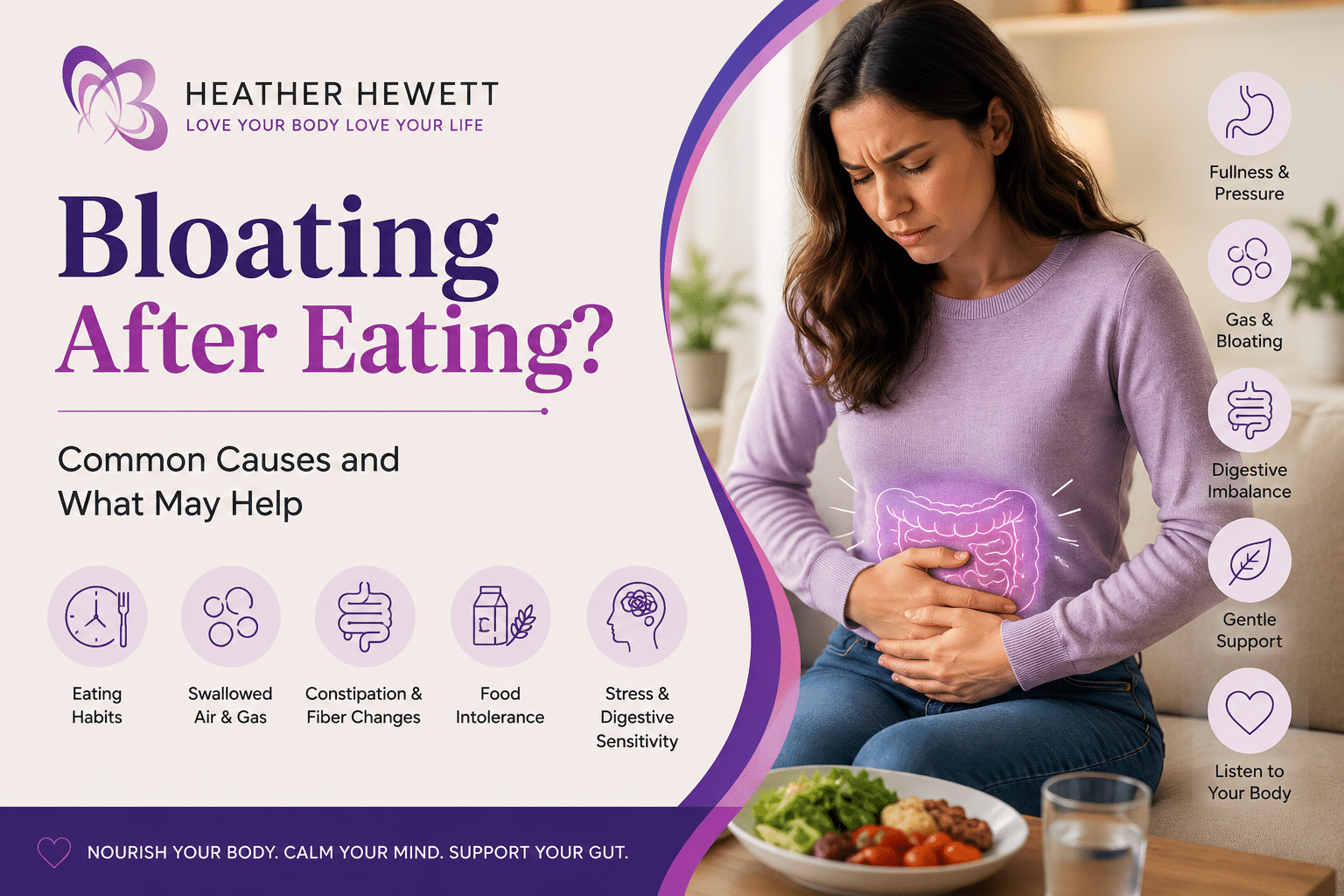
Bloating after eating can happen for many reasons, including meal size, eating too quickly, swallowed air, constipation, changes in fiber intake, food intolerance, digestive sensitivity, or an underlying digestive condition. Occasional bloating can be normal, but frequent, painful, persistent, or unexplained bloating deserves a closer look.
When your stomach feels uncomfortable after a meal, it is natural to focus on whatever you just ate.
You may wonder:
- Was it the dairy?
- Was it gluten?
- Did I eat too much fiber?
- Do I have a food intolerance?
- Should I eliminate something?
Those questions make sense, but the last meal does not always tell the whole story.
When I work with clients who are dealing with recurring digestive concerns, I prefer to look at the wider pattern.
That can include:
- What you ate
- How much you ate
- How quickly you ate
- When you ate
- Your bowel habits
- Fiber intake
- Hydration
- Food tolerance
- Stress
- Recent routine changes
- Previous food restriction
The goal is not to ignore possible food triggers.
It is to understand the pattern before automatically restricting the diet.
Is It Normal to Feel Bloated After Eating?
Some temporary fullness or mild bloating after eating can be normal, particularly after a larger meal. Bloating that happens frequently, becomes painful, persists, or significantly affects daily life deserves more attention.
Your digestive tract naturally changes as food and fluid move through it.
After eating, you may temporarily experience:
- Fullness
- Mild pressure
- Some gas
- A feeling that your abdomen is more expanded
That alone does not necessarily mean something is wrong.
Cleveland Clinic notes that bloating is common and often harmless, but persistent bloating can sometimes be related to constipation, digestive disorders, food intolerance, or other health conditions.
Cleveland Clinic: Bloating, Causes and When to Be Concerned
Bloating and Abdominal Distension Are Not Always the Same
Bloating is the feeling of fullness, pressure, or tightness in the abdomen, while abdominal distension refers to a visible or measurable increase in abdominal size.
They can happen together, but they do not always.
This distinction matters because how bloated you feel is not determined only by how much your abdomen physically expands.
Gut movement and sensitivity to pressure can also influence the experience.
What Causes Bloating After Eating?
Common causes of bloating after eating include swallowed air, larger meals, gas produced during digestion, constipation, changes in fiber intake, food intolerance, and digestive conditions such as IBS. Sometimes several factors overlap rather than there being one single cause.
That is why my first question is usually not:
“Which food should we remove?”
A more useful question is:
“What pattern is happening around the bloating?”
Eating Too Quickly and Swallowing Air
Eating too quickly can contribute to bloating because you may swallow more air while eating.
Some swallowed air leaves through burping. Some can travel farther through the digestive tract and contribute to pressure or gas.
But eating quickly may also be the end of a longer pattern.
For example:
Long gap between meals
↓
Strong hunger
↓
Larger meal
↓
Faster eating
↓
More fullness or bloating
In this situation, simply telling yourself to “eat more slowly” may miss part of what happened.
Meal timing and hunger may matter too.
Large Meals and Feeling Overly Full
Larger meals can temporarily increase fullness or bloating because your digestive system has more food and fluid to accommodate.
That does not mean larger meals are inherently a problem.
The pattern matters.
Ask yourself:
- Does bloating mainly happen after unusually large meals?
- Does it happen after smaller meals too?
- Had I eaten normally earlier in the day?
- Was I extremely hungry before this meal?
Occasional fullness after a larger meal is different from bloating that occurs after nearly everything you eat.
Gas and Fermentation During Digestion
Gas is a normal part of digestion. Some gas is produced when bacteria in the large intestine ferment carbohydrates that reach them.
Certain foods may generate more gas than others for some people.
However, bloating is not simply:
Food → Gas → Bloating
How gas moves through the digestive tract and how sensitive you are to pressure can also matter.
Mayo Clinic explains that gas is a normal part of digestion and that bloating can occur when gas becomes trapped or does not move efficiently through the digestive system.
Mayo Clinic: Gas and Gas Pains
Changes in Fiber Intake
Increasing fiber can temporarily increase gas and bloating for some people, particularly when fiber intake rises quickly.
Fiber plays an important role in digestive health.
But the right approach is individual.
Your response can depend on:
- Your current fiber intake
- The type of fiber
- How quickly you increase it
- Hydration
- Constipation
- Your individual digestive tolerance
This is why blanket advice such as:
“Just eat more fiber”
is not always useful.
Sometimes more fiber is appropriate.
Sometimes the type, timing, or amount needs closer consideration.
Food Intolerance and Carbohydrate Malabsorption
Some food intolerances or difficulty absorbing certain carbohydrates can contribute to gas and bloating. However, bloating alone does not prove that you have a food intolerance.
Lactose intolerance is one example.
Certain fermentable carbohydrates can also cause digestive symptoms for some people.
But there is an important difference between:
“I felt bloated after this food once.”
and
“I consistently experience the same symptoms when I eat this food under similar circumstances.”
One reaction gives you information.
It does not automatically give you a diagnosis.
Constipation
Constipation can contribute to bloating because stool and gas may move more slowly through your digestive tract.
This is one of the factors I especially want people to consider before blaming the most recent meal.
What was happening in your digestive system before you ate can matter just as much as what happened afterward.
Can Constipation Cause Bloating After Eating?
Yes. Constipation can contribute to bloating after eating because stool and gas may already be moving slowly through the digestive tract, and another meal can make existing pressure or fullness more noticeable.
This leads to an important idea:
The meal may be when you notice the bloating, not necessarily the whole reason it happened.
If your digestive tract is already moving slowly, another meal adds food and fluid to a system that may already feel full.
So instead of only asking:
“What was in my lunch?”
also consider:
- When was my last bowel movement?
- Has my bowel pattern changed?
- Has my fiber intake changed?
- Am I drinking enough fluids for my needs?
- Has my daily routine changed?
Cleveland Clinic lists bloating and nausea among possible constipation symptoms and explains that constipation involves stool moving too slowly through the digestive tract.
Bloating Is Not Always About Excess Gas
Feeling bloated does not always mean there is an unusually large amount of gas in your digestive system. Gut motility and sensitivity to stretching or pressure can also affect how bloated you feel.
This is an important distinction.
Two people may have similar amounts of intestinal gas but experience those sensations very differently.
Cleveland Clinic describes visceral hypersensitivity as one reason someone can feel significant bloating even when their gas volume is not unusually high.
Digestive Sensitivity Can Affect How Bloating Feels
Visceral sensitivity refers to increased sensitivity to sensations inside the digestive tract.
Normal pressure or stretching may feel mild to one person and much more uncomfortable to another.
This does not mean symptoms are imaginary.
It reflects the close communication between the digestive tract and nervous system.
Does Bloating After Eating Mean You Have a Food Intolerance?
No, not necessarily. Bloating after eating can have many possible causes, so one uncomfortable reaction does not confirm that you have a food intolerance.
Possible contributors include:
- Meal size
- Eating speed
- Swallowed air
- Constipation
- Sudden fiber changes
- Food intolerance
- Digestive sensitivity
- Stress
- IBS or another digestive condition
That is why I prefer not to immediately turn bloating into a list of foods to avoid.
One Bloated Meal Does Not Identify a Food Trigger
One episode of bloating after eating does not necessarily identify the food responsible. A repeated, consistent pattern usually provides more useful information.
Before deciding that a food is the problem, ask:
- Has this happened repeatedly?
- Was the portion unusual?
- Had I gone a long time without eating?
- Was I already constipated?
- Was fiber much higher than normal?
- Did I eat particularly quickly?
- Was stress unusually high?
- Does the same response happen under similar circumstances?
These questions do not diagnose the cause.
They help create a clearer picture.
Look for a Consistent Pattern Before Restricting Foods
Before removing more foods, look for a repeatable pattern and consider the wider context around your symptoms. Unnecessary restriction can make eating more complicated without necessarily explaining why bloating is happening.
My approach is simple:
Understand before restricting.
There are situations where dietary changes are appropriate.
But repeatedly eliminating foods without a clear reason may lead to:
- A narrower diet
- More confusion
- Increased food anxiety
- Difficulty identifying what actually helped
- Reduced nutritional variety
If bloating keeps returning and you are unsure whether food tolerance, constipation, fiber, eating patterns, or other nutrition factors may be involved, my personalized gut health nutrition support can help you look at these factors together.
Explore my Gut Health Nutritionist service
Why Am I Bloated After Every Meal?
Bloating after every meal can have several possible explanations, including constipation, eating patterns, food intolerance, digestive sensitivity, or an underlying digestive condition. Frequent bloating is worth investigating rather than assuming one particular food is responsible.
If this happens consistently, look at the pattern.
Potential contributors may include:
- Constipation
- Large portions
- Fast eating
- Long gaps between meals
- Food intolerance
- Sudden increases in fiber
- Swallowed air
- Digestive sensitivity
- IBS or another digestive condition
Eating naturally activates digestion.
So the most useful question may not be:
“Why does eating make me bloated?”
Instead ask:
“Why is my digestive system responding this way so consistently?”
Persistent or worsening symptoms deserve appropriate medical evaluation.
Can Stress Make Bloating Worse?
Yes. Stress may contribute to or make bloating more noticeable for some people by affecting gut movement, digestive sensitivity, and eating patterns.
Stress can also affect:
- Appetite
- Meal timing
- Eating speed
- Food cravings
- Sleep
- Bowel habits
The brain and digestive tract communicate in both directions through the gut-brain connection.
Harvard Health explains that stress can influence how quickly food moves through the digestive tract and can increase sensitivity to bloating and other digestive sensations.
Harvard Health: Brain-Gut Connection and Digestion
I have a separate guide that explores this relationship in depth:
Can Stress Cause Digestive Problems?
Internal link: Use the live URL of Blog #1 here.
I would not repeat that entire topic in this article because stress is only one possible piece of the bloating picture.
Look Beyond the Last Meal: The Bloating Pattern Check
When bloating happens after eating, your last meal is only one part of the picture. Looking at food, portion size, eating pace, meal timing, bowel habits, recent changes, and repeated symptom patterns can provide more useful information than automatically blaming one food.
When I work with clients, I often encourage this broader view.
I call it The Bloating Pattern Check.
It is not a diagnostic tool.
It is a practical way to organize the information your body may be giving you.
1. What Did You Eat?
Food matters, but look for repeated responses.
Ask:
- Was this a familiar meal?
- Have these foods caused similar symptoms before?
- Was fiber unusually high?
- Was there a food you already know you do not tolerate?
One meal is one data point.
2. How Much Did You Eat?
Meal size may influence fullness.
Ask:
- Was this portion larger than usual?
- Had I eaten much earlier in the day?
- Was I extremely hungry?
- Do smaller meals create the same symptoms?
3. How Did You Eat?
Eating pace and context can matter.
Ask:
- Was I rushing?
- Did I eat while working?
- Was I distracted?
- Was I extremely hungry?
- Did I eat faster than usual?
4. When Did You Eat?
Look beyond the last 30 minutes.
Ask:
- Had I skipped a meal?
- Was this meal much later than usual?
- Had there been a long gap between meals?
- Has my eating schedule changed recently?
The whole day can provide useful context.
5. What Were Your Bowel Habits Like?
Ask:
- Am I constipated?
- Have my bowel movements changed?
- Did I already feel full before eating?
- Has stool become more difficult to pass?
The digestive system does not reset every time you sit down for a meal.
6. What Recently Changed?
Consider whether something else changed recently:
- Fiber intake
- Hydration
- Supplements
- Medication
- Activity
- Travel
- Sleep
- Stress
- Meal timing
A new symptom does not automatically mean a new food intolerance.
7. Does It Happen Consistently?
This may be the most useful question.
Ask whether bloating consistently appears with:
- Similar foods
- Similar portions
- Constipation
- High-stress periods
- Faster eating
- Long gaps between meals
- Other digestive symptoms
A pattern can tell you more than a single bloated meal.
Not Sure What Your Bloating Pattern Is Telling You?
If bloating keeps returning and you are unsure whether constipation, fiber, food tolerance, meal timing, or several factors are involved, you do not necessarily need to begin by eliminating more foods.
My approach looks at the broader picture so we can identify which factors may actually be relevant to you.
Explore Gut Health Nutrition Support
What May Help Reduce Bloating After Eating?
What helps bloating depends on what is contributing to it. Regular meals, a comfortable eating pace, adequate hydration, gradual fiber changes when appropriate, attention to constipation, and avoiding unnecessary restriction may help in different situations.
There is no universal bloating protocol.
Cause matters.
Keep Meals Reasonably Consistent
Reasonably consistent meals may help reduce long gaps that lead to intense hunger, larger meals, or faster eating later.
You do not need a perfect schedule.
The goal is to look at the overall pattern.
Slow Down When Eating
Eating at a comfortable pace may reduce swallowed air and help you notice fullness more clearly.
You do not need to eat unusually slowly.
And eating speed is not the cause of every episode of bloating.
It is simply one factor worth considering.
Stay Hydrated
Adequate hydration supports normal digestive and bowel function and can be especially relevant when increasing fiber or dealing with constipation.
Fluid needs are individual.
The goal is appropriate, consistent hydration rather than following one universal number.
Increase Fiber Gradually When Appropriate
If increasing fiber is appropriate for you, increasing it gradually may be easier to tolerate than making a sudden large change.
Consider:
- Current fiber intake
- Fiber type
- Hydration
- Bowel habits
- Your digestive response
If your concerns involve broader nutrition needs beyond recurring bloating, my Clinical Nutrition Coaching provides a more comprehensive individualized nutrition approach.
Pay Attention to Constipation
If you regularly feel bloated after meals, consider whether constipation may already be present.
Sometimes addressing the bowel pattern is more useful than focusing exclusively on the last food you ate.
Avoid Automatically Eliminating Foods
Do not assume every episode of bloating means another food needs to be removed.
Restriction works best when there is a clear reason and appropriate guidance.
Otherwise, each new elimination can create another variable and make the pattern harder to understand.
Track Patterns Without Becoming Overly Restrictive
Briefly tracking meals, bowel habits, symptoms, and relevant changes may help you identify useful patterns.
You might notice:
- Meal timing
- Portion size
- Bowel movements
- Fiber changes
- Stress
- Eating pace
- Repeated symptoms
The goal is to gather information.
It is not to monitor every bite indefinitely.
When Should You Be Concerned About Bloating?
Bloating that is persistent, severe, worsening, unexplained, or accompanied by other concerning symptoms should be discussed with an appropriate healthcare professional.
Cleveland Clinic recommends seeking medical evaluation for persistent bloating and specifically notes concerns such as severe pain, fever, vomiting, bleeding, weakness, or unexplained weight loss.
Nutrition support can complement healthcare.
It should not replace medical evaluation when symptoms may need diagnosis or treatment.
When Personalized Gut Health Nutrition Support May Help
Personalized nutrition support may be helpful when bloating keeps returning and you are struggling to understand whether meal patterns, constipation, fiber, food tolerance, stress, or other nutrition factors may be contributing.
When I work with clients, I look beyond the last meal.
Depending on what is relevant to you, together we may explore:
- Current nutrition
- Meal timing
- Meal consistency
- Bowel habits
- Fiber intake
- Hydration
- Food tolerance
- Previous elimination diets
- Stress
- Eating pace
- Relationship with food
The goal is not another generic list of foods to avoid.
It is to understand which factors may actually matter in your situation.
Learn more about my Gut Health Nutritionist service
The Bottom Line
Bloating after eating does not automatically mean the last food you ate is the problem.
Meal size, eating pace, constipation, fiber intake, food tolerance, digestive sensitivity, stress, and digestive conditions can overlap.
Instead of immediately asking:
“Which food should I eliminate?”
try asking:
“What pattern keeps showing up?”
Look at:
Food. Portion. Pace. Timing. Bowel habits. Recent changes. Repetition.
One meal can give you a clue.
A repeated pattern can give you much more useful information.
That is why my approach starts with understanding before restriction.
Tired of Guessing What Is Causing Your Bloating?
Recurring bloating can make it tempting to keep changing your diet, eliminating foods, or trying one digestive strategy after another.
My approach starts differently.
Together, we can look at your nutrition, meal patterns, bowel habits, fiber intake, hydration, food tolerance, stress, previous restriction, and relationship with food to better understand the bigger picture.
The goal is not to give you another generic list of foods to avoid.
It is to help you make more informed nutrition decisions based on your individual needs.
Explore Gut Health Nutrition Support
Frequently Asked Questions
Why am I bloated after eating?
Bloating after eating can happen because of meal size, swallowed air, gas production, constipation, fiber changes, food intolerance, digestive sensitivity, or digestive conditions. Sometimes several factors overlap.
Is it normal to feel bloated after eating?
Some mild, temporary fullness or bloating after eating can be normal, especially after a larger meal. Frequent, painful, persistent, or unexplained bloating deserves closer attention.
Why am I bloated after every meal?
Bloating after every meal may be related to constipation, eating patterns, food intolerance, digestive sensitivity, or an underlying digestive condition. Frequent symptoms are worth evaluating rather than automatically blaming one food.
Can eating too fast cause bloating?
Yes. Eating quickly may contribute to bloating because you can swallow more air while eating. Eating pace is one possible factor, not the only cause.
Can constipation cause bloating after eating?
Yes. Constipation can contribute to bloating, and eating may make existing pressure or fullness more noticeable when stool and gas are moving slowly.
Can too much fiber cause bloating?
Yes. Increasing fiber quickly or eating more fiber than you currently tolerate may contribute to gas and bloating. Fiber type, hydration, bowel habits, and individual tolerance also matter.
Does bloating mean I have a food intolerance?
No. Bloating alone does not confirm a food intolerance because many other factors can contribute to bloating after eating.
Can stress cause bloating?
Stress may contribute to or worsen bloating for some people by affecting gut movement, digestive sensitivity, and eating patterns. Bloating can also have many other causes.
What helps reduce bloating after eating?
What helps depends on the cause. Regular nourishment, a comfortable eating pace, hydration, gradual fiber changes when appropriate, and addressing constipation may help in different situations.
When should I worry about bloating?
Persistent, severe, worsening, or unexplained bloating should be discussed with an appropriate healthcare professional, particularly when it occurs with other concerning symptoms.