
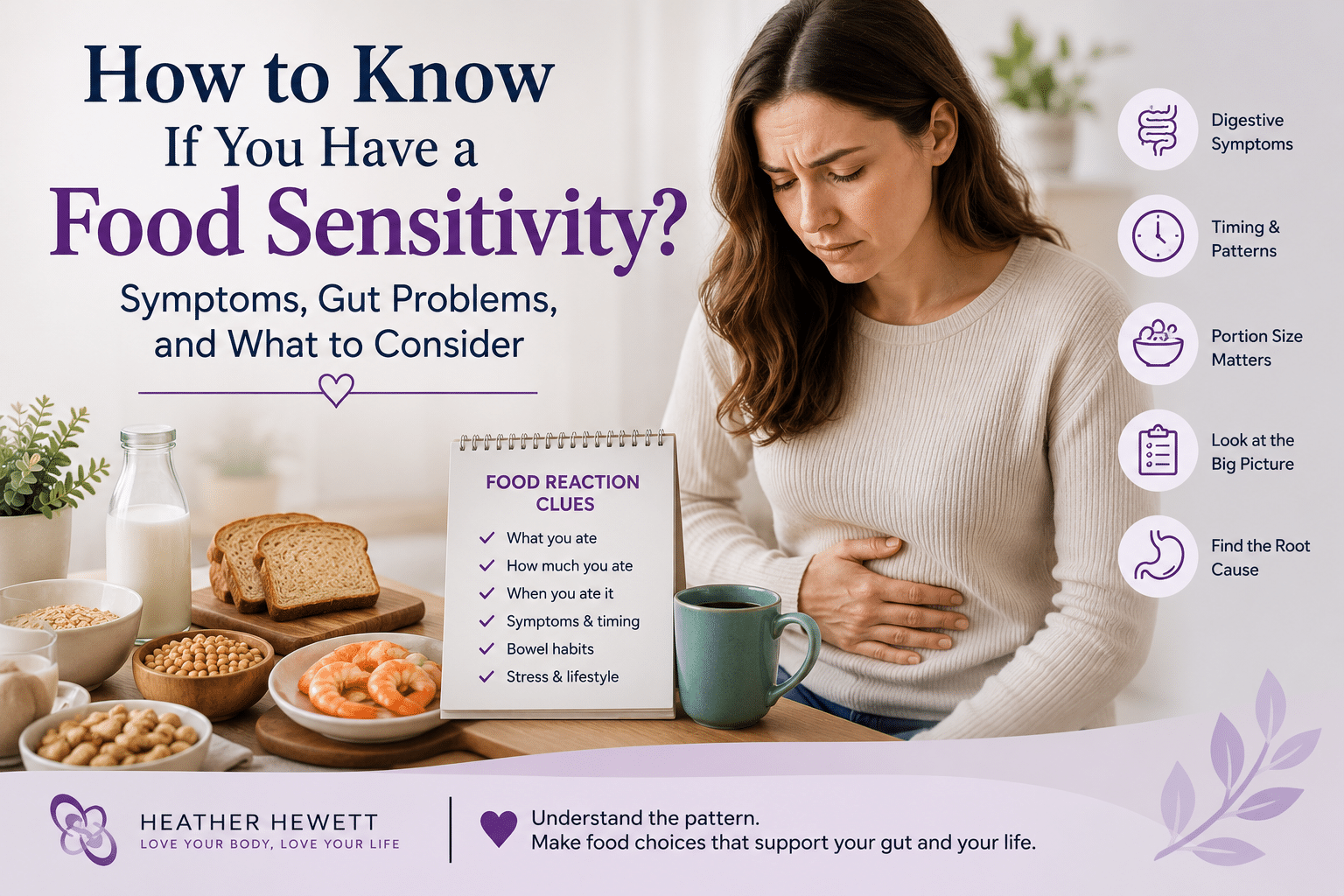
You may suspect a food sensitivity when digestive symptoms such as bloating, gas, abdominal discomfort, diarrhea, or nausea repeatedly occur after eating a particular food. However, these symptoms do not prove that the food is the cause. Looking at repeatability, amount, timing, bowel habits, and the wider digestive context can provide more useful information than one reaction after one meal.
When digestive symptoms show up after eating, it is natural to start asking questions.
Was it the dairy?
Was it wheat?
Was there too much fiber?
Do I need to stop eating that food?
Should I get a food sensitivity test?
Those questions make sense.
But digestive symptoms are not always as simple as:
I ate a food → I felt uncomfortable → that food must be the problem.
When I work with clients who suspect a food sensitivity, I prefer to look for a pattern before creating a list of foods to avoid.
That may include:
- What you ate
- How much you ate
- When you ate it
- When symptoms began
- Whether the reaction has happened before
- Your bowel habits
- Meal size and eating patterns
- Stress
- Previous dietary restriction
- Whether the same symptoms occur even without the suspected food
My goal is not to make every meal feel like an investigation.
It is to gather enough useful information to make better decisions.
What Is a Food Sensitivity?
“Food sensitivity” is a broad term that is not always used consistently. It is often used to describe unwanted reactions to food that are not classic food allergies, and many healthcare resources use it interchangeably with food intolerance.
Cleveland Clinic currently describes food intolerance as another name for food sensitivity and explains that it involves the digestive system rather than the immune-system mechanism seen in food allergy.
That terminology can still become confusing.
One person may say:
“I am sensitive to dairy.”
Another may say:
“I am lactose intolerant.”
Someone else may use “food sensitivity” to describe almost any uncomfortable reaction after eating.
That is why I prefer to focus on the specific reaction and pattern, rather than the label alone.
Learn more from Cleveland Clinic about food intolerance and sensitivity
Food Sensitivity vs Food Intolerance
Food sensitivity and food intolerance are often used interchangeably, although food intolerance more commonly describes difficulty digesting or processing a particular food or food component.
Lactose intolerance is a familiar example.
Someone with lactose intolerance may have difficulty digesting lactose, the natural sugar in dairy foods.
Depending on the person and the amount eaten, symptoms may include:
- Bloating
- Gas
- Abdominal discomfort
- Diarrhea
Cleveland Clinic also notes that symptoms of food intolerance often depend on how much of a food is eaten.
That means a food reaction is not always binary.
Some people may tolerate a smaller amount better than a larger amount.
The specific reaction often matters more than the terminology.
Food Sensitivity, Food Intolerance, and Food Allergy: What Is the Difference?
Food allergy involves an immune-system reaction, while food intolerance more commonly affects digestion or the body’s ability to process a food. Because food allergy can potentially cause serious reactions, suspected allergy symptoms should not be treated as simply a digestive intolerance.
Mayo Clinic makes the same fundamental distinction. A true food allergy involves the immune system and may cause a serious reaction, while food intolerance commonly affects the digestive system and may allow some people to tolerate smaller quantities.
| Factor | Food Intolerance or Sensitivity | Food Allergy |
| Typical mechanism | Often related to digestion or processing a food/component | Immune-system reaction |
| Amount | Symptoms may sometimes depend on quantity | Small amounts may trigger reactions |
| Digestive symptoms | Bloating, gas, discomfort, diarrhea may occur | Digestive symptoms can also occur |
| Potential severity | Often uncomfortable | Can be serious |
This article focuses primarily on digestive food reactions and intolerance, not diagnosis or management of food allergy.
If symptoms suggest a possible allergic reaction, appropriate medical care is important.
Mayo Clinic: Food Allergy vs. Food Intolerance
What Symptoms Can Food Sensitivity or Intolerance Cause?
Food intolerance can cause digestive symptoms such as bloating, gas, abdominal discomfort, diarrhea, or nausea. However, these symptoms can also occur for many other reasons, so symptoms alone cannot confirm a food intolerance.
Cleveland Clinic lists abdominal pain or cramping, diarrhea, gas, bloating and nausea among common food-intolerance symptoms, but also explains that diagnosis relies on symptoms, history, pattern recognition and appropriate evaluation rather than one universal test.
The symptom tells us:
Something happened.
It does not necessarily tell us:
Why it happened.
Bloating and Gas
Bloating and gas can occur with some food intolerances, particularly when the body has difficulty digesting or absorbing a particular food component. However, bloating and gas are common digestive symptoms and do not identify a specific food on their own.
Other possible contributors may include:
- Constipation
- Meal size
- Eating quickly
- Swallowed air
- Fiber changes
- Digestive sensitivity
- IBS
- Stress
If bloating is the main symptom, the bigger digestive pattern deserves attention rather than automatically labeling one ingredient as the cause.
Abdominal Discomfort
Abdominal discomfort or cramping may occur with food intolerance, but it can also have other digestive causes. A repeated pattern associated with a particular food is more informative than one isolated episode.
Pay attention to whether the reaction:
- Happens repeatedly
- Happens after similar amounts
- Begins at a similar time
- Occurs when the suspected food is absent too
These details may be more useful than the symptom alone.
Diarrhea or Changes in Bowel Habits
Some food intolerances can contribute to diarrhea or changes in bowel habits. Persistent or significant bowel changes deserve appropriate medical evaluation rather than being automatically attributed to food sensitivity.
Bowel habits also provide important context.
For example, existing constipation or another digestive pattern may affect how you feel after eating.
That is why I look at what your digestion was doing both before and after the meal.
Nausea
Nausea can occur with some food reactions, but it is a nonspecific symptom with many possible causes. Nausea alone cannot tell you whether a particular food is responsible.
Repeated patterns deserve attention.
One isolated episode is much harder to interpret.
Does the Reaction Happen Consistently?
A reaction that repeatedly occurs under similar circumstances is more informative than one symptom after one meal. If you suspect a food, look at whether the same food, amount, timing, and symptom pattern occur more than once.
This is one of the most important principles in this article.
One reaction gives you a clue. A repeatable pattern gives you more useful information.
Imagine that you eat dairy one evening and feel bloated afterward.
That is useful information.
But several questions remain:
- Have you eaten dairy previously without a problem?
- Was the amount unusually large?
- Were you already constipated?
- Was the meal larger than normal?
- Did you eat very quickly?
- Did you consume several other fermentable foods?
- Were you already bloated before the meal?
- Does the same symptom happen when dairy is absent?
A single reaction cannot answer those questions.
Repeated patterns create a clearer picture.
Does the Amount of Food Matter?
Yes, it can. Some food intolerances are dose-dependent, meaning a smaller amount may be tolerated while a larger amount produces symptoms.
Both Mayo Clinic and Cleveland Clinic note that people with some food intolerances may tolerate smaller quantities without the same reaction.
This is why food reactions are not always as simple as:
“I can eat this.”
or
“I cannot eat this.”
For some people, the more useful question may be:
“Does the amount change my response?”
For example, a small amount of a food may cause no noticeable symptoms, while a larger portion repeatedly produces discomfort.
That pattern is useful information.
It does not automatically mean the food needs to be completely removed.
How Long After Eating Can Food Intolerance Symptoms Start?
Food intolerance symptoms may develop after eating, but timing can vary depending on the food, the amount consumed, and individual digestion. Timing can help identify a pattern, but symptoms appearing after a food do not by themselves prove that the food caused them.
Cleveland Clinic notes that symptoms may develop gradually and sometimes appear hours after eating.
It is easy to think:
“I ate bread three hours ago and now I am bloated, so bread caused it.”
Possibly.
But other factors may overlap.
The meal may have contained several foods.
You may have eaten a larger portion.
You may have been constipated.
Your previous meal was also part of the day’s digestion.
Stress or eating patterns may have changed too.
Timing can provide a clue, but timing alone does not prove causation.
Can Food Sensitivity Cause Bloating?
Yes, food intolerance can contribute to bloating for some people, but bloating has many other possible causes. Constipation, meal size, eating pace, digestive sensitivity, IBS, and other digestive factors may also contribute.
This is why bloating alone is not enough to confirm a food sensitivity.
The pattern matters.
If bloating happens after many different meals, it may make less sense to focus exclusively on one food.
Could Your Digestive Symptoms Have Another Cause?
Yes. Bloating, gas, abdominal discomfort, and bowel changes are not unique to food intolerance. Constipation, meal patterns, IBS, digestive sensitivity, stress, and other gastrointestinal conditions can produce overlapping symptoms.
Mayo Clinic specifically lists IBS among possible reasons for food-intolerance-like digestive symptoms, while Cleveland Clinic notes that healthcare providers may need to rule out food allergy, celiac disease and other conditions during evaluation.
This is one reason I avoid immediately labeling a food as the cause.
Constipation Can Make Food Look Guilty
Constipation can contribute to bloating, pressure, and abdominal discomfort that becomes more noticeable after eating. The food you just ate may be present when symptoms appear without necessarily being the whole reason they developed.
Imagine that your digestive system is already moving slowly.
You eat dinner.
Then you feel bloated.
It is easy to think:
“Dinner caused this.”
But constipation may already have been part of the picture.
The food may simply be when the symptom became more noticeable.
Meal Size and Eating Patterns Can Matter
Larger meals, long gaps between meals, and eating quickly can influence fullness and digestive symptoms. Looking at the pattern around a meal can therefore be more useful than looking only at the ingredient list.
For example:
Skipped meal
↓
Strong hunger
↓
Larger portion
↓
Faster eating
↓
Digestive discomfort
The ingredients are only one part of that picture.
Stress Can Affect Digestion
Stress can influence digestion and eating patterns for some people, which may make digestive symptoms more noticeable. Stress is one possible factor, not an explanation for every food-related symptom.
If stress repeatedly overlaps with digestive symptoms, that is useful context to consider alongside food patterns.
IBS or Other Digestive Conditions
IBS and other digestive conditions can cause symptoms that overlap with food intolerance, including bloating, abdominal discomfort, constipation and diarrhea. Persistent or unexplained symptoms may need medical evaluation to determine what is actually contributing.
This is why self-diagnosing a food sensitivity from one symptom can be misleading.
The Food Reaction Reality Check
When you suspect a food is causing digestive symptoms, look beyond the food itself. Repeatability, amount, timing, meal context, bowel habits, whether symptoms occur without that food, and whether professional evaluation is appropriate can all provide useful information.
I think of this as The Food Reaction Reality Check.
It is not a diagnostic test.
It is a practical framework for organizing what you notice.
1. Repeatability
Ask whether the same reaction happens repeatedly after the same food under similar circumstances.
One isolated reaction is difficult to interpret.
A repeated pattern is more useful.
Ask:
- Has this happened several times?
- Is the reaction similar each time?
- Does it happen under similar circumstances?
2. Amount
Notice whether the amount changes your response.
Ask:
- Does a small amount feel fine?
- Do symptoms appear after a larger amount?
- Is there a consistent quantity-related pattern?
If amount matters, complete avoidance may not always be the only question worth asking.
3. Timing
Record when symptoms begin in relation to eating, but do not use timing alone to identify a trigger.
Ask:
- Do symptoms appear soon afterward?
- Several hours later?
- Is the timing consistent?
- Were other foods eaten during that window?
Timing is useful information.
It is not proof by itself.
4. Context
Consider what else was happening around the meal, including other foods, meal size, eating pace, meal timing, stress, sleep, and recent routine changes.
A suspected food reaction does not happen in isolation.
The surrounding context can change the digestive picture.
5. Bowel Pattern
Consider what your digestion was doing before the suspected food was eaten. Constipation or existing bowel changes may influence how you feel afterward.
Ask:
- Was I already bloated?
- Was I constipated?
- Had my bowel habits changed?
- Were symptoms already developing?
6. Specificity
Ask whether the same symptom also happens when the suspected food is absent.
This can be especially useful.
If bloating happens after dairy but also happens frequently after meals without dairy, dairy may not be the only factor worth investigating.
7. Evaluation
If symptoms are persistent, significant, worsening, or difficult to interpret, appropriate professional evaluation can help determine whether medical or nutrition factors need closer attention.
Remember:
A suspected food is a hypothesis, not a diagnosis.
That distinction can prevent a lot of unnecessary restriction.
Still Not Sure Whether Food Is Actually the Problem?
If the same digestive symptoms keep returning but the pattern remains unclear, you do not necessarily need to begin by removing more foods.
When I work with clients, I look at the wider context, including repeatability, amount, timing, bowel patterns, meal patterns, food tolerance, previous restriction, and your relationship with food when those factors are relevant.
If you would like personalized help making sense of those patterns, explore my Gut Health Nutritionist service.
Do Food Sensitivity Tests Actually Work?
Many commercially marketed IgG food sensitivity tests are not considered reliable for diagnosing food intolerance or identifying which foods are causing symptoms. A positive IgG result may reflect normal exposure to a food rather than prove that the food is causing a reaction.
The American Academy of Allergy, Asthma & Immunology states that IgG food testing has not been scientifically proven to diagnose food sensitivities and notes that IgG may simply reflect normal exposure or tolerance to a food.
This matters because these panels can produce long lists of foods.
You may receive a report suggesting you avoid:
- Dairy
- Eggs
- Wheat
- Soy
- Nuts
- Fruits
- Vegetables
It can be tempting to treat every result as a confirmed problem.
But:
A long list of “positive” foods should not automatically become a long list of foods to avoid.
Testing needs context.
Symptoms matter.
Repeatability matters.
Medical history matters.
And the type of test matters.
AAAAI: The Myth of IgG Food Panel Testing
Should You Eliminate Foods to Find a Trigger?
Not automatically. A structured elimination and reintroduction process can sometimes be useful, but removing multiple foods without a clear reason or plan can make your diet more restrictive and harder to interpret.
Cleveland Clinic describes food diaries and elimination followed by gradual reintroduction as tools healthcare professionals may use when investigating food intolerance, while also emphasizing adequate nutrient intake and professional guidance.
My preferred principle is:
Investigate before you eliminate.
Why Removing Too Many Foods Can Create More Confusion
If you remove several foods at the same time and your symptoms change, it may be difficult to know which change made the difference.
Imagine removing:
- Dairy
- Gluten
- Soy
- Eggs
- Onions
all at once.
Two weeks later, you feel somewhat different.
Which food mattered?
Was it the food?
Did constipation improve?
Did meal timing change?
Did fiber change?
Was stress lower?
You changed several variables at once.
More restriction does not automatically produce more clarity.
When Elimination and Reintroduction May Be Useful
A targeted elimination and reintroduction approach may sometimes help investigate a suspected intolerance when there is a clear reason for using it.
The key word is targeted.
The process should have a purpose and should avoid unnecessary nutritional restriction.
This becomes particularly important when several foods or entire food groups are involved.
If your nutrition needs extend beyond one suspected food and you need a broader individualized approach, my Clinical Nutrition Coaching looks at nutrition, digestion, stress, food sensitivities, and the wider health picture together. Heather’s live Clinical Nutrition page specifically includes digestive and food-sensitivity support within its current service scope.
How to Track Food Reactions Without Turning Every Meal Into a Test
A simple food and symptom record can help identify patterns when it includes what you ate, how much, when symptoms appeared, bowel habits, and relevant context. The goal is to gather enough information to recognize patterns, not to monitor every bite indefinitely.
Cleveland Clinic also lists food diaries as one of the tools used to identify patterns when investigating possible food intolerance.
Useful things to note may include:
Food
What did you eat?
You do not need to record every gram.
Amount
Was it a small, moderate, or larger portion?
Timing
When did you eat?
Symptoms
What did you notice?
For example:
- Bloating
- Gas
- Abdominal discomfort
- Bowel changes
- Nausea
Symptom Timing
When did symptoms begin?
Bowel Habits
Were you constipated?
Had your bowel pattern changed?
Context
Was stress unusually high?
Did you sleep differently?
Had you skipped meals?
Was the meal unusually large?
Repeatability
Has the same pattern happened before?
You do not need to track forever.
The purpose of tracking is clarity, not control.
If tracking begins to make eating increasingly rigid or stressful, that is useful information too.
What If Gluten or Wheat Seems to Be the Problem?
Symptoms after eating gluten or wheat can have different explanations, so they should not automatically be labeled as a generic food sensitivity. Conditions such as celiac disease are different from ordinary food intolerance and may require medical evaluation.
Mayo Clinic specifically distinguishes celiac disease from ordinary food intolerance and food allergy.
If wheat or gluten-containing foods seem consistently associated with symptoms, consider discussing that pattern with an appropriate healthcare professional before making a major long-term dietary change.
When Should You Get Medical Help for Food-Related Symptoms?
Seek appropriate medical care when food-related symptoms are severe, persistent, worsening, or significantly affect your ability to eat normally. Possible allergic reactions require medical attention rather than being treated as a simple food intolerance.
Cleveland Clinic recommends healthcare evaluation for severe or ongoing symptoms such as significant abdominal pain, persistent diarrhea, unexplained weight loss, or unexplained anemia or iron deficiency.
Medical evaluation may also be important when symptoms continue despite dietary changes or when the pattern remains unclear.
Nutrition support can complement medical care.
It does not replace diagnosis or treatment when those are needed.
When Personalized Gut Health Nutrition Support May Help
Personalized nutrition support may be helpful when digestive symptoms keep returning but you are unsure whether food tolerance, constipation, meal patterns, digestive sensitivity, stress, or previous dietary restriction may be contributing.
When I work with clients, I do not begin with a long list of foods to remove.
I look at the pattern first.
Depending on what is relevant to you, together we may explore:
- Foods you suspect
- Portion size
- Symptom timing
- Repeatability
- Bowel habits
- Meal timing
- Fiber intake
- Hydration
- Food tolerance
- Stress
- Previous elimination diets
- Your relationship with food
The goal is not to create a bigger list of foods to fear.
It is to understand which factors may actually matter.
If you want personalized help making sense of recurring digestive symptoms, learn more about my Gut Health Nutritionist service.
Frequently Asked Questions
How do you know if you have a food sensitivity?
You may suspect a food sensitivity when symptoms repeatedly occur after eating a particular food, but symptoms alone cannot confirm it. Repeatability, amount, timing, and appropriate evaluation can help clarify the pattern.
What are common food sensitivity symptoms?
Food intolerance can cause digestive symptoms such as bloating, gas, abdominal discomfort, diarrhea, or nausea. These symptoms can also have other causes.
What is the difference between food sensitivity and food intolerance?
The terms are often used interchangeably, although food intolerance generally describes difficulty digesting or processing a particular food or food component. “Food sensitivity” is a broader and less consistently defined term.
Can food sensitivity cause bloating?
Yes, food intolerance can contribute to bloating for some people. However, constipation, meal size, digestive sensitivity, IBS, and other factors may also cause bloating.
How long after eating do food intolerance symptoms occur?
The timing can vary, and symptoms may sometimes develop hours after eating. Timing can provide a clue, but it does not prove which food caused the symptoms.
Does the amount of food matter with intolerance?
Yes, it can. Some food intolerances are dose-dependent, so a smaller amount may be tolerated while a larger amount causes symptoms.
Do food sensitivity tests actually work?
Many commercially marketed IgG food sensitivity tests are not considered reliable for diagnosing food intolerance. A positive IgG result does not necessarily prove that a food is causing symptoms.
Should you do an elimination diet for food sensitivity?
Not automatically. Elimination and reintroduction may sometimes be useful, but removing multiple foods without a clear plan can make the diet unnecessarily restrictive and the results harder to interpret.
Can you suddenly develop a food intolerance?
Food intolerance can develop at different points in life, but new digestive symptoms do not automatically prove that you have developed an intolerance. Other possible explanations may also need to be considered.
How do you tell if symptoms are from food or another gut problem?
Look for repeatability, amount, timing, bowel habits, meal context, and whether symptoms also occur without the suspected food. Persistent or unclear symptoms may need appropriate professional evaluation.
The Bottom Line
Digestive symptoms after eating can provide useful clues, but they do not automatically prove that a food is the cause.
If you suspect a food sensitivity, look beyond the latest meal.
Consider:
Repeatability.
Amount.
Timing.
Context.
Bowel patterns.
Specificity.
Appropriate evaluation.
Remember:
A suspected food is a hypothesis, not a diagnosis.
One reaction can give you a clue.
A repeated pattern can give you more useful information.
And when dietary changes are appropriate:
Investigate before you eliminate.
The goal is not to create a longer list of foods to avoid.
It is to understand the pattern clearly enough to make targeted, informed nutrition decisions.
Tired of Guessing Which Foods to Avoid?
Recurring digestive symptoms can make every meal feel like a test.
My approach starts with investigation, not restriction.
Together, we can look at food patterns, symptom timing, bowel habits, meal context, food tolerance, previous restriction, stress, and your relationship with food to better understand what may be contributing.
The goal is not another generic list of “problem foods.”
It is to help you make more informed nutrition decisions based on your individual patterns and needs.