
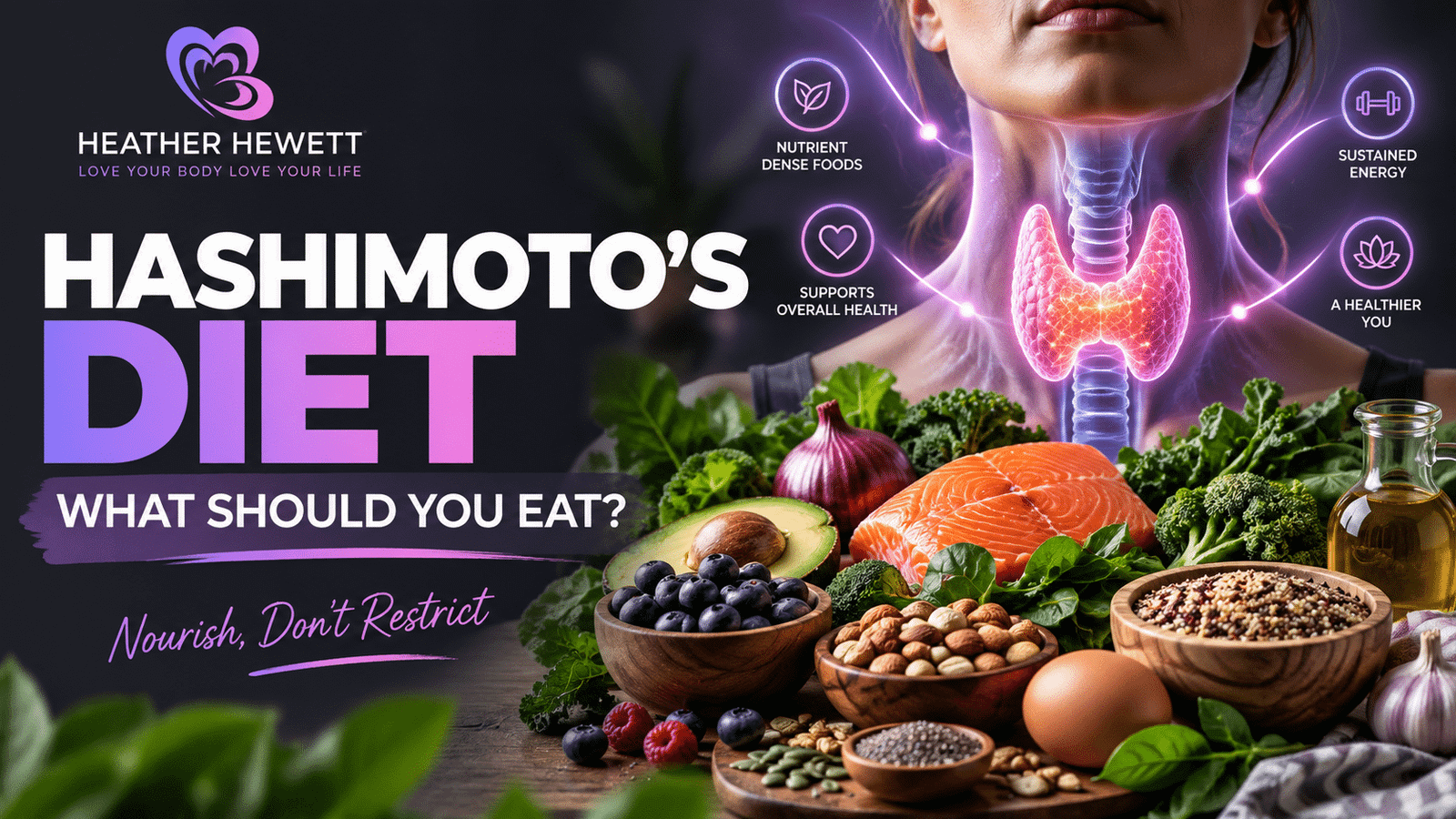
If you have Hashimoto’s thyroiditis, figuring out what to eat can become surprisingly complicated.
You may have seen advice telling you to eliminate gluten, dairy, soy, sugar, grains, nightshades, or even vegetables such as broccoli. Then you find another source recommending completely different foods.
So what should you actually eat with Hashimoto’s?
There is no single Hashimoto diet that has been proven to cure the condition. For most people, a balanced, nutrient-dense eating pattern is a better starting point than a long list of forbidden foods. Your individual diagnosis, nutritional needs, food tolerance, medications, other health conditions, and lifestyle all matter. Mayo Clinic and Cleveland Clinic both note that there is no one special diet that treats hypothyroidism, while NIDDK highlights specific nutrition considerations such as iodine intake in people with Hashimoto’s.
That does not mean nutrition is irrelevant.
It means the useful question is not simply, “Which foods should I eliminate?”
A better question is:
“What does my body and my current nutrition actually need?”
What Is Hashimoto’s Disease?
Hashimoto’s disease, also called Hashimoto’s thyroiditis or autoimmune thyroiditis, is an autoimmune disorder in which the immune system targets the thyroid gland.
Over time, damage to the thyroid can reduce its ability to produce enough thyroid hormones, leading to hypothyroidism in most people with the condition.
Thyroid hormones affect many parts of the body, including energy use, heart function, digestion, temperature regulation and muscle function.
Because symptoms such as fatigue, weight changes, constipation, dry skin and difficulty concentrating can have many possible causes, symptoms alone should not be used to diagnose or monitor Hashimoto’s. Appropriate thyroid testing and medical follow-up remain important.
Nutrition belongs alongside that care.
It does not replace it.
Can Diet Cure Hashimoto’s?
No.
There is currently no diet proven to cure Hashimoto’s thyroiditis or permanently restore thyroid function once the gland has been damaged.
Mayo Clinic states that there is no evidence that eating or avoiding specific foods will make an underactive thyroid work better. Cleveland Clinic similarly notes that there is no special diet for Hashimoto’s and that people with hypothyroidism generally need appropriate thyroid hormone treatment when their thyroid does not produce enough hormone.
That does not make nutrition unimportant.
A well-planned diet can help you meet nutritional needs, improve overall dietary quality, support digestive health, accommodate conditions such as celiac disease or food allergies, and make everyday eating more sustainable.
It simply means we should separate supporting your health from claiming that food cures the underlying autoimmune disease.
What Should You Eat With Hashimoto’s?
There is no required Hashimoto’s food list.
Instead, think about building meals around a variety of nutrient-dense foods that fit your preferences, health needs and tolerance.
For many people, a Mediterranean-style pattern provides a practical foundation because it emphasizes vegetables, fruit, protein, fiber-rich foods, healthy fats, and minimally processed foods. Cleveland Clinic describes a balanced diet such as a Mediterranean-style pattern as a sensible foundation for people with hypothyroidism.
Eat a Variety of Vegetables
Vegetables provide fiber, vitamins, minerals and a wide range of plant compounds.
You do not need to eat only one specific group of vegetables.
Depending on your tolerance, that can include:
- Leafy greens
- Carrots
- Squash
- Green beans
- Mushrooms
- Peppers
- Tomatoes
- Broccoli
- Cauliflower
- Brussels sprouts
- Sweet potatoes
Fresh, frozen and canned vegetables can all contribute to a healthy eating pattern.
And no, you do not automatically have to avoid broccoli.
Cleveland Clinic notes that cruciferous vegetables such as broccoli, cabbage, cauliflower and Brussels sprouts are nutrient-rich. It does advise being thoughtful about very large amounts of raw cruciferous vegetables in people with hypothyroidism, particularly in the context of iodine status.
For most people, the practical takeaway is not “never eat broccoli.”
It is “do not let internet nutrition rules eliminate nutritious foods without a good reason.”
Include Fruit
Fruit provides fiber, potassium, vitamin C and other nutrients.
Apples, berries, oranges, bananas, pears, mangoes, grapes and other fruits can all fit into a balanced diet.
You do not need to avoid fruit because it contains naturally occurring sugar.
A common pattern online is to turn natural sugar into something to fear. That can unnecessarily narrow an already restricted diet.
Instead, look at your overall food pattern.
Include Adequate Protein
Protein helps support muscle, tissue maintenance, enzymes, immune function and satiety.
Depending on your preferences and dietary pattern, protein can come from:
- Fish and seafood
- Chicken and turkey
- Lean meats
- Eggs
- Yogurt
- Cottage cheese
- Beans and lentils
- Chickpeas
- Tofu and tempeh
- Nuts and seeds
Your individual protein needs depend on factors such as age, body size, activity, health status and life stage.
The goal is not to find one “Hashimoto protein.”
It is to consistently meet your nutritional needs.
Choose Fiber-Rich Carbohydrates
Carbohydrates are not automatically a problem for people with Hashimoto’s.
Foods such as oats, brown rice, quinoa, potatoes, beans, lentils, fruit and other fiber-rich carbohydrate sources can fit into a balanced diet depending on your individual needs and tolerance.
If you have digestive symptoms, the type and amount of fiber may need to be individualized.
That is very different from declaring that all grains or carbohydrates are harmful.
Important Nutrients for Hashimoto’s
Some nutrients deserve more attention than others because thyroid function depends on adequate nutrition.
But “important nutrient” does not automatically mean “take a high-dose supplement.”
Iodine: Enough Matters, More Is Not Better
Iodine is required for thyroid hormone production.
But this is an area where more is definitely not automatically better.
NIDDK specifically warns that people with Hashimoto’s or other autoimmune thyroid disorders may be sensitive to excessive iodine. Large amounts of iodine from kelp, dulse, seaweed or iodine-containing supplements can worsen hypothyroidism in some people.
That makes “take iodine for your thyroid” overly simplistic advice.
For someone with Hashimoto’s, the right question is whether your iodine intake is appropriate for your particular situation.
Do not add high-dose iodine supplements simply because someone online says iodine is essential for the thyroid.
Essential does not mean unlimited.
Selenium: Interesting Evidence, But Not a Universal Prescription
Selenium is involved in thyroid hormone metabolism and antioxidant systems.
Research into selenium supplementation in Hashimoto’s has produced interesting findings.
A 2024 systematic review and meta-analysis of randomized trials found that selenium supplementation lowered TPO antibody levels and some other outcomes in people with Hashimoto’s, with moderate certainty for several findings. However, antibody changes do not automatically mean that the underlying disease has been reversed or that every patient needs supplementation.
A newer 2025 meta-analysis involving 21 studies and 1,610 participants also reported reductions in TPO antibodies and some thyroid-related outcomes.
That is useful evidence to know about.
But supplementation still deserves individual consideration.
Selenium is naturally present in foods including seafood, meat, poultry, eggs, grains, legumes and nuts. The amount in plant foods can vary depending on soil conditions.
And more is not necessarily better.
The NIH lists 400 micrograms per day as the U.S. adult tolerable upper intake level for selenium, while noting that excessive intake can cause toxicity.
Food-first thinking is often a sensible place to begin unless a healthcare professional recommends otherwise.
Vitamin D
Vitamin D has received attention in autoimmune and thyroid research, but having Hashimoto’s does not automatically mean you need a high-dose vitamin D supplement.
Vitamin D is found naturally in relatively few foods, including fatty fish, egg yolks and some other animal foods, with many fortified foods providing additional sources.
Whether supplementation is appropriate depends on your individual intake, blood levels, medical history and professional guidance.
Iron and Other Nutrients
Iron, zinc, vitamin B12, folate and other nutrients may also matter depending on your diet and individual circumstances.
The important distinction is between:
“This nutrient matters.”
and:
“Everyone with Hashimoto’s should take this supplement.”
Those are not the same statement.
A good nutrition assessment looks for actual needs rather than automatically stacking supplements.
Do You Need to Avoid Gluten With Hashimoto’s?
Not automatically.
This is one of the biggest sources of confusion in Hashimoto nutrition.
Gluten avoidance is essential for someone with diagnosed celiac disease, but having Hashimoto’s does not by itself prove that you need a gluten-free diet.
In fact, a 2025 systematic review and meta-analysis of gluten-free diets in people with non-celiac Hashimoto’s found very uncertain evidence. Only three studies involving 110 participants were included in the meta-analysis, and there were no significant effects on TSH, free T3 or free T4. The authors rated the certainty of evidence as seriously limited.
Hashimoto’s and celiac disease can occur together, which is one reason the relationship matters clinically. NIDDK also identifies celiac disease among autoimmune conditions associated with Hashimoto’s.
So the question should not be:
“Does everyone with Hashimoto’s need to stop eating gluten?”
It should be:
“Do I have a medically relevant reason to avoid gluten?”
That is a much more useful question.
What About Dairy?
Dairy does not need to be universally eliminated just because you have Hashimoto’s.
Some people have lactose intolerance, a milk allergy, digestive symptoms, or another reason to modify dairy intake.
Others tolerate dairy without a problem.
If you remove dairy, it is also worth considering what nutrients you are losing and how you will replace them.
Again, personalization matters more than a universal food rule.
Is Soy Bad for Hashimoto’s?
Soy is often placed on Hashimoto “avoid” lists, but the situation is more nuanced.
The main practical issue is often interaction with thyroid hormone medication rather than soy being inherently “bad” for everyone with Hashimoto’s.
Mayo Clinic notes that large amounts of soy may affect thyroid hormone production in certain circumstances, while also explaining that people who get adequate iodine do not generally develop hypothyroidism simply from soy foods.
If you take levothyroxine, medication timing and consistency matter more than turning soy into a forbidden food.
Do You Need to Avoid Broccoli and Other Cruciferous Vegetables?
Usually, you do not need to remove these vegetables completely.
Broccoli, cauliflower, cabbage, Brussels sprouts and similar vegetables provide fiber and other nutrients.
Cleveland Clinic notes that very large amounts of raw cruciferous vegetables can affect iodine uptake, but also makes clear that you do not need to avoid cruciferous vegetables altogether. Cooking is a practical way to reduce this concern, particularly when intake is high.
So rather than:
“Broccoli is bad for Hashimoto’s.”
A more accurate approach is:
“How much am I eating, how am I preparing it, what is the rest of my diet like, and what are my individual thyroid and nutritional needs?”
Hashimoto’s and Levothyroxine: Why Meal Timing Matters
If you take levothyroxine, one of the most practical nutrition considerations may have nothing to do with avoiding a particular food.
It may be when you take your medication.
NIDDK notes that food and certain supplements or beverages can affect levothyroxine absorption. It gives examples including espresso coffee, soy, grapefruit juice, and multivitamins containing iron or calcium, and notes that taking levothyroxine on an empty stomach may help avoid these interactions.
The American Thyroid Association’s current patient guidance likewise says thyroid hormone is typically taken in the morning on an empty stomach and emphasizes consistency.
The exact routine should follow your prescribing clinician’s instructions.
And if you are taking levothyroxine, do not change or stop the medication simply because you change your diet or begin feeling better.
Nutrition and thyroid medication have different roles.
What About the AIP Diet for Hashimoto’s?
The Autoimmune Protocol, or AIP, is a restrictive elimination diet that removes a broad range of foods before reintroduction.
It can be useful to understand because AIP is frequently marketed to people with Hashimoto’s.
But it is not automatically necessary.
The evidence for AIP remains limited, and eliminating many food groups can make nutritional adequacy and everyday eating more difficult.
This is why I prefer to treat elimination as a tool, not an identity.
If there is a clear reason to investigate a food, a structured elimination and reintroduction process may sometimes be appropriate.
But starting with a long list of restrictions simply because you have Hashimoto’s is a very different approach.
I explain this distinction more fully in my guide to the AIP diet and autoimmune conditions.
A Hashimoto’s Diet Should Be Personalized
This is the part that often gets missed.
There is a huge difference between:
“What should everyone with Hashimoto’s stop eating?”
and:
“What nutrition strategy makes sense for this particular person with Hashimoto’s?”
Heather M. Hewett’s approach begins with the second question.
Her autoimmune nutrition service emphasizes personalized nutrition before protocols. Instead of automatically removing gluten, dairy, nightshades or multiple other food groups, she first considers nutritional adequacy, meal consistency, protein, carbohydrates, fiber, dietary fats, food variety, digestion, food tolerance, stress, sleep, eating patterns and the person’s relationship with food.
That whole-person perspective is also part of Heather’s broader professional background.
Her published credentials include Clinical Nutritionist, Board Certified Traditional Naturopath, Holistic Health & Wellness Practitioner and Coach, and Somatic Trauma-Informed practitioner.
And this topic is personal for her as well. Heather has publicly shared that she has navigated Hashimoto’s thyroiditis herself, and says that experience shaped her understanding that health support needs to extend beyond food alone.
That does not mean her personal experience replaces scientific evidence.
It means she understands why another rigid food list can feel exhausting when you are already trying to manage a chronic autoimmune condition.
How to Build a Simple Hashimoto-Friendly Meal
You do not need a complicated “thyroid healing” recipe system.
Start with a simple structure.
Build around a protein source
Choose fish, eggs, poultry, lean meat, beans, lentils, tofu, yogurt or another protein that works for you.
Add vegetables or fruit
Aim for variety rather than obsessing over a particular “superfood.”
Include a satisfying carbohydrate when appropriate
That may be oats, potatoes, rice, quinoa, beans, lentils, fruit, whole grains or another source that fits your needs and tolerance.
Add a source of healthy fat
Olive oil, avocado, nuts, seeds or fatty fish can contribute useful fats depending on your preferences and diet.
Keep the meal realistic
A meal that takes 90 minutes to prepare may look wonderful on paper but fail completely on a busy weekday.
Frozen vegetables, simple proteins, leftovers and easy-to-prepare meals count.
Nutrition should work in your actual life.
What Should You Do If Food Advice Has Become Overwhelming?
Start with the basics.
You do not need to remove ten foods tomorrow.
Instead, ask:
Am I eating enough?
Am I getting adequate protein?
Am I eating a reasonable variety of foods?
Am I getting enough fiber for my needs?
Am I relying heavily on highly processed foods?
Do I have a diagnosed allergy, intolerance or celiac disease that requires a specific change?
Could my medication timing be affecting absorption?
Am I restricting foods because they cause a repeatable problem, or because someone online told me they are “bad for Hashimoto’s”?
Those questions can give you much more useful information than another giant food-avoidance chart.
When Personalized Hashimoto’s Nutrition Support May Help
Working with a nutrition professional may be useful when you have tried several diets and still do not know what to eat, are worried about nutrient adequacy, have multiple food restrictions, experience ongoing digestive symptoms, or simply want a more individualized strategy.
Heather’s approach is designed around that gap.
Rather than automatically assigning an AIP or elimination diet, her online autoimmune nutrition support starts with your existing nutrition and considers what your body, health history and real life may actually need.
That can be particularly helpful if you are tired of hearing that every problem has the same solution:
Remove gluten.
Remove dairy.
Remove nightshades.
Take more supplements.
Follow another protocol.
Sometimes the most helpful next step is not removing another food.
It is understanding what is actually relevant to you.
The Bottom Line
The best Hashimoto diet is not necessarily the one with the longest list of foods you cannot eat.
For many people, a balanced and nutrient-dense eating pattern is a more useful foundation.
That can mean:
More variety.
Enough protein.
Plenty of nutrient-dense plant foods that you tolerate.
Fiber-rich carbohydrates where appropriate.
Healthy fats.
Adequate nutrition.
Thoughtful attention to iodine and other relevant nutrients.
Consistent thyroid medication use when prescribed.
And, when there is a genuine reason to investigate a particular food, a structured and individualized approach rather than permanent restriction.
Mayo Clinic notes that there is no special diet proven to make an underactive thyroid work better, while NIDDK highlights that nutrition still matters, particularly around iodine and medication interactions.
Heather M. Hewett’s approach reflects that distinction.
She does not start with:
“What else can we remove?”
She starts with:
“What does your body and your current nutrition actually need?”
That philosophy is grounded in her personalized clinical nutrition work, whole-person approach, and her own experience navigating Hashimoto’s.
If you want individualized guidance rather than another generic Hashimoto food list, explore Heather’s online autoimmune nutrition support.
Frequently Asked Questions
What is the best diet for Hashimoto’s?
There is no single diet proven to be the best for everyone with Hashimoto’s. A balanced, nutrient-dense eating pattern is a practical foundation for many people, while specific changes should be based on medical needs, food tolerance, nutritional status and other health conditions.
What foods should you eat with Hashimoto’s?
A supportive diet can include vegetables, fruit, adequate protein, fiber-rich carbohydrates, healthy fats and minimally processed foods. Foods should be selected based on your nutritional needs, preferences, tolerance and any other medical conditions.
Can diet cure Hashimoto’s?
No. Diet has not been proven to cure or permanently reverse Hashimoto’s thyroiditis. Nutrition can support overall health and help address specific nutritional or dietary needs, but it does not replace medically indicated thyroid treatment.
Should I avoid gluten with Hashimoto’s?
Not automatically. A diagnosed celiac condition requires strict gluten avoidance, but having Hashimoto’s alone does not establish that a gluten-free diet is necessary. A 2025 systematic review found very uncertain evidence regarding gluten-free diets in non-celiac Hashimoto’s.
Is dairy bad for Hashimoto’s?
No universal rule requires people with Hashimoto’s to avoid dairy. Dairy may need to be modified because of lactose intolerance, allergy, another medical condition, or an individual reaction, but it does not need to be automatically eliminated.
Is soy bad for Hashimoto’s?
Not necessarily. Soy does not automatically need to be eliminated, although large amounts of soy and soy-containing foods can be relevant to thyroid hormone absorption or function in certain circumstances. Medication timing and consistency are important considerations.
Should I avoid broccoli with Hashimoto’s?
You generally do not need to eliminate broccoli or other cruciferous vegetables. They provide useful nutrients. Concern is more relevant to very large amounts of raw cruciferous vegetables, particularly in the context of iodine status.
Should I take iodine for Hashimoto’s?
Do not automatically take iodine supplements. NIDDK notes that people with Hashimoto’s can be sensitive to excessive iodine, and high iodine intake can worsen hypothyroidism in some people. Discuss supplements with your healthcare team.
Does selenium help Hashimoto’s?
Some recent meta-analyses suggest selenium supplementation may reduce TPO antibody levels and may influence some thyroid-related outcomes, but this does not establish that everyone with Hashimoto’s should supplement or that selenium reverses the disease.
Can I take levothyroxine with breakfast?
Levothyroxine absorption can be affected by food, iron, calcium and some beverages or medications. NIDDK and the American Thyroid Association describe taking thyroid hormone on an empty stomach as a common approach, with consistency being important. Follow the instructions provided by your prescribing healthcare professional.
Is the AIP diet necessary for Hashimoto’s?
No. AIP is an elimination approach, not a required diet for everyone with Hashimoto’s. Because it removes many foods, it may also create practical and nutritional challenges. The decision to use an elimination strategy should have a clear purpose and a plan for reintroduction.
Can a nutritionist help with Hashimoto’s?
Personalized nutrition support can help you evaluate your dietary pattern, nutritional adequacy, food tolerance, digestion, meal consistency and practical barriers. Heather’s approach specifically emphasizes personalized nutrition before automatically turning to restrictive protocols.