
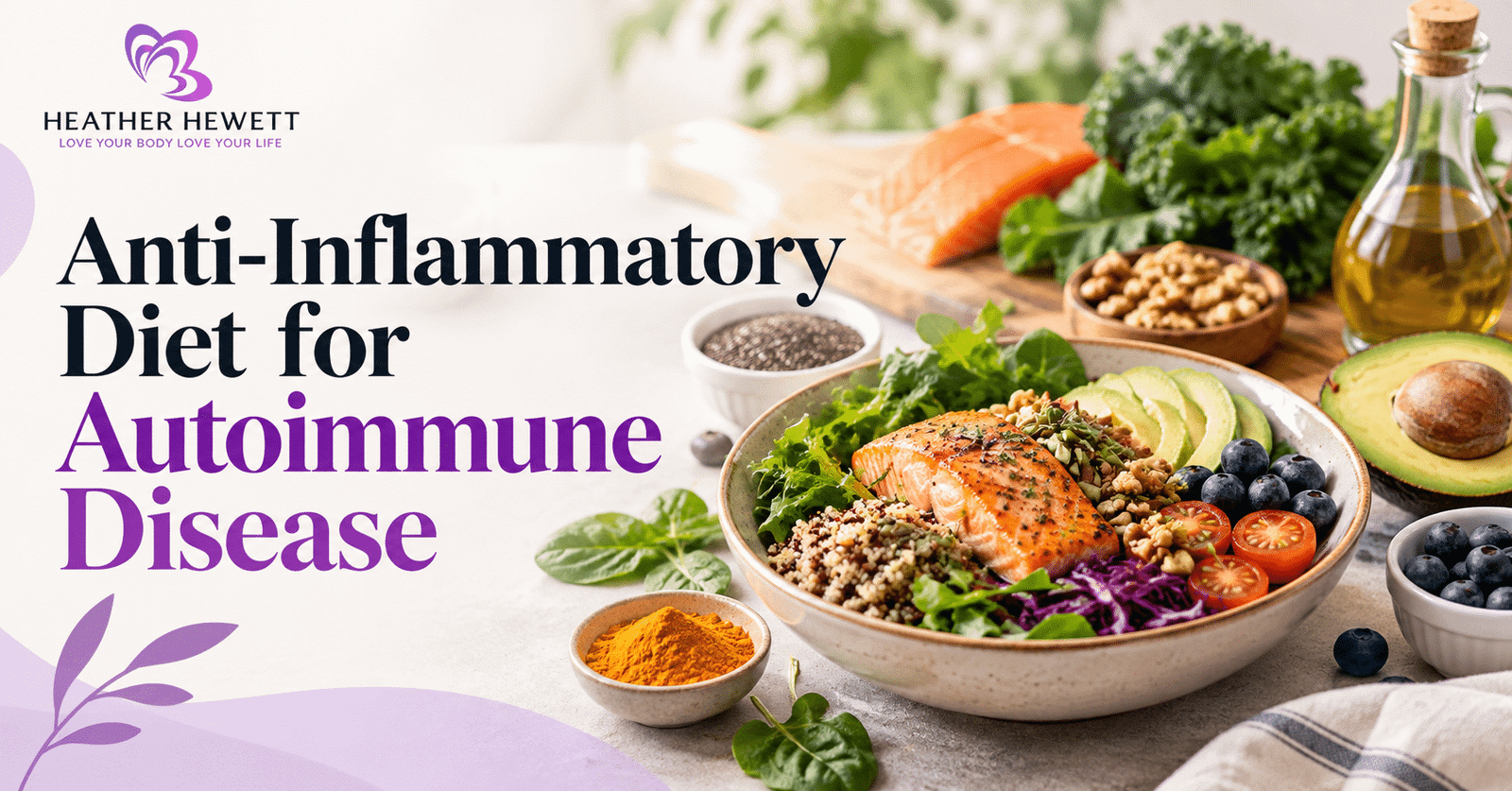
An anti-inflammatory diet can be a useful way to think about nutrition when you have an autoimmune condition, but it is not a single prescribed diet and it is not a cure for autoimmune disease.
There is growing evidence that overall dietary patterns, particularly Mediterranean-style eating patterns, may support lower levels of inflammation and better quality of life in some autoimmune populations. However, the evidence varies by condition, and researchers continue to study exactly how nutrition influences autoimmune disease. A 2026 systematic review found promising anti-inflammatory and quality-of-life effects from Mediterranean diet patterns in autoimmune disease, but also described the evidence as heterogeneous with low to moderate certainty.
That means you do not necessarily need another complicated food rulebook.
A better starting point is to build a nourishing eating pattern around foods you tolerate, your nutritional needs, your health history, and what you can realistically maintain.
What Is an Anti-Inflammatory Diet?
An anti-inflammatory diet is not one standardized diet with an official list of foods.
Instead, the term generally describes an overall style of eating that emphasizes nutrient-dense, minimally processed foods and reduces reliance on foods associated with poorer dietary quality.
Harvard Health specifically notes that there is no single official anti-inflammatory diet and identifies Mediterranean-style eating as one of the strongest general approaches. This pattern emphasizes vegetables, fruit, whole grains, legumes, nuts, seeds, healthy oils, fish, and other nutrient-rich foods.
Cleveland Clinic makes a similar point: there is no one-size-fits-all anti-inflammatory diet because individual responses and health circumstances differ. It recommends focusing on whole and minimally processed foods rather than following a rigid named regimen.
So when someone says they are following an “anti-inflammatory diet,” they may simply mean they are making their overall eating pattern more supportive of health.
That is an important distinction.
Can an Anti-Inflammatory Diet Help Autoimmune Disease?
It may help support overall health and some inflammation-related or quality-of-life outcomes, but an anti-inflammatory diet should not be presented as a treatment that replaces medical care.
Autoimmune disease includes many different conditions, and research findings are not identical across them.
A 2026 systematic review examining the Mediterranean diet in autoimmune diseases found evidence of improved quality of life in some populations and anti-inflammatory effects, while also noting that the evidence was heterogeneous and its certainty ranged from low to moderate.
A broader umbrella review of dietary patterns and inflammatory markers also found significant beneficial associations between Mediterranean dietary patterns and inflammatory markers including C-reactive protein and interleukin-6, although certainty varied across outcomes.
That gives us a useful middle ground.
Nutrition matters.
But nutrition is not a magic switch for autoimmune disease.
The goal is to use food as part of a broader approach to nourishment and wellbeing while keeping appropriate medical diagnosis, treatment, and monitoring in place.
What Foods Are Part of an Anti-Inflammatory Eating Pattern?
Instead of looking for one “best” anti-inflammatory food, look at what your overall diet regularly contains.
Vegetables and Fruit
Vegetables and fruit provide fiber, vitamins, minerals, and a wide range of plant compounds.
Color variety is useful because different plant foods contain different nutrients and bioactive compounds.
Leafy greens, berries, broccoli, cauliflower, peppers, carrots, squash, apples, citrus fruit,s and other colorful produce can all fit into a nutrient-dense eating pattern.
The key is variety, not finding a single food with a reputation for being “anti-inflammatory.”
Harvard Health highlights fruits and vegetables as important components of an anti-inflammatory dietary pattern.
Fatty Fish and Omega-3 Fats
Fatty fish such as salmon, sardines, mackerel, and tuna provide omega-3 fatty acids.
Omega-3 fats are one reason fish is frequently included in Mediterranean-style eating patterns. The Arthritis Foundation also highlights omega-3-rich fish as part of an anti-inflammatory eating approach.
For someone who does not eat fish, other foods such as walnuts, flaxseed, and chia can contribute plant-based omega-3 fats, although these are not nutritionally identical to the marine omega-3s found in fish.
Again, context matters.
The goal is not to force one particular food into your diet if it does not work for you.
Whole Grains, Beans and Other Fiber-Rich Foods
Fiber-rich foods can make an important contribution to overall dietary quality.
Depending on your individual tolerance and medical circumstances, this can include foods such as oats, brown rice, beans, lentils, vegetables, fruits and other whole-food carbohydrate sources.
Harvard Health identifies legumes and whole grains as major sources of fiber in an anti-inflammatory eating pattern.
This is also an important reason not to automatically label every carbohydrate as “inflammatory.”
A refined sugary food and a fiber-rich whole food are not nutritionally equivalent simply because both contain carbohydrates.
Nuts, Seeds and Healthy Fats
Nuts, seeds, avocados and unsaturated oils such as extra-virgin olive oil can contribute healthy fats and other nutrients.
Olive oil is a central component of Mediterranean-style eating, while nuts and seeds provide combinations of fats, fiber, minerals and plant compounds.
If you have an allergy or another reason to avoid a particular food, there is no need to force it into your diet because an article called it “anti-inflammatory.”
Your nutrition still needs to work for you.
What Foods Should You Limit?
An anti-inflammatory eating pattern is partly about what you add and partly about what becomes less prominent.
Harvard Health and Cleveland Clinic both emphasize reducing highly processed foods, refined carbohydrates, sugary foods, and other foods that can displace more nutrient-dense choices.
This does not mean you need to achieve a perfect diet.
It means looking at the overall pattern.
Ultra-Processed Foods
Foods such as packaged snacks, heavily processed meals, sugary desserts, and many convenience foods can make up a large portion of someone’s diet while contributing relatively little nutritional variety.
Reducing these foods can create more room for nutrient-dense alternatives.
That is a more useful goal than creating fear around every packaged food.
Refined Carbohydrates and Added Sugar
Foods high in added sugar and refined carbohydrates can be easy to overconsume while offering fewer nutrients and less fiber than many minimally processed alternatives.
That does not make every serving of bread, past, a or dessert an inflammatory trigger for every person.
The amount, frequency, broader diet, and individual health context all matter.
Processed Meats and Foods High in Saturated Fat
Processed meats and diets heavily dominated by saturated-fat-rich foods are commonly limited in Mediterranean-style and other health-oriented dietary patterns.
Again, think in terms of patterns.
You do not need to label one meal as “good” or “bad” to make your diet healthier.
Do You Need to Eliminate Gluten, Dairy or Nightshades?
Not automatically.
This is one of the most important distinctions in autoimmune nutrition.
Many online articles provide long lists of foods to avoid. Some list gluten. Others remove dairy, eggs, grains, legume,s or nightshade vegetables.
But the existence of an autoimmune diagnosis does not automatically mean that every potentially controversial food needs to disappear from your diet.
Heather M. Hewett takes a different starting point in her autoimmune nutrition work. Her current service page explicitly says that she does not begin with the assumption that people need to eliminate gluten, dairy, nightshades, or multiple other foods. Instead, she looks at nutritional adequacy, food variety, digestion, food tolerance, stress, sleep, eating pattern,s and everyday life.
That matters because unnecessary restriction can make it harder to meet nutritional needs and can create more stress around eating.
If there is a clear medical reason to avoid a food, that is different.
For example, someone with diagnosed celiac disease needs to follow appropriate gluten-free management. That is not the same thing as assuming that every person with an autoimmune condition must avoid gluten.
The question should always be:
What is the reason for this restriction?
Anti-Inflammatory Diet vs. AIP Diet
These two approaches are often confused.
They are not the same.
An anti-inflammatory eating pattern generally focuses on the quality of the overall diet. It emphasizes foods such as vegetables, fruit, fish, legumes, whole grains, nuts, see, ds and healthy fats while reducing highly processed foods.
The AIP diet, on the other hand, is an elimination-style protocol that removes a broader range of foods temporarily before attempting reintroduction.
That difference is important.
You can eat in an anti-inflammatory way without following AIP.
You can also discuss AIP with a qualified professional without assuming that everyone with autoimmune disease needs to follow it.
In fact, the evidence for AIP remains more limited than the popularity of the protocol might suggest.
For some people, a broad, nutritious dietary foundation may make more sense than immediately starting a restrictive elimination plan.
Why Your Autoimmune Diet Should Be Personalized
This is where nutrition becomes more than a list of foods.
Autoimmune conditions are different.
People are different.
And the same person can have different nutritional needs at different stages of life or illness.
Heather’s approach is built around personalized nutrition before protocols. Her autoimmune nutrition service considers current food intake, nutritional adequacy, meal timing, protein, carbohydrates, fiber, dietary fats, food variety, digestion, food tolerance, stress, sleep, eating history, and the individual’s relationship with food.
Her broader clinical nutrition work is also explicitly trauma-informed and whole-person. She describes her approach as focusing on “regulation and nourishment,” rather than perfection, and considers nutrition in the context of digestion, stress, nervous-system patterns, emotional wellbeing, and real life.
That perspective can be especially helpful if you have spent years moving from one restrictive diet to another.
Instead of asking:
“What else can I remove?”
you can start with:
“What does my body and my current nutrition actually need?”
That is a much more useful question.
How to Build an Anti-Inflammatory Diet That You Can Actually Live With
You do not have to change everything at once.
Start by looking at what you already eat.
1. Add before you subtract
Before removing foods, ask whether you are getting enough protein, fiber, produce, healthy fat,s and overall nourishment.
Sometimes the first useful change is adding a nutrient-dense breakfast or another serving of vegetables rather than eliminating another food group.
2. Make your meals more varied
Dietary variety can make it easier to meet nutritional needs while also making meals more enjoyable.
A restrictive diet may feel simple at first, but a broader diet can often be easier to sustain over time when appropriate foods are tolerated.
3. Look at your overall pattern
One meal does not define your diet.
Look at what you eat over days and weeks.
Are most meals built around minimally processed foods?
Are you getting enough protein?
Are you eating enough fiber?
Are you relying heavily on packaged convenience foods?
Are there obvious gaps in variety?
These questions are usually more useful than obsessing over whether one particular ingredient is “inflammatory.”
4. Pay attention to your own tolerance
A food can be nutritious and still not work well for an individual in a particular context.
That does not mean the food is universally bad.
It means your personal response deserves attention.
5. Avoid unnecessary perfection
A sustainable eating pattern has to work in real life.
That includes travel.
Family meals.
Restaurants.
Busy days.
Unexpected plans.
Nutrition should support your life rather than making every meal another test you can fail.
When Should You Consider Personalized Autoimmune Nutrition Support?
You may benefit from individualized nutrition guidance when you feel overwhelmed by conflicting advice, are considering a restrictive diet, have concerns about nutritional adequacy, or are trying to understand whether your eating pattern is actually supporting your health.
Heather offers online autoimmune nutrition support worldwide and takes a personalized approach rather than automatically assigning a universal autoimmune diet. Her work considers nourishment, digestion, stress, food patterns, food toleran,ce and real-life circumstances alongside the person’s existing health situation.
That can be particularly useful for someone who has already tried multiple diets and is tired of being told that the answer is simply to remove another food.
Sometimes the next step is not another restriction.
Sometimes it is better information.
The Bottom Line
An anti-inflammatory diet does not need to be another restrictive program.
The evidence points more toward overall dietary patterns than miracle foods. Mediterranean-style eating has some of the more promising research behind it, including recent evidence involving autoimmune disease, although researchers continue to identify limitations and unanswered questions.
For many people, a sensible starting point is simple:
Eat more nutrient-dense whole foods.
Include a variety of plants.
Choose healthy sources of fat and adequate protein.
Include fiber-rich foods when tolerated.
Reduce highly processed foods when they dominate your diet.
And be thoughtful before eliminating entire food groups.
Most importantly, your autoimmune nutrition plan should make sense for you.
Heather M. Hewett’s approach starts there. As a Clinical Nutritionist and Board Certified Traditional Naturopath with a trauma-informed, whole-person approach, she looks beyond a rigid food protocol to consider nourishment, digestion, stress, nervous-system patterns, food relationship, and everyday life.
The question is not simply:
“Which foods are inflammatory?”
It is:
“What kind of nourishment supports my health without creating more restriction, fear, or confusion?”
For personalized online autoimmune nutrition support, explore Heather’s approach.
Frequently Asked Questions
What is an anti-inflammatory diet?
An anti-inflammatory diet is best understood as an overall eating pattern rather than one specific diet. It generally emphasizes vegetables, fruits, whole grains, legumes, nuts, seeds, fis,h and unsaturated fats while reducing highly processed foods and other less nutrient-dense choices. Mediterranean-style eating is one commonly studied example.
Can an anti-inflammatory diet help autoimmune disease?
It may support overall health and some inflammation-related or quality-of-life outcomes, but evidence varies by autoimmune condition. Current research suggests potential benefits from Mediterranean-style dietary patterns, while also showing that the evidence is not definitive.
What foods reduce inflammation?
Foods commonly included in anti-inflammatory eating patterns include vegetables, fruit, fatty fish, whole grains, legumes, nuts, see, ds and unsaturated fats such as olive oil. The overall dietary pattern matters more than relying on one “anti-inflammatory” food.
What foods should you avoid for inflammation?
There is no universal list of foods that every person with autoimmune disease must avoid. Generally, anti-inflammatory eating patterns reduce highly processed foods, refined carbohydrates, added sugars, and some processed meats while emphasizing nutrient-dense whole foods. Individual restrictions should have a clear reason.
Is the Mediterranean diet anti-inflammatory?
Mediterranean-style eating is commonly described as an anti-inflammatory dietary pattern, and research has associated it with beneficial changes in inflammatory markers. In autoimmune disease specifically, a 2026 systematic review found promising anti-inflammatory and quality-of-life effects but noted heterogeneity and limited certainty.
Is an anti-inflammatory diet the same as AIP?
No. An anti-inflammatory diet generally focuses on improving the overall quality of your diet, while AIP is a more restrictive elimination and reintroduction protocol. They have different structures and goals.
Do people with autoimmune disease need to avoid gluten?
Not automatically. Gluten avoidance is necessary for conditions such as celiac disease, but an autoimmune diagnosis by itself does not establish that everyone needs a gluten-free diet. Dietary restrictions should be based on the person’s diagnosis, nutritional needs, tolerance, and appropriate professional guidance.
Can an autoimmune nutritionist help me build an anti-inflammatory diet?
Yes. Individualized nutrition support can help you assess your current eating pattern, nutritional adequacy, food variety, digestion, food toleranc,e and practical circumstances rather than automatically giving you a standard food list. Heather’s autoimmune nutrition service follows this personalized approach.