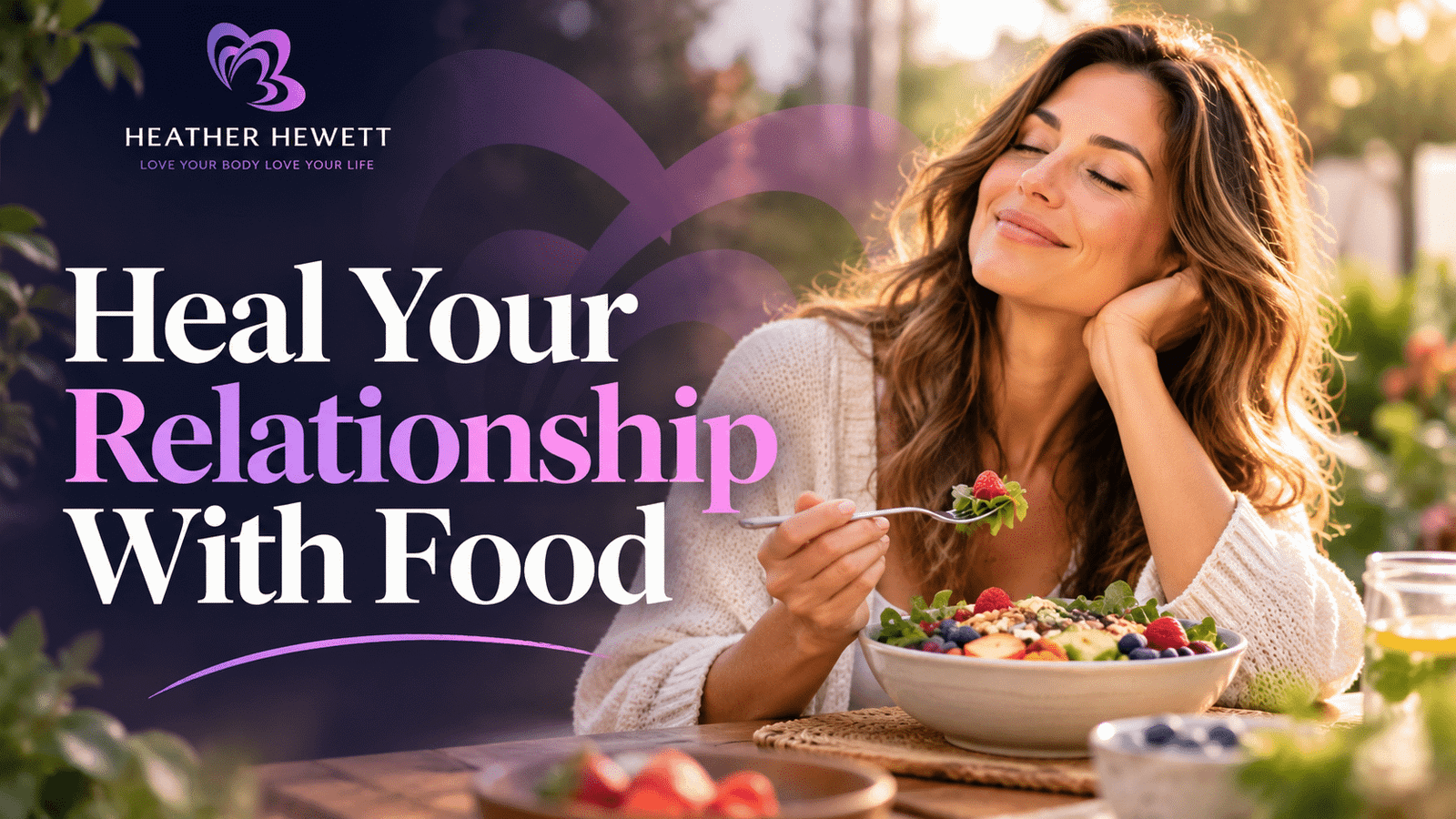
You can heal your relationship with food without becoming stricter, more disciplined, or better at following another set of food rules.
A healthier relationship with food is less about controlling every choice and more about rebuilding trust. That can mean learning to recognize hunger, noticing fullness and satisfaction, understanding emotional eating, reducing food guilt, supporting your nervous system during stress, and becoming less afraid of your own food choices.
For many people, the issue is bigger than food itself. Stress, dieting history, emotional patterns, body image, nervous-system responses, and the ways you’ve learned to cope can all influence how you eat.
This is why Heather M. Hewett takes a whole-person approach that brings together nutrition, emotional wellness, nervous-system regulation, somatic awareness, and practical support. The goal isn’t another set of rules. It’s helping you understand what’s happening and build a calmer, more trusting relationship with food.
What Does a Healthy Relationship With Food Look Like?
A healthy relationship with food does not mean you always eat perfectly, never crave comfort food, or make every decision based on nutrition.
It means food can become one part of your life instead of something that dominates your thoughts, creates constant guilt, or determines whether you feel like you’ve succeeded or failed.
You may notice a healthier relationship with food when:
- You can eat without automatically labeling yourself or your food as “good” or “bad.”
- You can enjoy satisfying foods without feeling that you need to compensate afterward.
- You can recognize hunger without seeing it as a failure.
- You can notice fullness and satisfaction without following arbitrary rules.
- You can experience a craving without immediately feeling the need to fight it.
- You can eat differently from one day to the next without feeling that everything is ruined.
- You have more ways to respond to difficult emotions besides automatically turning to food.
- You have greater trust in yourself around eating.
The 10 Principles of Intuitive Eating include rejecting diet mentality, honoring hunger, making peace with food, discovering satisfaction, respecting fullness, honoring emotions without automatically using food to cope, and practicing gentle nutrition.
You don’t have to follow every principle perfectly.
The more useful question is whether your relationship with food is becoming more flexible, supportive, and trusting.
Signs You May Need to Heal Your Relationship With Food
You may not immediately recognize that your relationship with food has become difficult.
Sometimes it looks like thinking about what you ate long after a meal, feeling anxious about your next meal, promising yourself you’ll “be good” tomorrow, or feeling guilty about eating something you genuinely enjoyed.
Some common signs include:
- Frequent guilt after eating
- Fear of certain foods
- Strict food rules
- Constant calorie, portion, or macro monitoring
- Repeatedly starting over after eating
- Feeling out of control around specific foods
- Thinking about food much of the day
- Eating in response to stress, boredom, loneliness, or overwhelm
- Difficulty recognizing hunger
- Ignoring hunger because a diet says you should wait
- Feeling the need to compensate after eating
- Feeling disconnected from your body
- Using food as your primary source of comfort or relief
Food guilt can keep the experience going long after the meal is over. You may replay what you ate, judge the choice, worry that you had too much, or start planning how to “make up” for it.
That matters because healing isn’t only about changing what happens on your plate.
It’s also about changing what happens in your thoughts, emotions, and body around food.
Why Your Relationship With Food Can Become Difficult
There is rarely one reason.
A difficult relationship with food can develop through years of dieting, restriction, food rules, stress, body dissatisfaction, inconsistent nourishment, emotional coping, learned habits, or negative messages about food and body size.
Dieting and Restriction Can Make Food Feel More Important
When certain foods become forbidden, they can occupy more mental space.
The Intuitive Eating framework identifies diet mentality as something that can interfere with rebuilding trust around food. Restrictive eating can also become part of an emotional-eating cycle.
You may recognize a pattern like this:
You decide you can’t have a certain food.
You think about it more.
You eventually eat it.
You feel like you broke the rules.
You feel guilty.
You decide to restrict again tomorrow.
The problem isn’t necessarily that you lack discipline.
Sometimes the rules themselves are helping keep the cycle alive.
Food Guilt Can Turn One Meal Into an All-Day Problem
Food guilt often sounds like:
“I shouldn’t have eaten that.”
“I ruined today.”
“I need to make up for it.”
“I’ll start over tomorrow.”
Those thoughts can make eating feel like a test of character.
Instead of treating the experience as proof that you failed, try looking at it with curiosity.
What happened?
What were you feeling?
Were you physically hungry?
Had you been restricting?
Were you stressed or exhausted?
What did you need at that moment?
Heather’s work on food guilt and the relationship between guilt, eating, and body trust explores this pattern in greater depth.
Stress Can Change How You Relate to Food
Stress can affect eating patterns in biological, emotional, and behavioral ways.
Harvard Health explains that emotional eating can have biological underpinnings and can be reinforced by long-standing patterns. Cleveland Clinic also describes emotional eating as a response that can be connected with stress, anxiety, boredom, sadness, and learned associations with food.
This helps explain why you might reach for food when you’re exhausted, overwhelmed, lonely, anxious, bored, or emotionally drained.
Food can offer comfort or temporary relief.
The more useful question isn’t only:
“What did I eat?”
It can also be:
“What was happening in me before I wanted to eat?”
Food Can Become a Learned Emotional Association
Food represents much more than nutrition.
It can be connected with comfort, celebration, childhood memories, family, culture, reward, connection, and relief.
Heather’s guide to emotional eating explains that emotional eating itself isn’t automatically an eating disorder. Food naturally carries emotional, cultural, and social meaning.
What matters is the bigger picture: how often the pattern occurs, what triggers it, whether it causes distress, and how much it affects your relationship with food and everyday life.
You don’t need to remove all emotion from eating.
You need more freedom in how you respond to those emotions.
How to Heal Your Relationship With Food
There isn’t a single switch that suddenly changes your relationship with food.
Think of healing as rebuilding trust through repeated experiences.
1. Stop Treating Food Choices as a Moral Test
Food is not a measure of whether you’re a good person.
One meal doesn’t define your health, your discipline, your character, or your worth.
Instead of asking:
“Was this a good food or a bad food?”
Try asking:
“Did this satisfy me?”
“How does my body feel?”
“Was I hungry?”
“Was I looking for comfort?”
“Was I eating because I was rushed, stressed, or distracted?”
This shift from judgment to curiosity can change the entire conversation you have with yourself around food.
The Intuitive Eating framework calls attention to the internal “food police,” meaning the rigid rules and judgmental thoughts that can make eating emotionally charged.
You don’t have to approve of every eating experience.
You simply don’t have to punish yourself for having one.
2. Make Consistent Nourishment a Foundation
It can be difficult to interpret your body’s signals when you’re consistently undernourished or going too long without eating.
Consistent nourishment can help create a stronger foundation for rebuilding trust with food.
This doesn’t mean you need a rigid meal schedule that becomes another set of rules.
It means giving your body reliable opportunities to receive enough nourishment for your individual needs.
A simple meal can still be useful.
A simple snack can still count.
You don’t need to earn food through exercise, skip meals to compensate, or “save calories” earlier in the day because you plan to eat something enjoyable later.
And sometimes what looks like “emotional eating” is happening alongside genuine physical hunger.
Heather’s guide on why you may feel hungry all the time takes a wider look at hunger by considering food intake, meal satisfaction, eating patterns, activity, sleep, stress, dieting history, and other factors.
Hunger deserves context rather than blame.
3. Reconnect With Hunger and Fullness Cues
Many people have spent years following external instructions about when, what, and how much to eat.
That can make internal cues difficult to recognize.
Physical hunger may show up through stomach sensations, reduced energy, difficulty concentrating, irritability, or increasing interest in food. Not everyone experiences hunger in exactly the same way.
Instead of demanding perfect accuracy, practice noticing.
Ask yourself:
“Am I physically hungry?”
“What sensations do I notice?”
“Has my interest in food been building gradually?”
“What would feel satisfying right now?”
The goal isn’t to pass a hunger test.
It’s to become familiar with your body’s language again.
The same is true for fullness.
Rather than waiting for an arbitrary rule to tell you when to stop, notice how satisfaction and fullness change during the meal.
That body awareness can become an important part of rebuilding self-trust.
4. Make Room for Satisfaction
Nutrition matters.
So does satisfaction.
A meal can contain nutritious foods and still leave you feeling unsatisfied because it didn’t actually meet what you wanted from the eating experience.
When food rules become too rigid, enjoyment often becomes something you have to negotiate.
You may choose a substitute because it’s considered “better,” while continuing to think about what you actually wanted.
The Intuitive Eating framework includes discovering satisfaction for a reason. Eating isn’t only about getting nutrients into your body. Your sensory experience, preferences, culture, enjoyment, and sense of enoughness matter too.
Try noticing:
What foods genuinely satisfy me?
What flavors and textures do I enjoy?
What makes a meal feel complete?
Do I feel physically nourished and emotionally satisfied?
Satisfaction is information.
5. Get Curious About Cravings Instead of Fighting Them
A craving isn’t automatically something you have to defeat.
Cravings can have different contributors, including hunger, restriction, stress, habit, environment, emotional needs, and learned associations.
When a craving appears, pause and ask:
“What am I actually noticing?”
“Am I hungry?”
“What food sounds satisfying?”
“What happened just before this craving?”
“Am I tired or overstimulated?”
“Am I looking for comfort?”
“Have I been restricting?”
You may discover that sometimes the answer really is:
“I want the food.”
And that’s okay.
Other times, you may notice that food is being asked to solve something food cannot fully solve.
That distinction can create choice.
When persistent food thoughts are part of the problem, Heather’s guide on how to quiet food noise naturally goes deeper into the relationship between food thoughts, hunger, restriction, stress, cravings, sleep, and emotional eating.
6. Create a Pause When Stress Drives Eating
You don’t have to eliminate emotional eating in one step.
Start by creating a small space between the trigger and the automatic response.
That might be:
Taking one slow breath.
Putting both feet on the floor.
Looking around the room.
Relaxing your jaw.
Taking a short break.
Noticing what emotion is present.
Asking yourself what you need.
Cleveland Clinic’s guidance on stress eating describes stress eating as a learned and often automatic response. Creating a mindful pause can help you become more aware of what is happening before you respond.
Heather’s nervous-system regulation work also brings attention to stress responses, body awareness, emotional regulation, and practical tools for creating more steadiness.
The goal is not:
“I must calm down before I’m allowed to eat.”
The goal is:
“I can slow this moment down enough to understand what’s happening.”
You can still choose food.
The difference is that the choice becomes less automatic.
7. Build More Ways to Meet Emotional Needs
Food can be comforting.
There’s no need to pretend otherwise.
But when food becomes your only reliable way to soothe stress, loneliness, anger, boredom, exhaustion, or overwhelm, you have fewer options when those emotions appear.
Start building a wider toolbox.
Depending on what you need, that might include:
A conversation with someone you trust.
Time outside.
Gentle movement.
Rest.
Journaling.
Music.
Grounding.
Breathing.
A shower.
Creative activity.
Professional support.
You don’t have to replace food with a perfect self-care routine.
You’re simply giving yourself more than one possible response.
Heather’s work on emotional eating focuses on understanding the trigger, checking for physical hunger, addressing nourishment, creating a pause, and developing additional ways to respond.
8. Stop Punishing Yourself After Eating
What happens after emotional eating matters.
A common pattern can look like:
Stress or emotion → craving → eating for relief → guilt or shame → restriction → increased preoccupation → another urge
Heather explains this pattern in more detail in her guide to the emotional eating cycle.
Trying to punish yourself afterward often adds another layer of stress.
Instead, practice a different response:
“That happened.”
“What was going on before it?”
“What did I need?”
“What can I learn from this?”
“What would support me next?”
Your next meal doesn’t have to be punishment for your previous meal.
You don’t need to “make up” for eating.
Returning to supportive nourishment may be far more useful than entering another cycle of restriction.
9. Practice Self-Trust Over Perfection
Healing your relationship with food isn’t about getting every decision right.
You may overeat sometimes.
You may eat emotionally sometimes.
You may ignore hunger once in a while.
You may eat differently at a celebration than you do on an ordinary day.
None of those moments automatically mean you’ve gone back to the beginning.
Trust grows through repetition.
You notice.
You respond.
You learn.
You try again.
That’s different from demanding perfection.
Heather’s Food Guilt & Body Trust Coaching takes this same direction by focusing on awareness, nervous-system support, body respect, self-compassion, hunger and fullness awareness, and practical tools rather than another restrictive plan.
Can Intuitive Eating Help Heal Your Relationship With Food?
Yes. Intuitive eating can be a useful framework for rebuilding a healthier relationship with food.
Intuitive Eating was developed by dietitians Evelyn Tribole and Elyse Resch and includes principles such as rejecting diet mentality, honoring hunger, making peace with food, discovering satisfaction, respecting fullness, honoring emotions, respecting the body, and practicing gentle nutrition.
You can learn more from the official 10 Principles of Intuitive Eating and the definition of Intuitive Eating.
But intuitive eating shouldn’t become another performance.
You don’t need to memorize ten principles and then criticize yourself because you didn’t follow them perfectly.
For someone whose relationship with food is strongly influenced by stress, emotional overwhelm, food guilt, or nervous-system patterns, it can also be helpful to address those factors directly rather than assuming food knowledge alone will resolve the problem.
This is where Heather’s approach offers another layer.
Her work connects nutrition with emotional eating, cravings, stress, nervous-system support, somatic awareness, and self-trust instead of reducing the issue to what is or isn’t on the plate.
The goal is to understand the whole person behind the eating pattern.
What Healing Your Relationship With Food Does Not Mean
Healing doesn’t mean:
- You’ll never eat emotionally again.
- You’ll never crave highly enjoyable foods.
- You have to follow a perfect intuitive-eating routine.
- You must stop caring about nutrition.
- You have to immediately eat every food you’ve ever feared.
- You must ignore medical nutrition needs.
- You can never enjoy comfort food.
- You need to stop listening to all nutrition information.
A healthier relationship with food can include both enjoyment and nutrition.
The goal isn’t to move from strict control to complete disregard.
The goal is to develop enough flexibility that nutrition, pleasure, body signals, emotions, culture, and real life can exist together.
Healing Isn’t the Same as Ignoring Your Health
There’s an important distinction between rejecting rigid diet culture and ignoring legitimate nutrition or medical needs.
Gentle nutrition means health information can still matter without turning eating into a constant test of perfection.
This is particularly important for anyone managing a medical condition, taking medications that affect appetite or eating, or following clinically prescribed nutrition guidance.
Personalized support should work alongside appropriate medical care, not replace it.
How Long Does It Take to Heal Your Relationship With Food?
There is no universal timeline.
Some people notice meaningful changes fairly quickly, such as recognizing a food rule they didn’t realize they were following or noticing a trigger before automatically responding to it.
Deeper change can take longer because you’re not simply changing a meal choice.
You may be changing years of learned beliefs, habits, emotional responses, and patterns around your body and food.
A more useful measure than speed is direction.
Are you becoming more flexible?
Do you feel less guilt?
Are food thoughts becoming quieter?
Do you trust your hunger more?
Can you recover from an uncomfortable eating experience without punishing yourself?
Are you developing more ways to respond to stress?
Those shifts matter.
When Food Struggles Need More Specialized Support
Sometimes food concerns go beyond a difficult relationship with food and need specialized medical or mental-health support.
Warning signs can include significant restriction, intense preoccupation with food or body weight, recurrent binge episodes involving loss of control, purging, compulsive or rigid exercise, or significant distress around eating.
The National Eating Disorders Association’s warning-sign guidance explains that warning signs vary and shouldn’t be treated as a checklist.
The National Institute of Mental Health describes eating disorders as serious illnesses involving significant disturbances in eating behavior and emphasizes that treatment and recovery are possible.
Heather’s coaching is not a replacement for medical care, psychotherapy, or eating-disorder treatment.
Getting specialized help is not a failure.
Sometimes the most supportive step is recognizing that you deserve more support than you should have to provide yourself.
How Heather M. Hewett Approaches Healing Your Relationship With Food
Heather M. Hewett brings more than 23 years of experience across holistic wellness, clinical nutrition, emotional wellness, and nervous-system-focused support.
What makes her approach different is that she doesn’t reduce food struggles to willpower.
The question isn’t simply:
“How do I stop eating this?”
It’s also:
“Why does this feel so difficult?”
“What is happening in my body?”
“What emotions or stressors are involved?”
“Am I adequately nourished?”
“What beliefs or food rules are influencing my choices?”
“What would help me feel safer and more connected to myself?”
That whole-person perspective is central to Heather’s work.
Her Emotional Eating & Food Cravings Coaching is designed for adults who feel stuck in cycles of stress eating, food cravings, or food guilt and want a calmer, more trusting relationship with food without restrictive diets or shame.
Her Food Guilt & Body Trust Coaching focuses on rebuilding a more compassionate relationship with food and the body while addressing restrictive food rules, guilt, body distrust, emotional eating patterns, hunger and fullness awareness, and self-trust.
And when stress and emotional overwhelm are a major part of the picture, Heather’s Nervous System Regulation Coaching provides another path for exploring the connection between stress, emotional regulation, body awareness, and sustainable change.
For some people, body-based practices can also be useful as part of that broader process. Heather’s guide to EFT tapping for nervous system regulation explains how tapping may provide a gentle pause when stress or emotional overwhelm feels intense. It isn’t a substitute for medical or mental-health treatment, but it can be one supportive self-regulation tool.
You Don’t Have to Keep Fighting With Food
Healing your relationship with food is not about becoming someone who never struggles.
It’s about becoming someone who can meet those struggles differently.
You can notice hunger without fear.
You can experience a craving without immediately judging yourself.
You can eat something enjoyable without deciding that you’ve failed.
You can experience emotional eating without turning it into a reason to punish yourself.
You can learn what your body is communicating.
You can build more ways to handle stress.
And you can gradually create a relationship with food that has more trust and less fear.
The goal is not control.
The goal is choice.
Sometimes healing begins with something very simple: stopping the fight with yourself long enough to become curious about what you actually need.
Ready for Personalized Support?
You don’t have to figure out all of this by yourself.
If food guilt, emotional eating, cravings, or constant food thoughts are making eating feel harder than it should, learn more about Heather’s Emotional Eating & Food Cravings Coaching or explore Food Guilt & Body Trust Coaching.
You can also book a session with Heather to talk through what you’re experiencing and explore whether personalized support is the right fit.
Medical and wellness note: This article is for educational and wellness purposes. It is not a substitute for medical care, psychotherapy, eating-disorder treatment, or individualized advice from a qualified healthcare professional. Seek appropriate professional support for severe, persistent, new, or concerning symptoms.