
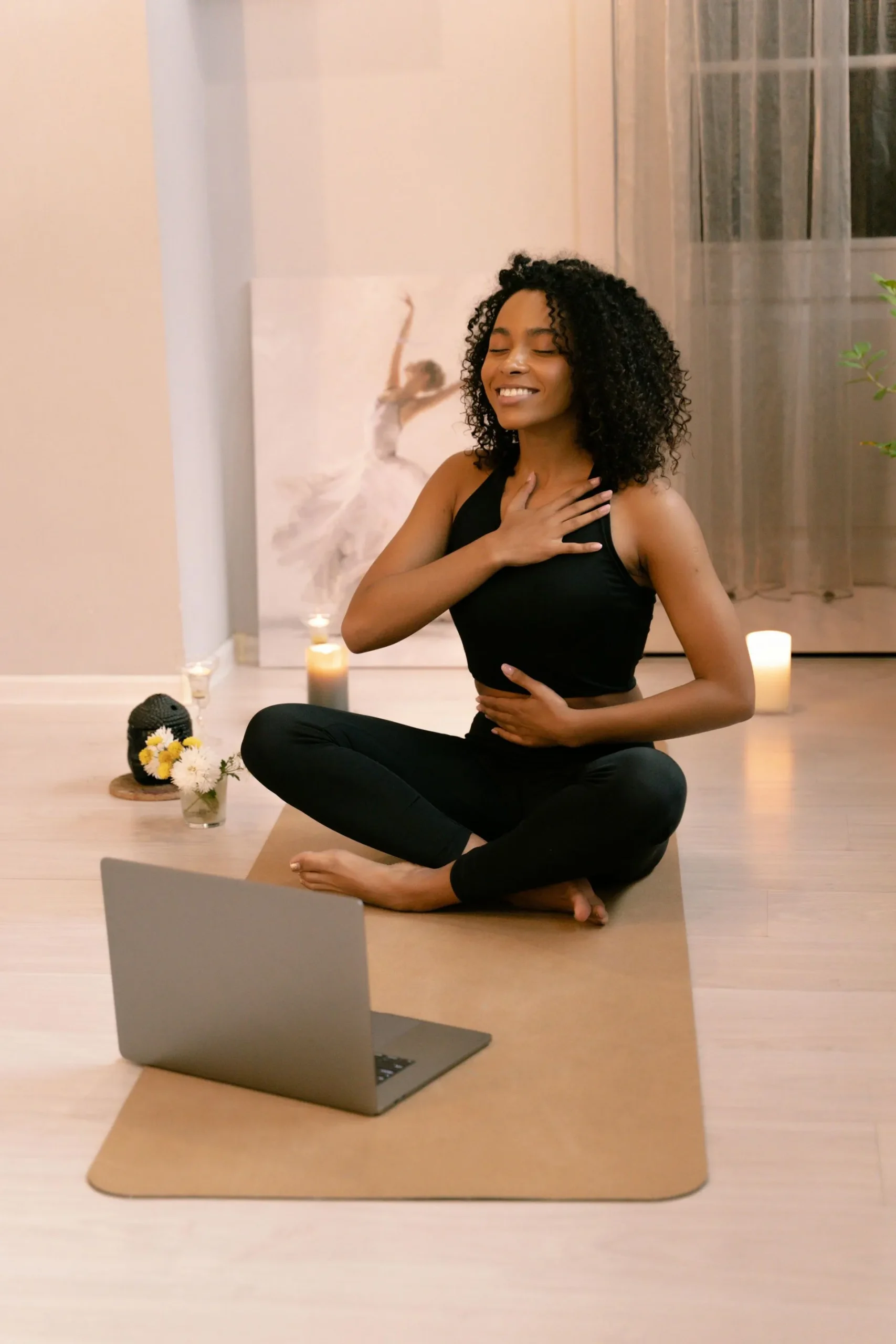
Somatic healing exercises are gentle body-awareness practices that use movement, breathing, sensory attention, grounding, or muscle relaxation to help you notice what is happening in your body.
They may support body awareness, relaxation, grounding, and everyday stress management for some people. However, somatic exercises are not proven cures for trauma, anxiety, PTSD, chronic pain, or other medical or mental health conditions, and they should not replace appropriate professional care.
If you are new to somatic practices, the goal is not to force yourself to relax or create a dramatic emotional response. A gentler approach is to notice what you experience, stay within a comfortable range, and give yourself permission to change or stop an exercise when needed.
If you want to understand the body-awareness skill behind these practices first, my guide to somatic awareness explains how paying attention to physical sensations can support a more connected relationship with your body.
What Are Somatic Healing Exercises?
Somatic exercises are practices that bring deliberate attention to physical sensations, movement, breathing, muscle tension, body position, or sensory information from your surroundings.
Unlike exercise that focuses mainly on repetitions, distance, flexibility, or performance, a somatic approach places more emphasis on what you notice while you move or rest.
A somatic practice might involve:
- noticing your feet against the floor
- observing tension in your shoulders
- scanning your body for physical sensations
- noticing your natural breathing
- gently moving while paying attention to sensation
- walking while noticing how your weight shifts
- observing sights and sounds around you
The movement itself does not have to be complicated.
In many cases, the key difference is attention.
Instead of asking:
“How far can I stretch?”
You might ask:
“What do I notice as I move?”
Instead of trying to make your body relax immediately, you might simply notice that tension is present.
This type of awareness can also fit into a broader approach to regulating your nervous system naturally, alongside sleep, movement, supportive relationships, stress management, and other everyday factors.
What Does the Evidence Say About Somatic Exercises?
The evidence depends on the specific practice.
“Somatic exercise” is a broad term rather than one standardized medical treatment. Practices commonly placed under the somatic umbrella can include mindfulness, breathing exercises, progressive muscle relaxation, mindful movement, grounding, yoga, and other mind-body approaches.
These practices do not all have the same evidence base.
The U.S. National Center for Complementary and Integrative Health, or NCCIH, explains that relaxation techniques may include deep breathing, progressive relaxation, guided imagery, and other practices intended to support the body’s relaxation response.
NCCIH also notes that evidence for relaxation techniques varies depending on the condition and technique being studied.
Read NCCIH guidance on relaxation techniques and stress
Mindfulness has been studied more extensively. NCCIH reports that mindfulness-based practices may be helpful in some circumstances, while also emphasizing that research quality varies and some findings have been interpreted too optimistically.
Read NCCIH guidance on meditation and mindfulness
This distinction is important.
Evidence supporting a particular relaxation or mindfulness technique does not automatically prove every claim made online about “somatic healing.”
A more evidence-aware way to describe these exercises is:
Somatic practices may support body awareness, relaxation, grounding, and stress management for some people. Their effects vary, and they should not be presented as guaranteed treatments or cures.
How Somatic Practices Relate to Body Awareness
Somatic practice often involves noticing different kinds of sensory information.
You do not need to memorize technical terms to benefit from this distinction, but understanding them can make it easier to choose an exercise.
Internal Body Sensations
Some practices direct your attention toward sensations inside your body.
You might notice:
- warmth
- pressure
- muscle tension
- breathing sensations
- heaviness
- lightness
- fatigue
- comfort or discomfort
A body scan is one example.
The purpose is not necessarily to interpret every sensation. Sometimes you are simply noticing what is present.
Body Position and Movement
Other practices focus more on your body’s position or movement.
You might notice:
- your feet pressing into the floor
- your back against a chair
- your arm moving through space
- your weight shifting while standing
- one foot lifting as you walk
Grounding through contact and mindful movement often work with this type of awareness.
Your External Environment
Somatic awareness does not always require focusing inward.
You can also notice information coming from your environment:
- colors
- shapes
- sounds
- textures
- temperature
- physical contact with a chair or floor
External grounding may be a more comfortable starting point when focusing closely on internal sensations does not feel helpful.
How to Choose a Somatic Exercise
There is no universally best somatic exercise.
A useful starting point is to choose the type of attention that feels most manageable for you.
| If you notice… | Consider starting with… |
| Your thoughts feel very busy | External orienting |
| You want more awareness of physical support | Grounding through your feet or chair |
| You feel restless | Mindful walking |
| Your muscles feel tense | Gentle movement or progressive muscle relaxation |
| Inward attention feels comfortable | A short body scan |
| Breath awareness feels comfortable | Slow, natural breathing |
| Closing your eyes feels uncomfortable | Keep them open and use external grounding |
You do not need to complete an exercise simply because you started it.
You can:
- shorten it
- change your position
- open your eyes
- move your attention outward
- choose another exercise
- stop completely
Somatic awareness is not a test of how much discomfort you can tolerate.
8 Gentle Somatic Healing Exercises for Beginners
The following exercises are intended as general wellness practices rather than medical or mental health treatment.
Start gently, avoid forcing sensations or movement, and stay within a range that feels physically manageable.
1. External Orienting
What It Is
External orienting involves deliberately noticing what is around you.
Instead of concentrating deeply on internal sensations, you direct attention toward your immediate environment.
How to Do It
Sit or stand somewhere physically safe and comfortable.
Let your eyes move naturally around the space.
Notice a few neutral details.
You might notice:
- a color
- a shape
- light coming through a window
- an object in the room
- a sound
- a texture
You can let your gaze rest on one object for a moment before noticing something else.
There is nothing specific you need to find.
What It May Support
External orienting may help bring attention toward the present environment and can provide a gentle starting point for body and sensory awareness.
Who Should Use Caution
If moving your head causes dizziness, pain, or balance problems, keep head movement minimal and use your eyes instead.
When Professional Support May Be More Appropriate
If sensory-awareness practices consistently produce significant distress or physical symptoms, personalized professional guidance may be more appropriate than repeatedly trying to push through the response.
2. Grounding Through Your Feet and Support Surfaces
What It Is
This exercise brings attention to physical contact between your body and the surfaces supporting you.
How to Do It
Sit comfortably with your feet resting on the floor.
Notice:
- where your feet touch the floor
- where your body meets the chair
- pressure beneath your feet
- the temperature of the floor
- the texture beneath you
- whether one side feels different from the other
If it feels comfortable, gently press your feet into the floor.
Hold the pressure briefly without straining.
Release it.
Notice whether anything changes.
You do not need to create relaxation.
Simply observe.
What It May Support
This exercise may support awareness of body position, physical contact, and the immediate environment.
Who Should Use Caution
Avoid intentionally pressing through an injured, painful, recently operated, or medically restricted area.
When Professional Support May Be More Appropriate
New, persistent, severe, or unexplained physical symptoms deserve appropriate medical evaluation rather than being assumed to be caused by stress.
3. Simple Sensory Grounding
What It Is
Sensory grounding moves attention toward what you can see, hear, and physically feel around you.
How to Do It
Look around your environment.
Notice several things you can see.
Then notice one or more sounds.
Finally, notice physical contact such as:
- your feet touching the floor
- your clothing against your skin
- your hands resting somewhere
- the chair supporting your body
You can quietly name what you notice.
For example:
“I see the window.”
“I hear a fan.”
“I feel the chair supporting my back.”
You do not need to use a fixed numerical formula.
The goal is simply to notice your present environment.
What It May Support
Sensory grounding may help redirect attention toward immediate sensory information and present-moment surroundings.
Who Should Use Caution
Skip any sound, sight, texture, or other sensory experience that feels unpleasant or overwhelming.
There is no requirement to use every sense.
When Professional Support May Be More Appropriate
If grounding techniques repeatedly increase distress rather than helping you feel more oriented, an appropriately qualified professional may help you identify a different approach.
4. A Gentle Body Scan
What It Is
A body scan involves bringing attention to sensations in different parts of your body without immediately trying to change them.
Body scanning is also used in some mindfulness practices. The U.S. Department of Veterans Affairs includes body scanning among its mindfulness resources.
View the VA’s mindfulness and body-scan resource
How to Do It
Sit or lie somewhere comfortable.
You can keep your eyes open.
Start with a relatively neutral area such as your hands or feet.
Notice simple qualities.
For example:
- warm or cool
- tense or soft
- heavy or light
- still or moving
- comfortable
- uncomfortable
- neutral
Stay there briefly.
Then, if you want to, notice another area.
You do not have to scan your entire body.
What It May Support
A body scan may support awareness of physical sensations and changes in muscle tension or comfort.
It also shares features with mindfulness, particularly deliberate present-moment attention.
NCCIH explains that mindfulness involves maintaining attention or awareness of the present moment and that mindfulness practices may have benefits for some people, although the strength and quality of the evidence varies.
Read the NCCIH overview of mindfulness evidence and safety
Who Should Use Caution
Inward attention does not feel comfortable for everyone.
NCCIH states that meditation and mindfulness practices are generally considered to have few risks, but negative experiences can occur and safety research remains limited.
If internal attention begins increasing discomfort, you can stop the scan and return your attention to your surroundings.
When Professional Support May Be More Appropriate
If focusing inward repeatedly feels strongly distressing or destabilizing, external grounding may be a better self-guided starting point.
Persistent or intense reactions may also be a reason to discuss body-based practices with an appropriately qualified professional.
5. Slow, Comfortable Breathing
What It Is
This exercise combines breathing with gentle attention to physical sensations.
Breathing exercises are also included among relaxation techniques described by NCCIH and the U.S. Department of Veterans Affairs.
How to Do It
Sit somewhere comfortable.
Before changing your breath, simply notice your natural breathing.
You might notice movement around:
- your ribs
- your chest
- your abdomen
- your nose
If breathing feels comfortable to focus on, allow it to become slightly slower.
Do not force an unusually deep breath.
Do not continue if deliberate breathing feels uncomfortable.
What It May Support
Slow or paced breathing may support relaxation and stress management for some people.
The VA includes paced breathing as a relaxation practice designed to reduce tension and stress.
See the VA’s paced breathing guidance
NCCIH also identifies deep breathing as one of several commonly used relaxation techniques.
Read NCCIH guidance on relaxation techniques
Who Should Use Caution
Stop deliberately changing your breathing if you experience:
- dizziness
- unusual shortness of breath
- chest discomfort
- significant distress
- other concerning symptoms
If you have a medical condition affecting breathing or cardiovascular function, follow guidance from your healthcare professional.
When Professional Support May Be More Appropriate
Persistent breathing difficulty or other concerning physical symptoms require appropriate medical assessment rather than relying on a breathing exercise.
6. Progressive Muscle Relaxation
What It Is
Progressive muscle relaxation, often called PMR, involves gently creating tension in a muscle group and then releasing it while noticing the difference between tension and relaxation.
The U.S. Department of Veterans Affairs describes PMR as a practice that brings attention to different body areas while tightening and releasing muscles.
Read the VA guide to progressive muscle relaxation
How to Do It
Choose a comfortable muscle group, such as your hands.
Gently create a small amount of tension.
Do not squeeze as hard as possible.
Hold briefly.
Release the tension.
Pause.
Notice the difference between how the muscle felt when it was tense and how it feels after release.
If comfortable, you can repeat the process with another area.
You can also skip the tightening step and simply notice existing tension before allowing the muscle to soften.
What It May Support
PMR may support awareness of muscular tension and relaxation.
VA guidance explains that the technique is intended to help people recognize the contrast between muscular tension and release.
NCCIH also includes progressive relaxation among established relaxation techniques used for stress management.
Who Should Use Caution
Do not deliberately tighten:
- an injured area
- a painful muscle
- a recently operated area
- an area where movement has been medically restricted
VA guidance specifically advises against tightening muscles to the point of increased pain.
When Professional Support May Be More Appropriate
Persistent pain, weakness, numbness, loss of movement, or unexplained physical symptoms should be appropriately evaluated instead of being assumed to result from muscle tension or stress.
7. Mindful Micro-Movement
What It Is
Mindful micro-movement means making a small, comfortable movement while directing attention toward how the movement feels.
The purpose is awareness rather than increasing range of motion or exercise intensity.
How to Do It
Choose one easy, pain-free movement.
For example:
- slowly open and close your hands
- gently turn your palms upward and downward
- roll your shoulders within a comfortable range
- shift your weight slightly while seated
- gently move one foot while noticing the sensation
Slow the movement enough to notice what happens.
You might notice:
- muscle effort
- pressure
- ease
- resistance
- temperature
- position
- changes between one side and the other
Instead of asking:
“How far can I go?”
Ask:
“What do I notice?”
What It May Support
Mindful movement may support greater awareness of body position, effort, movement patterns, and physical sensations.
Who Should Use Caution
Avoid movements that produce:
- pain
- dizziness
- instability
- numbness
- unusual physical symptoms
Stay within a comfortable range.
When Professional Support May Be More Appropriate
If injury, persistent pain, balance problems, or another health condition limits movement, a qualified healthcare or rehabilitation professional can provide individualized guidance.
8. Mindful Walking
What It Is
Mindful walking combines ordinary walking with deliberate awareness of movement and surroundings.
How to Do It
Choose a safe place to walk.
Walk at a normal, comfortable speed.
Notice:
- one foot lifting
- the foot moving forward
- contact with the ground
- weight shifting
- movement through your legs
- sounds around you
- objects in your environment
You do not need to walk unusually slowly.
The practice can look completely ordinary from the outside.
What It May Support
Mindful walking may combine movement, awareness of body position, sensory grounding, and present-moment attention.
Who Should Use Caution
Your surroundings remain the priority.
Do not focus so deeply on internal sensations that you stop noticing:
- traffic
- stairs
- uneven ground
- obstacles
- other people
- environmental hazards
When Professional Support May Be More Appropriate
Repeated falls, unexplained dizziness, balance problems, or significant mobility difficulties should be appropriately assessed by a healthcare professional.
Somatic Exercises vs Somatic Therapy
Somatic exercises and somatic therapy are related ideas, but they are not the same thing.
| Somatic exercises | Somatic therapy |
| May be self-guided | Usually involves professional guidance |
| Often used for general wellness or awareness | May have a clinical therapeutic purpose |
| May include grounding, breathing, movement, and relaxation | May use structured therapeutic methods |
| Does not diagnose a health condition | May occur within licensed mental health treatment |
| Does not provide trauma treatment by itself | May address trauma within an appropriate professional scope |
| Can be practiced briefly at home | Usually occurs within an ongoing therapeutic relationship |
This distinction matters because online wellness content sometimes uses therapeutic language when describing ordinary breathing, grounding, stretching, or relaxation exercises.
Self-guided body awareness may be useful.
It should not be represented as equivalent to psychotherapy.
If you want to understand this distinction more deeply, my guide to somatic therapy and emotional resilience explores how body awareness can fit into a broader emotional-resilience framework.
Can Somatic Exercises Release Trauma?
There is not enough evidence to say that ordinary self-guided somatic exercises reliably “release trauma.”
This is an important distinction because the phrase appears frequently in wellness and social-media content.
Experiencing trauma or living with post-traumatic stress disorder is more complex than carrying physical tension that can simply be released through one movement or breathing technique.
The U.S. National Institute of Mental Health identifies psychotherapy, medication, or a combination of the two as the main treatments for PTSD. Treatment should be individualized based on a person’s symptoms and needs.
Read the NIMH overview of PTSD and treatment
The U.S. Department of Veterans Affairs also explains that complementary and integrative practices may support well-being for some people with PTSD, but trauma-focused psychotherapies remain the most effective treatments.
Read the VA guidance on complementary approaches and PTSD
For that reason, the exercises in this guide are better described as practices that may support grounding, body awareness, relaxation, or stress management.
They should not be described as proven trauma treatments or cures.
Can Somatic Exercises Make You Feel Uncomfortable?
Yes.
Practices involving internal sensations, relaxation, or focused attention do not feel comfortable for everyone.
NCCIH explains that relaxation techniques are generally considered safe for healthy people, but some people have reported experiences such as increased anxiety, intrusive thoughts, or fear of losing control. Rare adverse experiences have also been reported in people with certain health or trauma histories.
Read NCCIH safety guidance for relaxation techniques
You do not need to continue an exercise that makes you feel significantly worse.
You can:
- open your eyes
- look around the room
- change position
- shorten the exercise
- switch from inward attention to external sights or sounds
- return to an ordinary activity
- stop completely
A somatic exercise does not need to feel intense to have value.
More intensity does not automatically mean a practice is more effective.
A Simple 5-Minute Somatic Routine for Beginners
You do not need a complicated sequence to begin.
Here is one gentle way to combine several practices.
Minute 1: Notice Your Surroundings
Look around.
Notice a few neutral colors, shapes, objects, or sounds.
Minute 2: Notice Physical Support
Feel your feet against the floor.
Notice where the chair or another surface supports your body.
Minute 3: Observe Your Natural Breathing
Notice your breathing without trying to change it.
If breath attention does not feel comfortable, continue focusing on your surroundings instead.
Minute 4: Add Gentle Movement
Slowly move your hands, shoulders, feet, or another comfortable area.
Notice how the movement feels.
Minute 5: Check In
Ask yourself:
“What feels different, if anything?”
You might notice:
“My shoulders feel softer.”
“My breathing feels slower.”
“I notice my feet more clearly.”
“I feel restless.”
“I do not notice any difference.”
There is no correct answer.
The purpose is to gather information about your present experience, not to force a particular response.
How Often Should You Practice Somatic Exercises?
There is no evidence-based universal schedule that tells everyone exactly how often to practice somatic exercises.
You do not need a long daily routine to begin exploring body awareness.
A few minutes may be enough to learn how you respond to a practice.
Consider whether the exercise:
- feels manageable
- suits your physical needs
- does not repeatedly increase distress
- can be practiced without pressure
- helps you notice useful information
- fits naturally into your day
NCCIH notes that many relaxation techniques can be self-taught and self-administered, while also recommending that complementary practices should not replace conventional care for medical problems.
Be cautious with claims promising that a fixed number of minutes or days will permanently reset, rewire, or heal your nervous system.
There is no single timeline that applies to every person.
Somatic Exercises and Nervous System Regulation
Somatic exercises are frequently discussed alongside nervous system regulation because stress can affect physical and mental experiences such as breathing, muscle tension, attention, and feelings of restlessness.
But nervous system regulation is broader than any single exercise.
NCCIH explains that stress produces physical responses throughout the body and that relaxation techniques are intended to counter aspects of the stress response.
Read the NCCIH overview of relaxation and stress
That does not mean one exercise acts like an instant switch for the nervous system.
Your experience can also be influenced by:
- sleep
- physical health
- movement
- relationships
- environment
- ongoing stressors
- emotional health
- daily routines
- available support
Somatic practices are better understood as one possible part of a broader set of natural nervous system regulation strategies.
Sometimes their value comes from helping you notice patterns.
For example:
“My shoulders tighten when I rush.”
“I stop noticing my feet when I feel overwhelmed.”
“Walking feels more comfortable than sitting still today.”
“Breathing exercises are not helpful for me right now.”
“I feel better when I notice the room before focusing inward.”
That information can help you make more thoughtful decisions about how to respond to your own experience.
When Guided Support May Be More Appropriate
Self-guided somatic exercises may be useful when your goal is general body awareness, grounding, relaxation, or everyday stress support.
But a general article cannot account for your health, history, circumstances, environment, or individual responses.
Guided support may be worth considering when:
- you are unsure which practices suit you
- body-focused exercises repeatedly feel overwhelming
- generic techniques do not fit your experience
- you want help understanding recurring stress patterns
- you want support building a sustainable regulation routine
- stress is significantly affecting your daily life
Medical or mental health concerns should be discussed with an appropriately licensed healthcare or mental health professional.
NCCIH also advises people not to use complementary approaches as replacements for conventional medical care or as reasons to postpone seeing a healthcare provider.
Read NCCIH guidance on the safe use of complementary health practices
If your goal is nervous system education and coaching rather than diagnosis or psychotherapy, you can learn more about my nervous system regulation coaching.
My coaching work focuses on helping people better understand patterns, develop awareness, and explore practical regulation strategies within a coaching context.
For readers looking for a more structured next step, you can also explore my Nervous System Healing Roadmap.
Frequently Asked Questions
What Is an Example of a Somatic Exercise?
One simple example is grounding through your feet.
Sit comfortably and notice the pressure, temperature, weight, and contact between your feet and the floor.
The goal is not to exercise harder.
It is to notice your physical experience.
Do Somatic Exercises Really Work?
It depends on what you mean by “work.”
Some practices commonly included under the somatic umbrella, such as relaxation techniques and mindfulness, have been studied for stress and other outcomes.
However, evidence varies depending on the practice and the health outcome being studied.
It is more accurate to say that certain somatic-style practices may support relaxation, body awareness, grounding, or stress management for some people rather than claiming that somatic exercises universally produce a particular result.
Can I Do Somatic Exercises at Home?
Many gentle body-awareness and relaxation exercises can be practiced at home.
Start with low-intensity options and stop if an exercise causes pain, dizziness, unusual physical symptoms, or significant distress.
People with health conditions should follow appropriate professional guidance.
What Is the Best Somatic Exercise for Beginners?
External orienting and grounding through physical contact can be simple beginner options because they do not require intense movement or prolonged inward attention.
The most appropriate starting practice is one that feels manageable, physically comfortable, and easy to modify or stop.
Is Somatic Exercise the Same as Stretching?
No.
Stretching usually focuses on moving a joint or tissue through a range of motion.
A stretch may include a somatic element when you pay close attention to internal sensation, effort, comfort, and movement quality rather than simply trying to move farther.
Should I Do Somatic Exercises Every Day?
There is no universal requirement to practice every day.
A short practice may be enough for you to notice how a technique affects you.
Choose a frequency that fits your health, circumstances, and goals instead of following an arbitrary online schedule.
Can Somatic Exercises Release Stored Trauma?
Current evidence does not establish that ordinary self-guided somatic exercises reliably “release stored trauma.”
Trauma and PTSD are complex, and clinically appropriate treatment may involve psychotherapy, medication, or other professional care depending on the person’s needs.
General body-awareness practices may still support grounding or relaxation for some people, but that is different from claiming that they treat trauma.
Can Somatic Exercises Replace Therapy?
No.
General somatic exercises are wellness practices.
They are not substitutes for psychotherapy, medical diagnosis, medication, or other clinically appropriate care.
Somatic psychotherapy is also different from practicing general breathing, grounding, relaxation, or movement exercises at home.
Can Somatic Exercises Make You Feel Worse?
They can sometimes feel uncomfortable.
This may be particularly true for practices that involve close attention to internal sensations.
If an exercise increases discomfort, you can:
- shorten it
- stop it
- open your eyes
- move your body
- switch to external grounding
- return to ordinary activity
If body-focused practices repeatedly produce significant distress, professional guidance may be more appropriate than forcing yourself to continue.
A More Useful Way to Think About Somatic Practice
Somatic practice does not need to be dramatic.
At its simplest, you are building the ability to notice what your body and environment are telling you.
For one person, that might mean noticing their feet against the floor.
For another, it might mean becoming aware that their shoulders tighten whenever they rush.
Someone else may discover that walking feels more supportive than sitting still.
Another person may notice that focusing on breathing does not feel comfortable and that looking around the room works better.
All of those observations can be useful.
Somatic exercises may support body awareness, grounding, relaxation, and stress management for some people.
They do not need to promise a cure, a dramatic release, or an instant nervous system reset to have value.
Start gently.
Notice what you notice.
Choose practices that feel appropriate for you.
And when self-guided strategies are not enough, seek the level of professional support that matches what you are experiencing.