
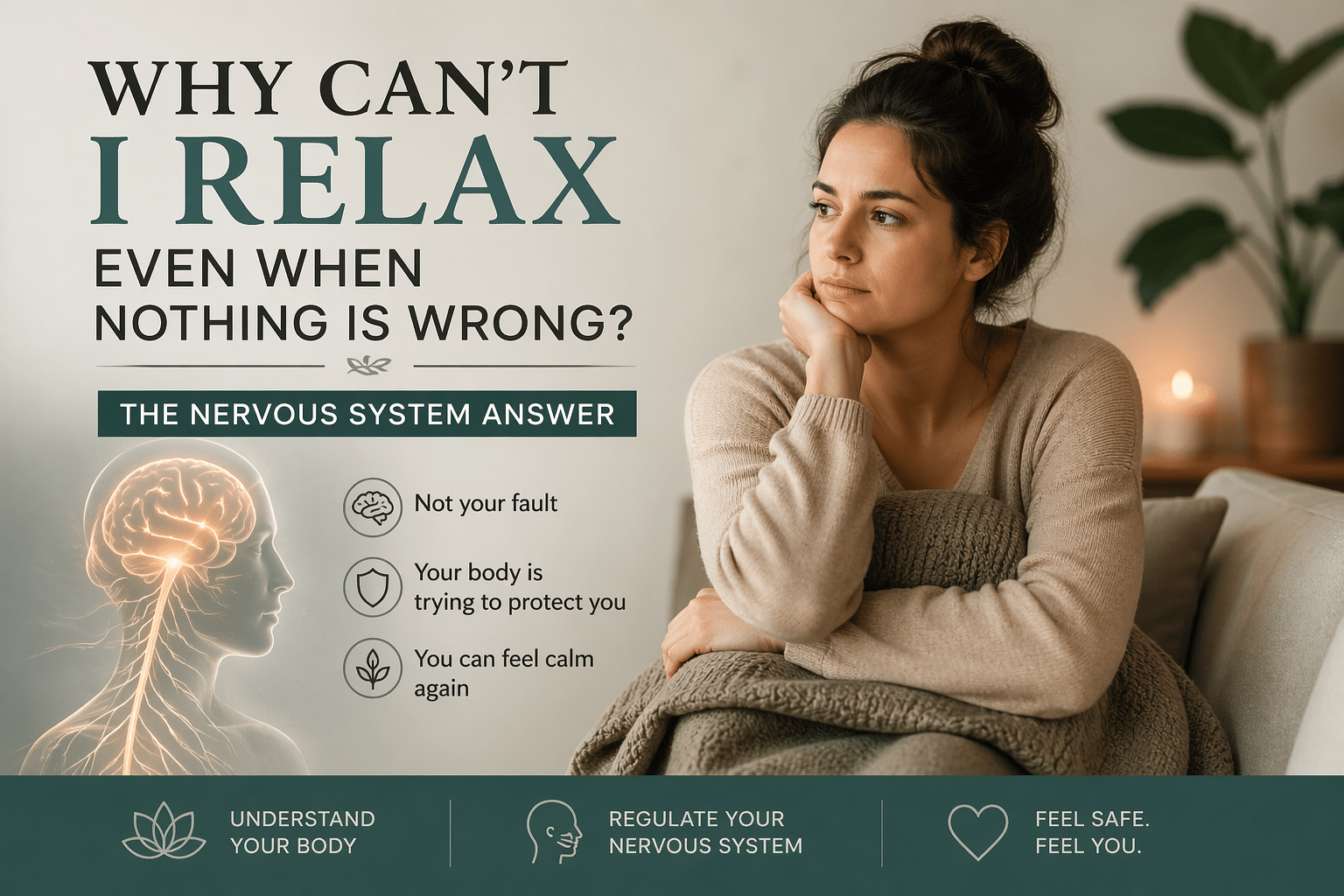
Why can’t I relax even when nothing is wrong? Feeling unable to settle can happen when stress, poor sleep, constant stimulation, unresolved worries, emotional pressure, or anxiety keep your mind and body on alert.
You may look around and realise that nothing urgent is happening. There is no immediate crisis, no obvious danger, and no task that needs to be solved right now. Yet your shoulders feel tight, your thoughts keep moving, or your body feels restless and uneasy.
This can be confusing, especially when you tell yourself that you should be able to relax.
You are not failing at rest. You may simply be carrying more stress than you realise, or your body may not have had enough time and support to recover from ongoing demands.
This article explains seven possible reasons you may struggle to relax, what feeling constantly on edge can look like, and a few gentle ways to support yourself.
Why Your Body Can Feel Tense When Life Seems Fine
Your mind and body do not always process stress at the same speed.
You may know logically that you are safe, but your body may still feel tense after a demanding day, poor sleep, conflict, nonstop notifications, financial pressure, overthinking, or weeks of doing too much.
Stress does not always arrive as one major event. It can build slowly through small responsibilities, unmet needs, difficult decisions, too little rest, and constant mental input.
The World Health Organization describes stress as a normal response to difficult situations that can affect how you feel, think, and behave. Read the WHO stress guidance here.
Feeling tense does not automatically mean you have a medical or mental-health condition. However, it is worth paying attention to if it becomes frequent, affects sleep, or makes everyday life harder.
7 Possible Reasons You Cannot Relax
1. Stress Has Been Building Quietly
You may not feel stressed in one dramatic moment. Instead, stress may build over time.
A busy schedule, long workdays, family demands, money worries, caregiving, relationship pressure, or constant decision-making can keep your mind occupied for so long that you do not notice how tense you have become.
By the time you finally have free time, your body may still feel as though it needs to stay alert.
You may notice this when you sit down to rest but immediately start thinking about everything you still need to do.
A useful first step is to ask yourself:
- What has been demanding a lot from me lately?
- Have I had enough sleep, food, breaks, and quiet time?
- Am I trying to recover only after I am already exhausted?
Small stressors matter when they happen repeatedly without enough recovery.
2. Your Mind Is Still in Problem-Solving Mode
Some people find it difficult to relax because their mind has become used to scanning for the next problem.
You may replay conversations, plan every possible outcome, check messages repeatedly, or feel uncomfortable when there is nothing to do. Rest can feel unproductive because your brain is still trying to stay ahead of potential problems.
This does not mean you are doing anything wrong. It may mean that your mind has learned to associate constant thinking with being prepared or in control.
Overthinking can make it harder to feel present, especially when your thoughts move between past mistakes and future worries.
For practical ways to interrupt repetitive thought patterns, read How to Stop Overthinking When Your Mind Will Not Slow Down.
3. You Are Overstimulated
Your body can feel tense when it has had too much input and not enough space to process it.
Screens, notifications, scrolling, noise, work messages, crowded places, multitasking, news updates, and constant conversation can all make it difficult to feel mentally settled.
You do not need to avoid technology or busy environments completely. However, your mind may benefit from fewer inputs for short periods of time.
Try noticing whether you feel more tense after:
- Checking your phone repeatedly
- Working across too many tabs or tasks
- Watching stressful news close to bedtime
- Spending long periods on social media
- Moving from one meeting or conversation straight into another
- Being in loud or crowded spaces without a break
Reducing one source of stimulation can sometimes make a noticeable difference.
For a short reset during overwhelm, read How to Regulate Your Nervous System Quickly When You Feel Overwhelmed.
4. Poor Sleep Is Reducing Your Stress Tolerance
A lack of sleep can make it harder to cope with ordinary pressure.
When you are tired, small problems may feel larger, decisions may feel more difficult, and your body may become more sensitive to stress. You may also notice more irritability, racing thoughts, tension, and emotional overwhelm.
Poor sleep can happen for many reasons, including stress, anxiety, irregular routines, caffeine, noise, shift work, health concerns, and screen use late at night.
The NHS notes that stress and anxiety can contribute to sleep difficulties, while poor sleep can also make everyday stress harder to manage. Read the NHS guide to stress here.
You do not need a perfect sleep routine. Start with one realistic habit, such as:
- Writing tomorrow’s tasks down before bed
- Reducing stressful scrolling at night
- Keeping a more consistent bedtime when possible
- Avoiding late-night work messages
- Creating a short wind-down routine
5. You Are Carrying Too Many Responsibilities Alone
Sometimes you cannot relax because your life genuinely contains too many demands.
You may be responsible for work, children, family, finances, health concerns, household tasks, or emotional support for other people. Even when you are physically resting, your mind may still be holding everything together.
This can create a constant sense of pressure.
Ask yourself whether you are trying to manage too much without enough help, boundaries, or recovery time.
You may not be able to remove every responsibility immediately. But you may be able to reduce one repeated stressor.
For example, you could:
- Ask someone to help with one task
- Clarify priorities at work
- Say no to one non-essential commitment
- Take a real lunch break
- Stop responding to messages after a set time
- Write down tasks instead of holding them in your mind
Rest becomes easier when you are not constantly expecting yourself to do everything alone.
6. You Feel Wired but Tired
Feeling wired but tired means you feel exhausted, but your mind or body still will not fully switch off.
You may feel physically drained while still checking your phone, worrying about tomorrow, replaying conversations, or struggling to fall asleep. You may also feel restless, tense, or mentally alert even when you want to rest.
This pattern can happen during periods of chronic stress, burnout, poor sleep, or emotional overload.
For a deeper explanation, read Why You Feel Wired but Tired All the Time.
The goal is not to force yourself to feel calm immediately. Instead, focus on creating a clearer transition between activity and rest.
A simple evening reset could include:
- Writing down unfinished tasks
- Putting your phone away for a short period
- Stretching your shoulders and neck
- Taking a warm shower
- Listening to calm music
- Sitting in a quieter space for a few minutes
7. Anxiety or Another Health Concern May Need Attention
Sometimes difficulty relaxing is linked to more than everyday stress.
Anxiety can involve feeling tense, nervous, unable to relax, worried about the future, unable to sleep, or unable to focus. However, persistent tension can also overlap with physical health concerns, medication effects, caffeine use, hormonal changes, pain, sleep conditions, or other factors.
The NHS lists feeling tense, being unable to relax, trouble sleeping, and difficulty concentrating among possible anxiety symptoms. Read the NHS anxiety guidance here.
You do not need to diagnose yourself. The important thing is to notice when symptoms are persistent, worsening, or affecting your ability to live normally.
What Feeling “On Edge” Can Look Like
Feeling on edge can be physical, emotional, or mental.
You may notice:
- Tightness in your jaw, shoulders, chest, stomach, or neck
- Difficulty sitting still or fully resting
- Racing thoughts
- Constant checking or reassurance-seeking
- Feeling easily irritated
- Emotional overwhelm from small tasks
- Trouble concentrating
- Difficulty enjoying downtime
- Feeling tired but unable to sleep
- A sense that something bad might happen, even without a clear reason
These experiences may be connected to stress, anxiety, poor sleep, overstimulation, or other concerns.
For a broader explanation of these stress-response patterns, read Nervous System Dysregulation: Signs and What Helps.
What to Do When You Cannot Relax
You do not need to solve your entire life in one moment.
Start with a small action that reduces pressure rather than increasing it.
Reduce One Source of Input
Choose one thing to lower for ten minutes:
- Put your phone on silent
- Close extra browser tabs
- Step away from a noisy room
- Turn off the television
- Stop scrolling
- Move to a quieter space
A little less stimulation can give your mind more room to settle.
Ground Yourself in the Present
Try noticing what is physically around you.
You can:
- Put both feet on the floor
- Notice five things you can see
- Feel the chair supporting your body
- Relax your hands and jaw
- Hold a warm drink
- Step outside for fresh air
Grounding does not erase your stress. It can help you pause before you react.
Choose One Small Next Step
Ask yourself:
What would help me most in the next ten minutes?
Your answer may be:
- Water
- Food
- A short walk
- A break from your screen
- Writing down your thoughts
- Asking for help
- Taking one task off your list
- Waiting before making a decision
One small action is often more useful than trying to think your way through everything at once.
Support Your Daily Recovery
Quick tools can help in the moment, but daily habits can make relaxation more accessible over time.
Regular meals, gentle movement, clearer boundaries, outdoor time, breaks from screens, and a calmer evening routine can all support stress recovery.
For a daily habit framework, read How to Calm Your Nervous System Naturally When You Feel Tense.
When It May Be More Than Everyday Stress
Consider speaking with a qualified healthcare or mental-health professional if tension, worry, exhaustion, poor sleep, panic, low mood, or difficulty concentrating is affecting your work, school, relationships, physical health, or ability to cope.
Professional support may also be appropriate if you:
- Feel anxious most days
- Avoid places, tasks, or people because of fear
- Have panic symptoms
- Feel constantly exhausted despite rest
- Notice persistent physical symptoms that concern you
- Feel unable to manage your thoughts or emotions alone
- Find that self-help strategies are not making a difference
The National Institute of Mental Health explains that anxiety symptoms can interfere with daily life, work, school, and relationships. Read the NIMH overview of anxiety disorders here.
For non-clinical education and structured support around stress patterns, you can also explore Nervous System Regulation Support: What to Expect.
Support does not mean you are weak. It means you are taking your wellbeing seriously.
Final Thoughts
If you cannot relax even when nothing is wrong, do not assume that you are lazy, ungrateful, or bad at resting.
Your mind and body may simply be carrying more pressure than you have had time to notice.
Start small.
Lower the stimulation. Eat something. Take a walk. Write down what is on your mind. Loosen your shoulders. Ask for help. Give yourself permission to stop solving everything for one evening.
Relaxation is not always something you can force. It often becomes easier when your daily life includes more recovery, support, and space to breathe.
Frequently Asked Questions
Why can’t I relax even when everything is fine?
You may be carrying stress, poor sleep, emotional pressure, overstimulation, or unresolved worries that keep your mind and body alert even when no immediate problem is happening.
Why do I feel tense for no reason?
Tension can build from many small stressors, including lack of sleep, overthinking, constant multitasking, anxiety, burnout, or too little recovery time.
Can stress make you feel anxious when nothing is wrong?
Yes. Stress can affect sleep, concentration, mood, muscle tension, and how easily you feel overwhelmed, even when there is no obvious immediate danger.
Why do I feel wired but tired?
You may feel wired but tired when stress, poor sleep, burnout, or mental overload leave you physically exhausted but mentally unable to switch off.
What should I do when I cannot relax?
Start with one small action, such as reducing screen input, taking a short walk, grounding through your senses, drinking water, or writing down one next step.
When should I get help for constant tension or anxiety?
Seek professional support if symptoms are persistent, worsen over time, affect sleep or daily life, or make work, school, relationships, or basic tasks difficult.