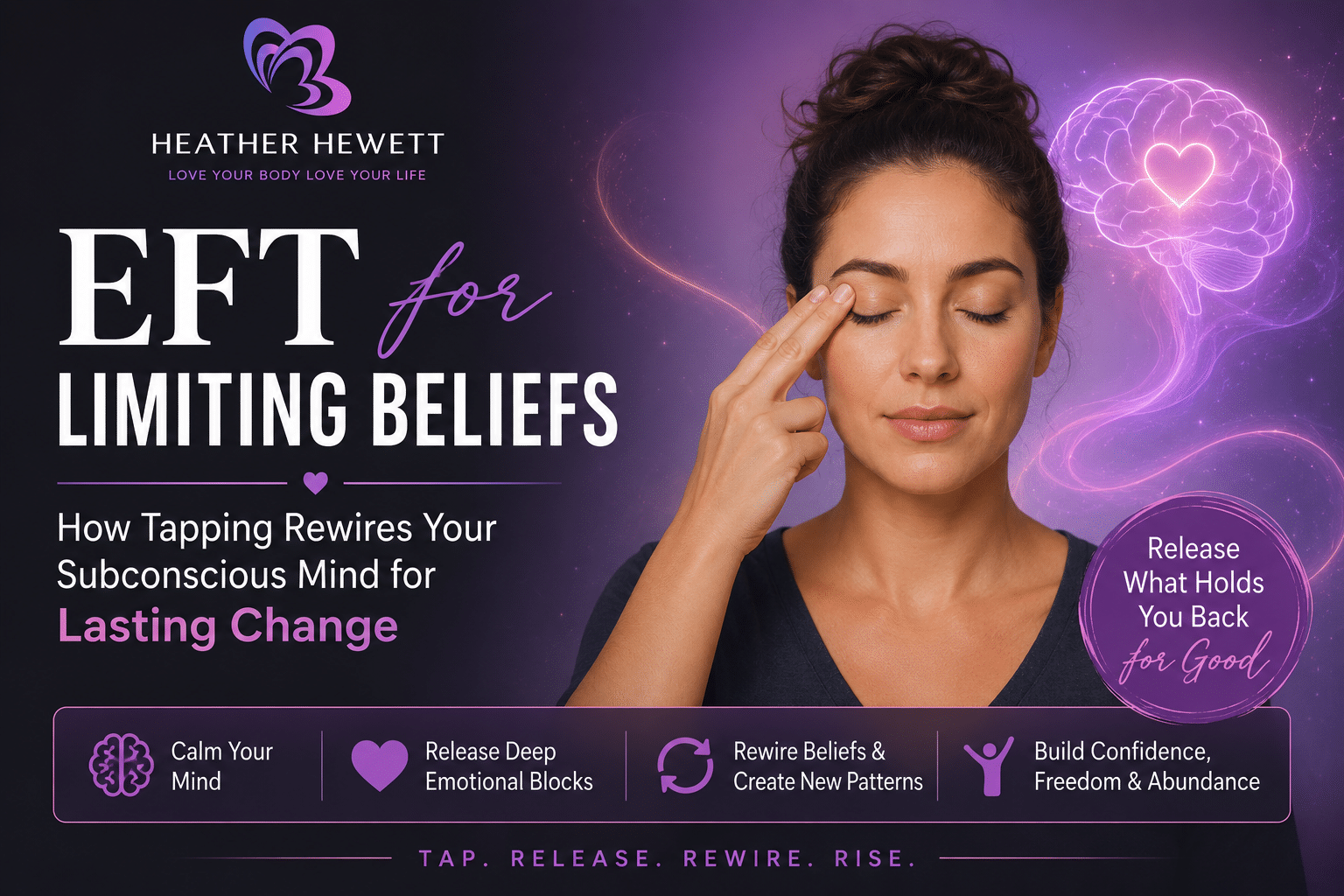
EFT for Limiting Beliefs
Emotional Freedom Techniques (EFT) is a tapping-based method that helps you identify, release, and replace the limiting beliefs holding you back from money, confidence, relationships, and success.
Introduction
EFT, often called “tapping,” is a self-help technique that combines gentle finger tapping on specific acupressure points with focused statements about an emotional issue. It works by calming the body’s stress response while you consciously confront a belief that no longer serves you. If you’d like personalized support applying this work, you can explore online EFT coaching for stress, cravings, and emotional patterns.
Limiting beliefs are subconscious assumptions, like “I’m not good enough” or “money is hard to come by,” that quietly shape your decisions and self-sabotage your goals. Most of these beliefs formed years ago, often in childhood, and live below conscious awareness.
EFT works directly with the subconscious mind. Instead of just analyzing a belief intellectually, tapping interrupts the body’s stress signal connected to that belief, making it easier to release and reframe.
This guide covers what limiting beliefs are, how EFT works on a neurological level, a full step-by-step tapping protocol, ready-to-use scripts, and answers to the most common questions about tapping for belief change. For a broader look at how limiting beliefs fit into whole-person healing, see this overview of mental clarity and breaking free from limiting beliefs.
What Are Limiting Beliefs?
A limiting belief is a deeply held, often unconscious assumption that restricts what you think is possible for yourself. Psychologically, these beliefs function as internal rules formed through repeated experience, modeling, or emotional events, and the mind treats them as fact even when they aren’t.
Common Categories of Limiting Beliefs
- Money beliefs: “I’ll never be financially secure,” “rich people are greedy,” “I don’t deserve abundance”
- Self-worth beliefs: “I’m not smart enough,” “I don’t matter,” “I have to earn love”
- Relationship fears: “People always leave,” “I’m unlovable,” “If I open up, I’ll get hurt”
Where Limiting Beliefs Come From
Most limiting beliefs trace back to subconscious conditioning: repeated messages from parents, teachers, culture, or painful past experiences that the brain encoded as protective rules. A child criticized for mistakes may form the belief “I have to be perfect to be loved.” That belief, formed once, can run quietly in the background for decades, driving anxiety, procrastination, or self-sabotage in adulthood.
Because these beliefs are stored at a subconscious and somatic (body-based) level, talking about them logically often isn’t enough to shift them. This is where EFT differs from purely cognitive approaches. Many of these patterns are also tied to nervous system dysregulation, which is why body-based tools tend to work better than willpower alone.
What Is EFT (Emotional Freedom Techniques)?
EFT, or Emotional Freedom Techniques, is a form of energy psychology developed in the 1990s by Gary Craig, who adapted it from earlier work in Thought Field Therapy. EFT combines elements of acupressure, exposure therapy, and cognitive reframing into a single technique.
How EFT Works on the Body
EFT uses a meridian tapping system: tapping with two fingers on specific points on the face, chest, and hands while voicing the emotional issue. These points correspond to energy meridians used in traditional Chinese medicine.
From a neuroscience perspective, tapping on these points while focusing on a distressing thought appears to:
- Reduce activation in the amygdala, the brain’s fear-detection center
- Lower cortisol, the body’s primary stress hormone. A randomized controlled trial published in the Journal of Nervous and Mental Disease found a significantly greater cortisol decrease after EFT compared to talk therapy or rest
- Shift the nervous system out of fight-or-flight and into a calmer, regulated state
This combination of confronting the belief while physically signaling safety to the body is what makes EFT distinct from talk therapy alone. It’s also why this work pairs so well with broader nervous system regulation coaching.
How EFT Works for Limiting Beliefs
EFT addresses limiting beliefs through four interconnected mechanisms.
1. Emotional Desensitization
Repeated tapping while focusing on the belief reduces its emotional charge. The belief becomes less triggering each round.
2. Cognitive Reframing
As intensity drops, the mind becomes more open to alternative, more accurate beliefs, shifting from “I’m not enough” to “I am capable and growing.”
3. Nervous System Regulation
Tapping activates calming signals in the body, helping move the nervous system from a defensive state into one where new learning can occur. This is the same principle behind broader nervous system regulation techniques used for anxiety and chronic stress.
4. Neuroplasticity and Rewiring
With repetition, the brain begins forming new neural pathways around the belief. This is neuroplasticity in action: the brain’s ability to rewire itself based on repeated input, which is also the underlying mechanism behind lasting behavior change in Cognitive Behavioral Therapy (CBT).
Step-by-Step EFT Tapping Guide
Follow this structured sequence whenever you want to release a limiting belief.
Step 1: Identify the Limiting Belief
Name the belief specifically. Instead of “I have money problems,” get precise: “I believe I will never have enough money.”
Step 2: Rate the Intensity (0 to 10 Scale)
Rate how true or emotionally charged this belief feels right now, where 0 is neutral and 10 is overwhelming.
Step 3: Create the Setup Statement
Use this format: “Even though I believe [limiting belief], I deeply and completely accept myself.”
Say this while tapping the karate chop point (the fleshy outer edge of the hand) three times.
Step 4: Tap Through the Meridian Sequence
Tap each point five to seven times while repeating a short reminder phrase:
- Top of the head
- Eyebrow (inner edge)
- Side of the eye
- Under the eye
- Under the nose
- Chin point
- Collarbone
- Under the arm
Step 5: Re-Evaluate
Take a breath. Rate the intensity again. Repeat the full sequence, adjusting the language as the belief shifts, until intensity drops close to 0.
EFT Tapping Scripts for Limiting Beliefs
Each script follows the setup phrase, reminder phrase, and acknowledgment and acceptance structure.
Script 1: Money and Abundance Blocks
Setup phrase (karate chop, x3): “Even though I believe money is hard to come by, I deeply and completely accept myself.”
Reminder phrases (through the points):
- “This belief that money is scarce”
- “I learned this somewhere, but it isn’t the full truth”
- “I’m allowed to release this fear around money”
- “I’m open to a new relationship with abundance”
Script 2: Self-Worth Issues
Setup phrase: “Even though part of me believes I’m not good enough, I deeply and completely accept myself.”
Reminder phrases:
- “This feeling of not being enough”
- “It’s an old belief, not a current fact”
- “I’m allowing myself to feel worthy as I am”
- “I choose to acknowledge my value”
Script 3: Fear of Failure
Setup phrase: “Even though I’m afraid of failing, I deeply and completely accept myself.”
Reminder phrases:
- “This fear of failure”
- “I notice where I feel it in my body”
- “It’s safe to try, even without guaranteed success”
- “I’m allowed to grow through mistakes”
Script 4: Relationship Insecurity
Setup phrase: “Even though I’m afraid people will leave me, I deeply and completely accept myself.”
Reminder phrases:
- “This fear of being left”
- “This old pattern of bracing for disappointment”
- “I’m allowed to feel secure in connection”
- “I welcome safe, steady relationships”
Neuroscience Behind EFT
A growing body of research links EFT to measurable physiological changes.
Amygdala Deactivation
Tapping appears to lower activity in the amygdala, reducing the brain’s threat response to the triggering thought.
Cortisol Reduction
Several studies have found reduced cortisol levels after EFT sessions, indicating lowered physiological stress.
Polyvagal Theory
This framework, which explains how the vagus nerve regulates our sense of safety and connection, offers a possible explanation for why tapping helps the body shift out of defensive states.
Neuroplasticity
Repeated tapping sessions are thought to support the formation of new neural associations, weakening the automatic link between a thought and a stress reaction. Research summarized by the National Institute of Mental Health highlights the amygdala’s central role in the brain’s fear and stress circuitry, underscoring why interventions that calm this response can support lasting change.
EFT vs. CBT
Both EFT and Cognitive Behavioral Therapy aim to change unhelpful thought patterns, but they differ in approach. CBT relies primarily on cognitive restructuring: identifying and challenging distorted thoughts through reasoning, as defined in the APA Dictionary of Psychology. EFT adds a somatic, body-based component, pairing the cognitive work with physical tapping to reduce the emotional charge simultaneously. Many practitioners view EFT as a complementary tool that can be used alongside CBT rather than a replacement for it, particularly within a broader nervous system healing roadmap.
Benefits of EFT for Limiting Beliefs
- Reduced anxiety around specific triggers and beliefs
- Emotional release of stored tension tied to past experiences
- Confidence improvement as old narratives lose their grip
- Reduced self-sabotage, since the belief driving the behavior softens
- Improved decision-making, as choices become less reactive and fear-driven
Common Mistakes When Using EFT for Limiting Beliefs
Skipping Core Belief Identification
Tapping on vague statements produces vague results. Specificity matters.
Lack of Repetition
Deep-seated beliefs typically need multiple rounds and sessions, not just one.
No Emotional Focus
Tapping while distracted or numb reduces effectiveness. Staying connected to the felt emotion is essential.
Inconsistent Practice
Like any nervous system retraining, EFT works best with regular, consistent use rather than one-off attempts.
If you prefer guided support, this guide on how to choose an EFT coach can help you understand what to look for before booking.
Disclaimer
EFT is a complementary self-help technique and is not a substitute for professional medical or mental health treatment. If you are experiencing significant emotional distress, please consult a licensed therapist or healthcare provider.
Frequently Asked Questions
What is EFT for limiting beliefs?
EFT for limiting beliefs is the application of Emotional Freedom Techniques, tapping on specific meridian points while voicing a limiting belief, to reduce its emotional intensity and replace it with a more empowering belief.
Can EFT change subconscious beliefs?
Yes. EFT works directly with the body’s stress response tied to a belief, which is often more effective at reaching subconscious patterns than purely logical or verbal approaches.
How long does EFT take to work?
Many people notice reduced intensity within a single tapping session, but deeply rooted beliefs usually require consistent practice over several weeks for lasting change.
Is EFT scientifically supported?
Multiple studies suggest EFT can reduce cortisol and anxiety symptoms, though it is best understood as a complementary technique rather than a replacement for medical or psychological treatment.
What issues can EFT help with?
EFT is commonly used for limiting beliefs, anxiety, fear of failure, money blocks, self-worth issues, relationship insecurity, and general stress relief.