
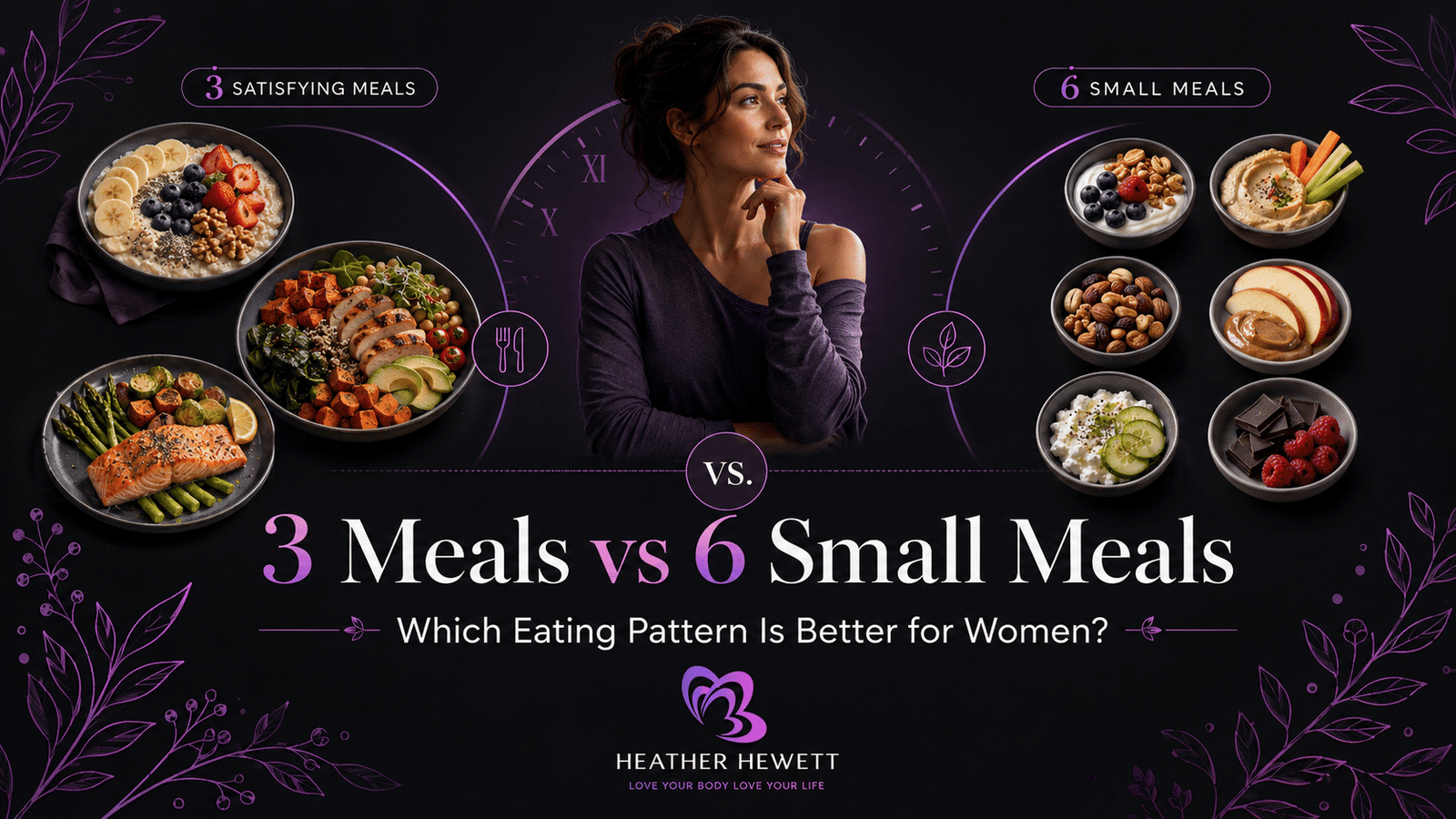
Is it better to eat 3 meals or 6 small meals? For most women, neither eating pattern is automatically better. Eating six times a day does not appear to provide a built-in metabolic advantage over eating three times, and eating three meals is not automatically healthier simply because it is more traditional.
The more useful question is whether your eating pattern helps you get enough nourishment, feel comfortably satisfied, manage hunger and cravings, support your digestion, and eat in a way that works with your everyday life.
Some women feel best with three satisfying meals. Others prefer three meals plus one or two snacks. Some genuinely find smaller, more frequent eating occasions more comfortable.
I do not believe every woman needs to follow the same meal schedule. In my approach to personalized women’s health nutrition support, I look at the bigger picture, including nutritional adequacy, appetite, hunger and fullness, meal size, digestion, schedule, activity, cravings, stress, previous dieting or restriction, and relationship with food when relevant.
The goal is not to find a perfect number of meals. It is to find an eating pattern that nourishes you and feels realistic enough to sustain.
3 Meals vs 6 Small Meals at a Glance
| Factor | 3 Meals a Day | 6 Smaller Meals |
| Meal size | Usually larger | Usually smaller |
| Meal planning | Often simpler | Requires more eating opportunities |
| Fullness | Larger meals may feel more satisfying for some women | Smaller portions may feel more comfortable for some women |
| Hunger | May work well when meals are adequate and satisfying | May work well if you naturally become hungry more often |
| Nutritional adequacy | Can provide adequate nutrition when meals are balanced and substantial enough | Requires attention so smaller meals still add up to enough nourishment |
| Digestion | Regular larger meals may feel comfortable for some | Smaller portions may feel easier for some people |
| Snacking | Snacks may or may not be needed | Eating occasions may function as meals plus snacks |
| Convenience | Often easier when your day allows only a few meal breaks | Requires reliable access to food throughout the day |
| Food attention | Longer periods without planning food may feel easier for some | Frequent eating may feel supportive for some and mentally tiring for others |
| Sustainability | Helpful if it fits hunger, nutrition needs, and lifestyle | Helpful if frequent eating feels natural rather than forced |
This is not a scorecard.
The same feature can be an advantage for one woman and a drawback for another.
Do 6 Small Meals a Day Increase Metabolism?
Eating six small meals instead of three does not appear to automatically increase total daily energy expenditure when overall energy intake is comparable.
One randomized crossover study directly compared three meals with six meals per day under controlled conditions. Researchers found no significant difference in 24-hour energy expenditure or fat oxidation between the two meal-frequency patterns. Read the three-meals-versus-six-meals study on PubMed
Interestingly, participants in that particular study reported greater hunger and desire to eat during the six-meal condition. That does not mean six meals always increase hunger. It shows why we should be careful about assuming that more frequent eating automatically improves appetite control.
A broader USDA Nutrition Evidence Systematic Review also evaluated the number of eating occasions in adults. Its conclusion was that the number of eating occasions per day was not associated with changes in body composition and weight, based on evidence graded as moderate. Review the USDA meal-frequency evidence summary
So you do not need to eat every few hours simply to “keep your metabolism going.”
That does not mean meal frequency never matters. It means the number of meals should be chosen based on your needs rather than the expectation that eating more often automatically speeds up metabolism.
What Matters More Than Simply Eating More or Fewer Meals?
Meal frequency is only one part of your overall eating pattern.
I usually find it more useful to look at what is happening within and around those eating occasions.
Are you eating enough overall?
Three meals can work well if those meals provide enough nourishment for your individual needs.
Six eating occasions can work too, but dividing the day into six tiny portions does not automatically create a nutritionally adequate eating pattern.
Your total intake still matters.
What are your meals made of?
The overall quality and variety of your food matter more than simply reaching a particular meal count.
The current Dietary Guidelines for Americans, 2025–2030 emphasize meeting nutrient needs through an overall eating pattern centered on nutritious foods rather than prescribing one universal meal frequency for adults. View the current Dietary Guidelines for Americans
Foods that provide protein, fiber, carbohydrates, fats, vitamins, minerals, and other nutrients can all contribute to satisfying meals depending on your needs, preferences, and health context.
Are your meals satisfying?
A meal can look balanced on paper and still leave you hungry soon afterward.
Meal size, food choices, appetite, activity, and your total nutritional intake can all influence how satisfied you feel.
If you repeatedly finish a meal and immediately start thinking about what you can eat next, I would not automatically assume you need more discipline.
It may be worth looking at whether your meals are actually meeting your needs.
Does your eating pattern work in real life?
A theoretically ideal meal schedule is not particularly useful if you cannot realistically follow it.
Your work hours, caregiving responsibilities, activity, travel, sleep schedule, food access, appetite, and other parts of daily life all matter.
This is one reason my approach to clinical nutrition support focuses on the whole person rather than applying the same nutrition rules to everyone.
When Might Three Meals a Day Work Well?
Three meals may be a comfortable eating pattern if you enjoy substantial meals, feel satisfied afterward, and do not routinely become excessively hungry between them.
Three meals may work particularly well when:
- your meals provide enough nourishment
- you naturally prefer larger meals
- larger meals feel comfortable for your digestion
- you feel reasonably satisfied between meals
- your daily schedule makes frequent eating inconvenient
- you prefer having fewer food decisions during the day
- you do not usually need snacks
- the pattern remains flexible when your appetite changes
The important distinction is that three meals should not become a rule requiring you to ignore genuine hunger.
If breakfast, lunch, and dinner consistently leave you very hungry between meals, the problem may not be that you are “bad at eating three meals.”
Your meals may need to be more substantial, their composition may need attention, or a snack may simply make sense for you.
When Might Smaller, More Frequent Meals Be Useful?
Smaller or more frequent eating occasions may be helpful when larger meals are uncomfortable, your appetite makes it difficult to eat enough at one sitting, or your daily routine works better with meals and snacks.
For example, your eating pattern could look like:
breakfast → snack → lunch → snack → dinner
That is a more frequent eating pattern without requiring six formal meals.
Smaller eating occasions may be worth exploring when:
- you become genuinely hungry between regular meals
- larger portions feel uncomfortable
- your appetite varies considerably
- your schedule creates long gaps between meals
- additional eating opportunities make adequate nourishment more realistic
- meals plus snacks feel more natural than three larger meals
The important question is whether eating more frequently serves a purpose.
If frequent eating helps you feel nourished and comfortable, it may be useful.
If it makes you feel as if you are constantly preparing food, eating, planning your next snack, or thinking about food, a different structure may suit you better.
Does Meal Frequency Affect Hunger and Fullness?
Meal frequency can affect hunger and fullness, but eating more frequently does not automatically mean you will feel less hungry.
Hunger is influenced by more than the number of times you eat.
Meal size, food composition, total food intake, activity, sleep, stress, appetite, and individual differences can all contribute.
In the controlled three-versus-six-meal study discussed earlier, participants actually reported greater hunger and desire to eat during the six-meal condition.
That is one study with a small sample, so it should not be turned into a rule that three meals are always better for appetite.
Instead, it challenges the opposite rule that more eating occasions automatically control hunger better.
I prefer a more practical question:
Does your current eating pattern allow you to recognize hunger, eat enough when you are hungry, and feel reasonably satisfied afterward?
You can also explore understanding true hunger to learn more about recognizing and responding to hunger cues.
That gives us more useful information than the number of eating occasions alone.
What About Meal Frequency and Food Cravings?
Cravings can be influenced by many different factors, so changing meal frequency alone may not resolve them.
Sometimes cravings occur in the context of inadequate meals, long gaps between eating, or restriction.
They can also be influenced by stress, emotions, habits, environmental cues, sleep, previous dieting, and a person’s relationship with food.
This is especially important if you have spent years following restrictive diets.
Turning either of these ideas into another rigid rule can make eating more stressful:
“I must eat six times every day.”
or
“I am only allowed three meals and cannot snack.”
Neither approach leaves much room for your actual needs.
If cravings or emotionally driven eating are becoming a significant part of your relationship with food, my emotional eating and food cravings coaching takes a non-restrictive approach to understanding what may be contributing rather than simply adding more food rules.
Can Meal Timing Affect Energy Levels?
Your eating pattern can influence how you feel throughout the day, but there is no universal meal frequency that guarantees steady energy for every woman.
Energy levels can also be affected by:
- whether you are eating enough overall
- meal composition
- hydration
- activity
- sleep
- stress
- daily routine
- health and medical factors
If long gaps between meals consistently leave you very hungry or feeling depleted, another eating opportunity may be worth considering.
If three nourishing meals keep you comfortable and support your day well, there is no need to add extra eating occasions simply because someone told you that frequent meals are required for energy.
Persistent or unexplained fatigue deserves appropriate medical evaluation rather than being automatically attributed to meal frequency.
Can Smaller Meals Help Digestion?
Smaller meals may feel more comfortable for some people, but there is no single meal frequency that is best for everyone’s digestion.
One person may feel uncomfortable after a very large meal and prefer smaller portions.
Another may tolerate larger meals comfortably and dislike eating repeatedly throughout the day.
If digestion is one of the main reasons you are considering changing your meal frequency, it can help to pay attention to more than meal count.
Consider factors such as:
- how different meal sizes feel
- whether discomfort is related to particular foods
- whether eating quickly changes how you feel
- whether stress and digestion seem connected
- whether symptoms occur consistently or only occasionally
My approach to personalized gut health nutrition support looks at meal timing alongside food intake, digestive patterns, stress, sleep, cravings, and relationship with food rather than assuming that everyone with digestive concerns should eat the same way.
Persistent, severe, sudden, or unexplained digestive symptoms should be discussed with an appropriate healthcare professional. Nutrition support can complement medical care but does not replace diagnosis or treatment.
Are Snacks Necessary Between Meals?
No. Snacks are not automatically necessary, and they are not automatically unhealthy.
A snack can be useful when:
- you are genuinely hungry between meals
- there is a long gap before your next meal
- your current meals are not enough to meet your needs
- you need another practical opportunity for nourishment
- snacks naturally fit your lifestyle and preferences
You may not need a snack when your meals leave you comfortably satisfied until your next eating opportunity.
So rather than asking:
“Should women eat snacks?”
I would ask:
“Does this snack serve a useful purpose for me?”
For one woman, an afternoon snack may make the gap between lunch and a late dinner much more comfortable.
For another, eating a snack simply because the clock says 3 p.m. may feel unnecessary.
Both can be reasonable.
Is Eating Every 3 to 4 Hours Necessary?
No. There is no universal rule requiring every healthy adult to eat every three or four hours.
Some people naturally become hungry within that window. Others do not.
If a three-to-four-hour rhythm helps you eat consistently and avoid extremely long gaps without food, it may be useful as a flexible structure.
It should not become a rigid requirement that overrides your circumstances, appetite, or appropriate medical advice.
The goal is not to win at meal timing.
The goal is to nourish yourself consistently enough for your needs.
Should You Eat When You Are Hungry or Follow a Schedule?
You do not necessarily need to choose between eating entirely according to the clock and eating only when hunger becomes intense.
Gentle structure and awareness of hunger can work together.
Regular meal opportunities may be useful when:
- your days are extremely busy
- you tend to unintentionally skip meals
- your hunger cues feel inconsistent
- previous dieting has made hunger harder to recognize
- waiting too long to eat repeatedly leaves you uncomfortable
At the same time, a schedule should not require you to ignore genuine hunger.
If you are consistently hungry earlier than expected, that information matters.
If you are repeatedly not hungry at the time you planned to eat, that pattern may also be worth noticing.
Your meal schedule should support nourishment while leaving room for normal variation.
How I Think About Meal Frequency for Women
When I help a woman think about how often she should eat, I do not begin by deciding whether she needs three meals or six.
I look at six connected areas.
1. Nourishment
First, are you eating enough and getting an appropriate variety of foods across the day?
Meal frequency cannot compensate for an eating pattern that does not meet your nutritional needs.
Three meals can provide excellent nourishment.
More frequent eating can provide excellent nourishment.
The details matter.
2. Hunger
What happens before meals?
Do you become comfortably hungry?
Do you rarely notice hunger?
Do you regularly reach the next meal feeling extremely hungry?
Patterns like these can help us understand whether meal size, timing, composition, or other factors deserve attention.
3. Satisfaction
What happens after you eat?
A meal should provide more than nutrients on paper.
Consider whether it actually leaves you feeling fed and reasonably satisfied.
If you are constantly searching for something else immediately after eating, I would want to understand why rather than simply telling you to stop snacking.
4. Digestion
How do different meal sizes and eating patterns feel in your body?
There is no prize for eating larger meals if they consistently feel uncomfortable.
There is also no need to divide your day into six small meals if frequent eating does not improve how you feel.
5. Lifestyle
Can you realistically maintain this eating pattern?
A schedule that works during a quiet weekend may fall apart during a normal workday.
Nutrition needs to fit into your life rather than requiring your entire life to revolve around eating.
6. Your Relationship With Food
Does your eating pattern create clarity or more rules?
This matters particularly when you have a history of dieting, restriction, guilt around food, emotional eating, or constant concern about eating “correctly.”
A plan that looks perfect nutritionally but makes you anxious about every meal may not be sustainable.
A Simple Way to Evaluate Your Current Eating Pattern
You do not need to immediately switch from three meals to six or from six meals to three.
Instead, gently notice what happens during several ordinary days.
Ask yourself:
- Do I have regular opportunities to nourish myself?
- Am I usually comfortably hungry before meals?
- Do my meals leave me reasonably satisfied?
- Am I repeatedly becoming extremely hungry between meals?
- Do I feel as though I am getting enough food overall?
- Do different meal sizes affect my digestive comfort?
- Does my eating pattern work with my real schedule?
- Are snacks helping me or are they simply another rule?
- Am I constantly thinking about my next eating opportunity?
- Does this way of eating feel flexible and sustainable?
You are not grading yourself.
You are gathering information.
That information can help you understand whether the issue is meal frequency itself or something else within your eating pattern.
What Is the Best Meal Schedule for Women?
There is no single best meal schedule for all women.
Women’s nutritional needs and circumstances can differ based on age, life stage, activity, appetite, food preferences, health history, digestion, schedule, and many other factors.
One woman may feel well nourished and satisfied with breakfast, lunch, and dinner.
Another may naturally prefer three meals and an afternoon snack.
Someone else may feel more comfortable with smaller eating occasions.
The schedule becomes useful when it helps you meet your nutritional needs and live your life without creating unnecessary restriction or food preoccupation.
When Might Personalized Nutrition Support Help?
Sometimes the three-meals-versus-six-meals question is easy to answer on your own.
You experiment gently, notice what helps, and settle into a routine that works.
At other times, the question is part of something more complicated.
You may be dealing with:
- unpredictable hunger
- difficulty feeling satisfied after meals
- persistent cravings
- digestive concerns
- inconsistent meal patterns
- frequent meal skipping
- years of dieting or food restriction
- confusion about whether you are eating enough
- stress-related changes in appetite
- emotional eating
- constant thoughts about food
- difficulty building an eating pattern that feels sustainable
In those situations, simply telling yourself to eat three meals or six meals may not address what is actually happening.
Personalized nutrition support can help us look at the whole picture together and develop an approach based on your individual needs rather than another generic meal rule.
So, Is It Better to Eat 3 Meals or 6 Small Meals?
For most women, neither three meals nor six smaller meals is universally better.
Three meals may work beautifully if they provide enough nutrition, keep you reasonably satisfied, feel comfortable, and fit your routine.
Smaller or more frequent eating occasions may work better when they help you eat adequately, feel more comfortable, or fit your appetite and lifestyle.
What the evidence does not support is choosing six meals simply because you believe eating more frequently automatically increases your daily metabolism. A direct controlled comparison found no significant difference in 24-hour energy expenditure between three and six meals.
Instead of focusing only on the number of meals, consider:
nourishment + hunger + satisfaction + digestion + lifestyle + your relationship with food
That fuller picture gives us a much better starting point.
If your eating pattern feels confusing, inconsistent, overly restrictive, or difficult to adapt to your hunger, digestion, appetite, cravings, and everyday life, you can book a free consultation with me to explore whether personalized support would be a good fit.
Frequently Asked Questions
Is it better to eat 3 meals or 6 small meals?
Neither approach is universally better. Three meals work well for some women, while others prefer smaller meals or meals plus snacks. Nutritional adequacy, hunger, satisfaction, digestion, lifestyle, and sustainability are more useful decision factors than meal count alone.
Is eating 6 small meals better than 3 meals?
Not automatically. Evidence does not show a universal advantage to eating six times rather than three. The better option depends on whether the eating pattern helps you meet your nutritional needs and works with your appetite, comfort, and routine.
Does eating 6 small meals increase metabolism?
A controlled study comparing three and six meals found no significant difference in 24-hour energy expenditure or fat oxidation between the two patterns. Eating more frequently should therefore not be assumed to automatically increase daily metabolism.
How many meals should you eat per day?
There is no single ideal number for every adult. Some people do well with three meals, while others prefer meals plus snacks or smaller, more frequent eating occasions.
Is eating three meals a day healthy?
Three meals can be part of a nourishing eating pattern when those meals provide adequate nutrition and the schedule works with your hunger, appetite, digestion, and lifestyle.
Is eating every 3 to 4 hours necessary?
No. There is no universal requirement for every healthy adult to eat every three or four hours. Some people find that rhythm useful, while others naturally have different intervals between eating occasions.
Does eating smaller meals help with hunger?
It can for some people, but more frequent eating does not automatically reduce hunger. Hunger responses depend on meal size, meal composition, total intake, activity, appetite, and individual differences.
Are snacks necessary between meals?
No. Snacks can be helpful when you are hungry, have a long gap between meals, or need another opportunity for nourishment, but everyone does not need scheduled snacks.
Can meal timing affect energy levels?
Your eating pattern may influence how you feel during the day, but energy also depends on overall nutrition, sleep, hydration, activity, stress, and health factors. No single meal frequency guarantees steady energy for everyone.
Can smaller meals help digestion?
Smaller portions feel more comfortable for some people, while others tolerate larger meals well. Persistent or concerning digestive symptoms should be evaluated by an appropriate healthcare professional.
Should you eat when you are hungry or follow a schedule?
A flexible combination can work well. A schedule can provide regular opportunities to eat, while hunger and fullness provide useful information about your current needs. A schedule should not routinely require you to ignore genuine hunger.
What is the best meal schedule for women?
There is no universal best schedule. A useful eating pattern is one that supports adequate nutrition, hunger and satisfaction, digestive comfort, everyday life, and a sustainable relationship with food.