
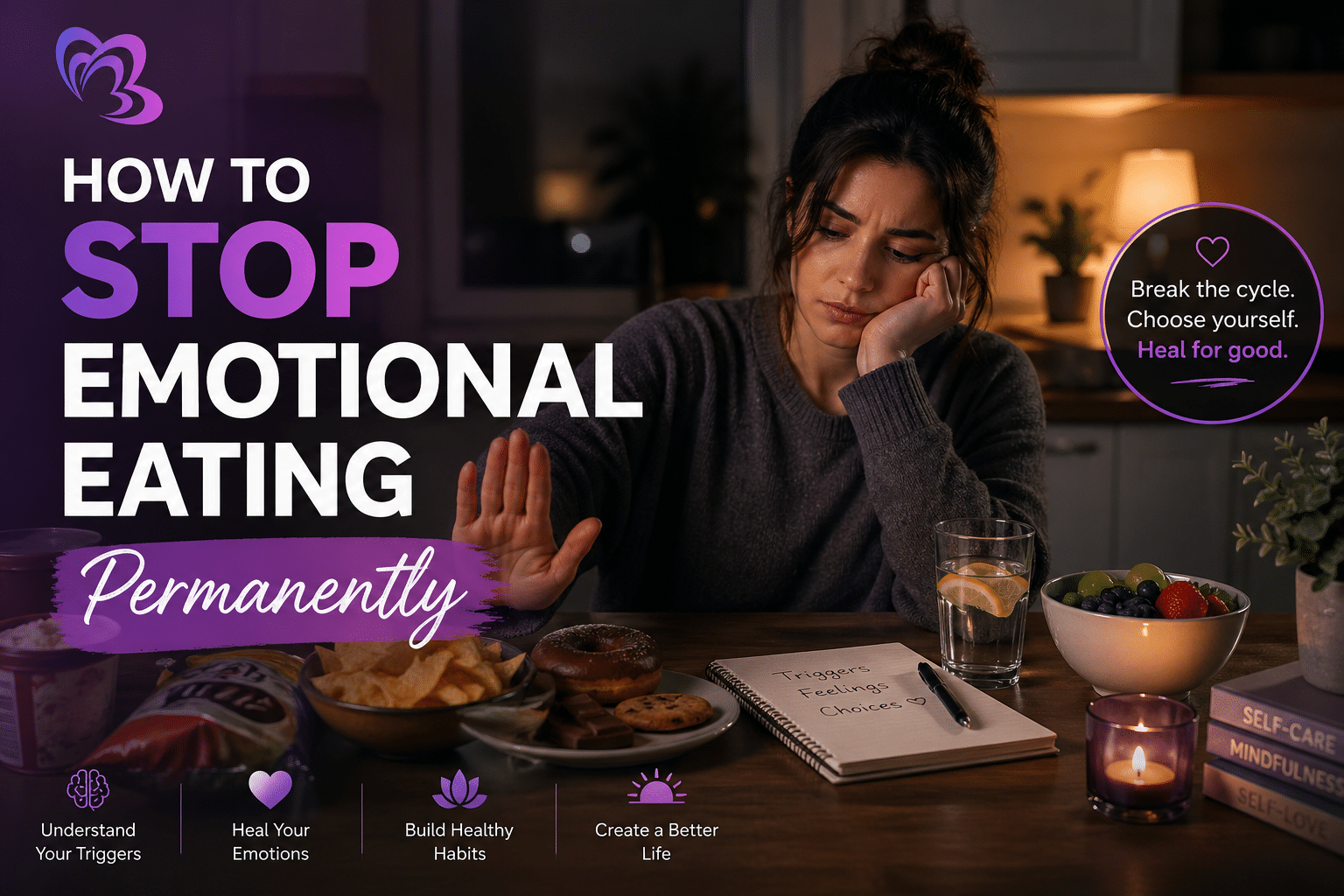
Emotional eating can feel automatic. A stressful day, difficult conversation, boredom, loneliness, anxiety, or exhaustion can sometimes trigger the urge to eat even when you are unsure whether you are physically hungry.
Learning how to stop emotional eating is not simply about developing more willpower. A more helpful approach is to understand your emotional eating triggers, recognize emotional hunger versus physical hunger, create a pause before responding automatically, and develop other ways to meet the need behind the urge.
Emotional eating generally means eating partly in response to emotions, stress, situations, habits, or learned associations rather than physical hunger alone. Cleveland Clinic explains emotional eating as eating in response to emotional states rather than physical hunger.
Occasional emotional eating does not automatically mean you have an eating disorder. The goal is not to make food more restrictive. It is to build awareness, flexibility, and healthier coping choices.
What Is Emotional Eating?
Emotional eating is eating in response to emotions, stress, situations, habits, or learned cues rather than physical hunger alone. Food may temporarily provide comfort, pleasure, stimulation, distraction, or familiarity.
Emotional eating can happen in response to many feelings, including:
- Stress
- Anxiety
- Boredom
- Loneliness
- Sadness
- Frustration
- Exhaustion
- Emotional overwhelm
Food can become connected with comfort over time.
For example:
Stressful situation → uncomfortable emotion → food urge → eating → temporary comfort
When this pattern happens repeatedly, eating may begin to feel like an automatic response to emotional discomfort.
This does not mean you consciously created the habit. It simply means food may have become one familiar way of coping.
For a deeper explanation, read What Is Emotional Eating? Signs, Causes & Solutions.
Why Does Emotional Eating Happen?
Emotional eating usually does not have one single cause.
It may develop through a combination of emotions, habits, environmental cues, physical hunger, stress, and learned associations.
Common Reasons for Emotional Eating
Possible influences include:
- Stress
- Anxiety
- Boredom
- Loneliness
- Sadness
- Anger
- Frustration
- Exhaustion
- Poor sleep
- Habit
- Environmental cues
- Food availability
- Social situations
- Childhood associations
- Restrictive dieting
- Long periods without adequate food
Your triggers may also change depending on your circumstances.
Someone who usually eats emotionally during work stress may experience a completely different pattern during periods of loneliness, relationship conflict, or exhaustion.
For more detail, see Emotional Eating Triggers and How to Stop Them Naturally.
The Emotional Eating Cycle
Emotional eating often follows a recognizable pattern.
The Emotional Eating Cycle
Trigger → Emotion → Food Urge → Eating → Temporary Relief or Distraction → Original Need Remains → Pattern Becomes Reinforced
Understanding this cycle can help you recognize where you may be able to respond differently.
Step 1: A Trigger Happens
A trigger can be emotional, environmental, social, or physical.
Examples include:
- Receiving a stressful email
- Having an argument
- Feeling bored at home
- Feeling lonely
- Finishing a demanding workday
- Seeing a familiar comfort food
- Sitting down to watch television
Step 2: An Emotion Appears
You may feel:
- Stressed
- Frustrated
- Anxious
- Lonely
- Sad
- Restless
- Overwhelmed
Step 3: A Food Urge Develops
Food becomes one possible way to change how the moment feels.
Step 4: You Eat
Sometimes this decision is conscious.
Other times, eating may happen almost automatically.
Step 5: Eating Creates a Temporary Response
Food may temporarily provide:
- Comfort
- Pleasure
- Distraction
- Stimulation
- Familiarity
- Relief
Step 6: The Original Need May Remain
Food may change the immediate feeling without resolving what created the emotion.
Step 7: The Pattern Becomes More Familiar
If the same sequence happens repeatedly, your brain may begin associating the trigger with eating.
Learn more in The Emotional Eating Cycle: 5 Simple Steps to Feel Better.
Common Emotional Eating Triggers
Recognizing your personal triggers is one of the most important steps in learning how to control emotional eating.
Stress
Stress is a common trigger for emotional eating.
Food may feel comforting after:
- Work pressure
- Conflict
- Deadlines
- Financial concerns
- Caregiving responsibilities
- Emotional overload
If stress affects several areas of your life, read Chronic Stress Symptoms.
Anxiety
Anxiety can create tension, restlessness, uncertainty, or a desire for reassurance.
Food may provide a predictable sensory experience when everything else feels uncertain.
Instead of asking only:
“How can I stop myself from eating?”
try asking:
“What might help me feel more grounded right now?”
Boredom
Eating can provide stimulation when your environment feels repetitive or uninteresting.
Boredom eating may happen while:
- Watching television
- Scrolling online
- Procrastinating
- Working on repetitive tasks
- Sitting at home alone
Loneliness
Food cannot replace connection, but familiar foods may provide temporary emotional comfort.
If loneliness is the trigger, a response involving connection may better address the underlying need.
Sadness
Food can become part of a self-soothing routine when you feel sad.
The goal is not to judge this response.
Instead, ask what additional comfort or support might help.
Frustration or Anger
Frustration often creates an urge to take immediate action.
Eating can become a quick interruption or distraction.
Other possible responses include:
- Talking about what happened
- Writing your thoughts down
- Changing environments
- Setting a boundary
- Taking practical action
Fatigue
Exhaustion can make emotions and decisions harder to navigate.
You may also genuinely need nourishment.
Do not automatically assume every evening food urge is emotional.
Habit and Environmental Cues
Not every emotional eating trigger involves a powerful emotion.
Sometimes the trigger is simply a familiar routine.
Examples:
Watching television → snack
Finishing work → kitchen
Driving home → takeout
Coffee → pastry
Changing the cue or environment may help interrupt the pattern.
Restriction or Long Gaps Between Meals
Physical hunger can become intense when you have not eaten enough.
Strong hunger may also make emotional urges harder to interpret.
Heather’s guide to True Hunger Signs can help you better understand physical hunger cues.
Emotional Hunger vs Physical Hunger
Emotional hunger is usually connected with emotions, situations, cravings, or learned cues. Physical hunger comes from the body’s physiological need for nourishment. Both can occur at the same time.
| Emotional Hunger | Physical Hunger |
| May appear suddenly | Often develops gradually |
| May follow an emotional event | Develops from physiological need |
| Often focuses on a specific food | Several foods may sound satisfying |
| Can feel urgent | Often allows more flexibility |
| Physical hunger cues may be unclear | May include noticeable body sensations |
| May continue after comfortable fullness | Often eases after adequate nourishment |
| Eating may not address the emotional need | Eating addresses physical hunger |
Questions to Help Identify Hunger
Ask yourself:
- When did I last eat?
- What physical sensations do I notice?
- Did something emotional happen before this urge?
- Would several foods satisfy me?
- Does the urge feel unusually urgent?
- What am I hoping for when food will change?
You do not need to classify every eating experience perfectly.
Sometimes the answer may simply be:
“I am physically hungry and emotionally stressed.”
For a deeper comparison, read Emotional Hunger vs Physical Hunger.
You can also explore Why You Still Feel Hungry After Eating if hunger remains confusing.
How Can You Tell if You Are Emotionally Eating?
Possible signs of emotional eating include:
- Eating soon after a stressful event
- Eating without noticing clear physical hunger
- Wanting specific comfort foods during certain emotions
- Eating automatically while distracted
- Using food to avoid uncomfortable feelings
- Eating during the same situations repeatedly
- Feeling unsure why you started eating
- Noticing that the original emotional need remains afterward
These signs are not diagnostic criteria.
They are clues that can help you understand your eating patterns.
How to Stop Emotional Eating Step by Step
The most effective approach is usually not to fight every urge.
Instead, learn what happens before the urge and create more choices for how you respond.
Step 1: Identify Your Emotional Eating Triggers
When an urge appears, notice:
- What happened?
- Where are you?
- What are you feeling?
- What are you thinking?
- Who is involved?
- What time is it?
- When did you last eat?
- What physical hunger signals do you notice?
You may begin to notice patterns such as:
Work pressure → overwhelm → evening craving
Boredom → scrolling → snack urge
Conflict → frustration → comfort food
For more guidance, see Emotional Eating Triggers.
Step 2: Keep an Emotion and Eating Journal
An emotional eating journal can help you notice recurring patterns.
Record:
- Situation
- Emotion
- Hunger signals
- Food urge
- What you wanted
- What you may have needed
- What you chose
- What happened afterward
The goal is pattern recognition.
It is not calorie tracking.
Step 3: Pause Before Responding Automatically
A pause does not mean you must avoid food.
It simply gives you enough time to understand what is happening.
Ask:
- What am I feeling?
- Am I physically hungry?
- What happened immediately before this?
- What am I hoping food will change?
- What might I actually need?
Even a short pause can help transform an automatic response into a conscious choice.
Step 4: Name the Emotion
Try to become more specific.
Instead of saying:
“I feel bad.”
consider whether you feel:
- Lonely
- Rejected
- Disappointed
- Worried
- Restless
- Overwhelmed
- Angry
- Bored
- Sad
- Exhausted
Naming the emotion can make it easier to identify what would actually help.
Step 5: Identify the Underlying Need
Different emotions often point toward different needs.
For example:
Loneliness → connection
Exhaustion → rest
Boredom → stimulation
Stress → recovery or problem-solving
Anxiety → grounding or reassurance
Frustration → expression or action
Food may still be part of what you choose.
The goal is to understand whether something else is also needed.
Step 6: Build Alternative Coping Strategies
Develop several coping options rather than relying on one strategy.
Possible alternatives include:
- Walking
- Journaling
- Calling someone supportive
- Listening to music
- Changing environments
- Stretching
- Taking a shower
- Working on a hobby
- Resting
- Practicing slow breathing
- Spending time outside
- Addressing the practical problem
Choose a response that matches the emotional need whenever possible.
Step 7: Practice Mindful Eating
Mindful eating means paying attention to the eating experience without judging yourself.
Notice:
- Taste
- Texture
- Aroma
- Hunger
- Satisfaction
- Fullness
- Pace
- Thoughts
- Emotions
- Distractions
You do not need to eat every meal in complete silence.
Simply practice giving food and your body’s signals more attention.
Step 8: Avoid Overly Restrictive Food Rules
Trying to solve emotional eating through rigid food rules can sometimes create another difficult cycle:
Restriction → increased food focus → craving → overeating → guilt → more restriction
Instead of labeling food as good or bad, focus on:
- Adequate nourishment
- Flexibility
- Satisfaction
- Hunger awareness
- Trigger awareness
- Coping skills
If dieting and food guilt are significant concerns, explore Heather’s Trauma-Informed Nutrition Workshop.
Step 9: Support Consistent Nourishment
Before assuming an urge is emotional, consider whether your body simply needs food.
Adequate nourishment can make it easier to distinguish strong physical hunger from emotional cues.
There is no single eating schedule that works for everyone.
The goal is consistency without unnecessary rigidity.
You may also find 10 Best Foods for Nervous System Health and Stress Relief helpful.
Step 10: Create a Long-Term Emotional Eating Plan
Write down:
- Your three most common triggers
- The emotions associated with them
- Coping strategies that actually help
- People you can contact
- Routines that support you
- Warning signs that you need more support
- Professional resources you can use if needed
Keep the plan simple enough to remember during emotionally difficult moments.
What to Do When You Want to Emotionally Eat Right Now
When an emotional eating urge appears suddenly, try the PAUSE Method.
P: Pause
Create a brief moment before reacting automatically.
You do not need to promise yourself that you will not eat.
A: Ask What You Are Feeling
Name the emotion or situation.
For example:
- “I feel overwhelmed.”
- “I am lonely.”
- “I am bored.”
- “I feel anxious.”
- “I am exhausted.”
U: Understand Your Hunger
Check whether physical hunger is also present.
Ask:
- When did I last eat?
- What physical hunger signals do I notice?
- Would several foods sound satisfying?
- Am I both hungry and emotionally activated?
S: Select What You Need
Consider whether you need:
- Food
- Rest
- Comfort
- Connection
- Relaxation
- Stimulation
- Reassurance
- Problem-solving
- Support
E: Eat Consciously if You Still Choose Food
Eating does not mean you failed.
If you still want food after checking in with yourself, you can choose to eat without adding guilt or punishment.
PAUSE Method Summary
PAUSE means Pause, Ask what you are feeling, Understand your hunger, Select what you need, and Eat consciously if you still choose food. The goal is to create awareness and choice instead of automatically reacting to an emotional trigger.
You can also explore EFT Tapping for Emotional Eating as another self-regulation tool.
Emotional Eating Triggers: What You May Need Instead
| Trigger | Possible Need | Response to Consider |
| Stress | Recovery or problem-solving | Walk, breathe, journal, make a plan |
| Boredom | Stimulation | Change activity or environment |
| Loneliness | Connection | Contact someone supportive |
| Anxiety | Grounding or reassurance | Slow breathing or conversation |
| Exhaustion | Rest | Take a break and support sleep |
| Frustration | Expression or action | Write, talk, or address the issue |
| Habit | A different routine | Change the cue and response |
These examples are not rules.
The same emotion can point toward different needs for different people.
How to Stop Stress Eating
To stop stress eating, identify your stress trigger, check whether physical hunger is present, pause before eating automatically, and use coping strategies that directly address the stress.
Common Stress Eating Triggers
These may include:
- Work pressure
- Family conflict
- Deadlines
- Financial concerns
- Relationship problems
- Overwhelm
- Lack of rest
A Simple Stress Eating Process
- Identify the stressor.
- Name the emotion.
- Check physical hunger.
- Decide whether food is part of what you need.
- Add another stress-management response.
- Address recurring stressors when possible.
If stress sometimes leads to loss-of-control eating, read Why Do I Binge Eat When Stressed?.
How to Stop Eating When You Are Bored
To reduce boredom eating, first check whether you are physically hungry. If boredom appears to be the main trigger, change your activity, environment, or source of stimulation.
Ask:
- Am I physically hungry?
- Am I looking for stimulation?
- What was I doing before the urge appeared?
- Does this happen in the same environment?
- Would another activity feel satisfying?
Possible alternatives include:
- Going outside
- Calling someone
- Changing rooms
- Reading
- Listening to music
- Starting a hobby
- Completing a short task
The goal is not to distract yourself from real hunger.
It is to notice whether boredom has become automatically linked with eating.
Emotional Eating and Food Cravings
Food cravings can come from emotional, behavioral, environmental, or physical factors. A craving does not automatically mean you are emotionally eating.
Cravings may be influenced by:
- Physical hunger
- Stress
- Emotion
- Habit
- Environment
- Food restriction
- Learned associations
- Sensory preferences
Instead of asking only:
“How do I make this craving disappear?”
ask:
“What might this craving be telling me?”
For more information, read What Causes Food Cravings?.
If sugar cravings are the main concern, see Why Do I Crave Sugar?.
Can Mindful Eating Help With Emotional Eating?
Yes, mindful eating may help you notice emotional triggers, hunger, fullness, satisfaction, and automatic eating behaviors more clearly.
Mindful eating can involve:
- Reducing distractions
- Slowing down
- Noticing taste and texture
- Checking hunger
- Noticing satisfaction
- Recognizing comfortable fullness
- Observing thoughts without judgment
Mindfulness is not about eating perfectly.
It is about increasing awareness.
Can Restrictive Dieting Make Emotional Eating Harder?
Yes, restrictive dieting can make emotional eating harder for some people because rigid food rules may increase food preoccupation, intense hunger, guilt, or all-or-nothing thinking.
Examples of rigid thinking include:
- “I can never eat this food.”
- “I ruined the whole day.”
- “I need to skip my next meal.”
- “I have to be perfect tomorrow.”
A more flexible question is:
“What would support me now?”
If you want a non-diet approach to nutrition, explore Heather’s Trauma-Informed Nutrition Workshop.
How to Reduce Emotional Eating Over the Long Term
Long-term change requires more than managing individual cravings.
Learn Your Emotional Eating Patterns
Continue noticing recurring triggers, emotions, environments, and situations.
Build Emotional Regulation Skills
Different emotions may need different responses.
Support Adequate Nourishment
Physical hunger needs food.
Avoid assuming every strong appetite signal is emotional.
Prioritize Sleep and Recovery
Exhaustion can make stress, hunger, cravings, and emotional regulation harder to understand.
Address Chronic Stress
Short-term coping strategies can help, but recurring stressors may also need practical solutions.
Build Supportive Relationships
Connection can be especially important when loneliness or overwhelm triggers eating.
Practice Flexible Awareness
Mindfulness should create more freedom, not more rules.
Develop Several Coping Strategies
No single technique will work in every situation.
Measure Progress Realistically
Progress may look like:
- Recognizing triggers earlier
- Feeling less automatic around food
- Understanding hunger more clearly
- Having more coping choices
- Experiencing less guilt
- Seeking help earlier when needed
For additional guidance, read How to Stop Emotional Eating Naturally Without Dieting.
You can also explore How to Stop Emotional Eating Permanently.
Emotional Eating, Trauma, and Learned Coping Patterns
For some people, emotional eating may be connected with past experiences, chronic stress, or learned ways of creating comfort and safety.
This does not mean every person who emotionally eats has experienced trauma.
It simply means emotional eating should not automatically be treated as a lack of discipline.
Learn more in Trauma and Emotional Eating.
If trauma symptoms are significant, support from an appropriately qualified mental-health professional may be helpful.
Emotional Eating, ADHD, and Impulsivity
Some people with ADHD may experience challenges involving impulsive eating, food planning, boredom, or reward-seeking behaviors.
However, emotional eating or food cravings alone do not indicate ADHD.
For a more focused discussion, read ADHD and Overeating: Causes, Cravings, and Practical Tips.
Emotional Eating vs Binge Eating
Emotional eating and binge eating are not the same. Emotional eating describes eating influenced by emotions or situations, while binge eating involves eating an unusually large amount of food within a limited period while experiencing a sense of loss of control.
| Emotional Eating | Binge Eating |
| Describes a reason or context for eating | Describes a specific eating episode |
| Can involve different amounts of food | Usually involves an unusually large amount |
| Loss of control is not required | Loss of control is a central feature |
| May happen occasionally | Repeated episodes may require professional assessment |
| Does not automatically indicate an eating disorder | May be associated with binge-eating disorder |
The National Institute of Diabetes and Digestive and Kidney Diseases provides more information about binge-eating disorder and loss-of-control eating.
For related guidance, see Why Do I Binge Eat When Stressed?.
When Should You Get Help for Emotional Eating?
Consider professional support if eating patterns cause significant distress or interfere with daily life.
Signs You May Benefit From Additional Support
These can include:
- Frequently feeling out of control while eating
- Significant anxiety around food
- Recurrent binge eating
- Increasing food restriction
- Constant thoughts about food
- Avoiding social situations because of eating concerns
- Eating patterns affecting relationships, school, work, or health
Possible professionals include:
- Registered dietitian
- Therapist
- Psychologist
- Eating-disorder specialist
- Primary healthcare professional
The National Institute of Mental Health provides additional information about eating disorders and treatment.
If your primary concern is emotional eating or food cravings, you can also explore Emotional Eating & Food Cravings Coaching.
You can learn more about Heather’s approach on the How I Help page.
Emotional Eating Self-Reflection Checklist
Use this checklist for reflection, not diagnosis.
- What happened immediately before this urge?
- What am I feeling?
- What am I thinking?
- Do I notice physical hunger?
- When did I last eat?
- What am I hoping food will change?
- What might I need right now?
- Is another response worth trying?
- If I still choose food, can I eat without judging myself?
Emotional Eating Journal
| Situation | Emotion | Hunger Signals | Food Urge | What I Needed | What I Chose | What I Noticed |
| Difficult meeting | Frustrated and tired | Mild hunger | Strong | Food and recovery | Snack and short walk | Hunger and stress were both present |
The purpose of this journal is pattern recognition.
It is not designed for calorie counting, punishment, or food policing.
Frequently Asked Questions
What is emotional eating?
Emotional eating means eating in response to emotions, stress, situations, or learned cues rather than physical hunger alone. It may provide temporary comfort, pleasure, or distraction.
How do I know if I am emotionally eating?
You may be emotionally eating if food urges frequently appear after stress, boredom, loneliness, anxiety, or other emotions without clear physical hunger. Repeated patterns matter more than a single eating experience.
What causes emotional eating?
Emotional eating can be triggered by stress, anxiety, boredom, loneliness, fatigue, habits, environmental cues, restrictive eating, or learned associations. Different people may have different triggers.
Why do I eat when I am not hungry?
You may eat without physical hunger because food can provide comfort, stimulation, pleasure, distraction, or familiarity. Habit and environmental cues can also trigger eating.
What is emotional hunger?
Emotional hunger is an urge to eat that is strongly connected with an emotion, situation, thought, or learned cue rather than physical hunger alone.
What is the difference between emotional hunger and physical hunger?
Emotional hunger often appears suddenly and may focus on a specific food, while physical hunger usually develops more gradually and reflects the body’s need for nourishment. Both can happen together.
How do I stop emotional eating when stressed?
Identify the stress trigger, pause, check whether you are physically hungry, and choose a response that addresses the stress directly. Food can still be part of the response if you are hungry.
How do I stop eating when I am bored?
First check whether you are physically hungry. If boredom is the main trigger, change your activity, environment, or source of stimulation and notice whether the food urge changes.
Can mindful eating help emotional eating?
Yes, mindful eating may help you notice emotional triggers, hunger, fullness, satisfaction, and automatic eating patterns more clearly. The goal is awareness, not perfect control.
Can food restriction contribute to emotional eating?
Yes, rigid restriction may increase food preoccupation, intense hunger, guilt, or all-or-nothing thinking for some people. A flexible and adequately nourished approach may be more helpful.
Is emotional eating the same as binge eating?
No. Emotional eating describes why or when someone eats, while binge eating involves eating an unusually large amount of food with a sense of loss of control.
Can anxiety trigger emotional eating?
Yes, anxiety can trigger emotional eating for some people because food may temporarily provide comfort or distraction. Other people may experience reduced appetite during anxiety.
Can stress cause food cravings?
Yes, stress can influence appetite and make familiar or rewarding foods feel more appealing. Hunger, habit, environment, and food restriction can also contribute to cravings.
How long does it take to change emotional eating habits?
There is no fixed timeline. Progress depends on your triggers, habits, stress levels, eating patterns, and available support.
Can a dietitian help with emotional eating?
Yes. A registered dietitian with appropriate training can help you understand hunger, eating patterns, nourishment, and food-related behaviors without relying on unnecessary restriction.
Can coaching help with emotional eating?
Coaching may help with emotional eating awareness, coping strategies, lifestyle habits, and accountability when the issue is within the coach’s professional scope.
Should I see a therapist for emotional eating?
A therapist may be helpful if emotional eating is connected with significant anxiety, trauma, distress, binge eating, or feeling out of control around food.
How to Stop Emotional Eating Without Fighting Yourself
Learning how to stop emotional eating does not require becoming perfectly disciplined around food.
The most useful starting point is understanding what happens before the urge.
Remember this sequence:
Recognize the trigger → Name the emotion → Check physical hunger → Pause → Identify the need → Choose a response → Learn from the experience
You can also remember the PAUSE Method:
Pause → Ask → Understand → Select → Eat consciously if you still choose food
Over time, you may become better at recognizing triggers, understanding hunger cues, and developing more ways to respond to stress, boredom, loneliness, anxiety, exhaustion, and other emotional experiences.
Progress does not require eliminating every emotionally influenced eating experience.
The goal is more awareness, more flexibility, and more choices.
A Gentle Next Step
If emotional eating and food cravings take up a significant amount of your attention, personalized support may help you understand your triggers and develop strategies that fit your life.
Learn more about Emotional Eating & Food Cravings Coaching with Heather M. Hewett.
You can also explore the Emotional Eating Reset Workshop.
Medical Disclaimer
This article is for educational and informational purposes only. It is not a substitute for personalized medical, nutritional, psychological, or mental-health advice, diagnosis, or treatment. If you are concerned about your eating behavior, physical health, or mental health, speak with an appropriately qualified healthcare professional.