
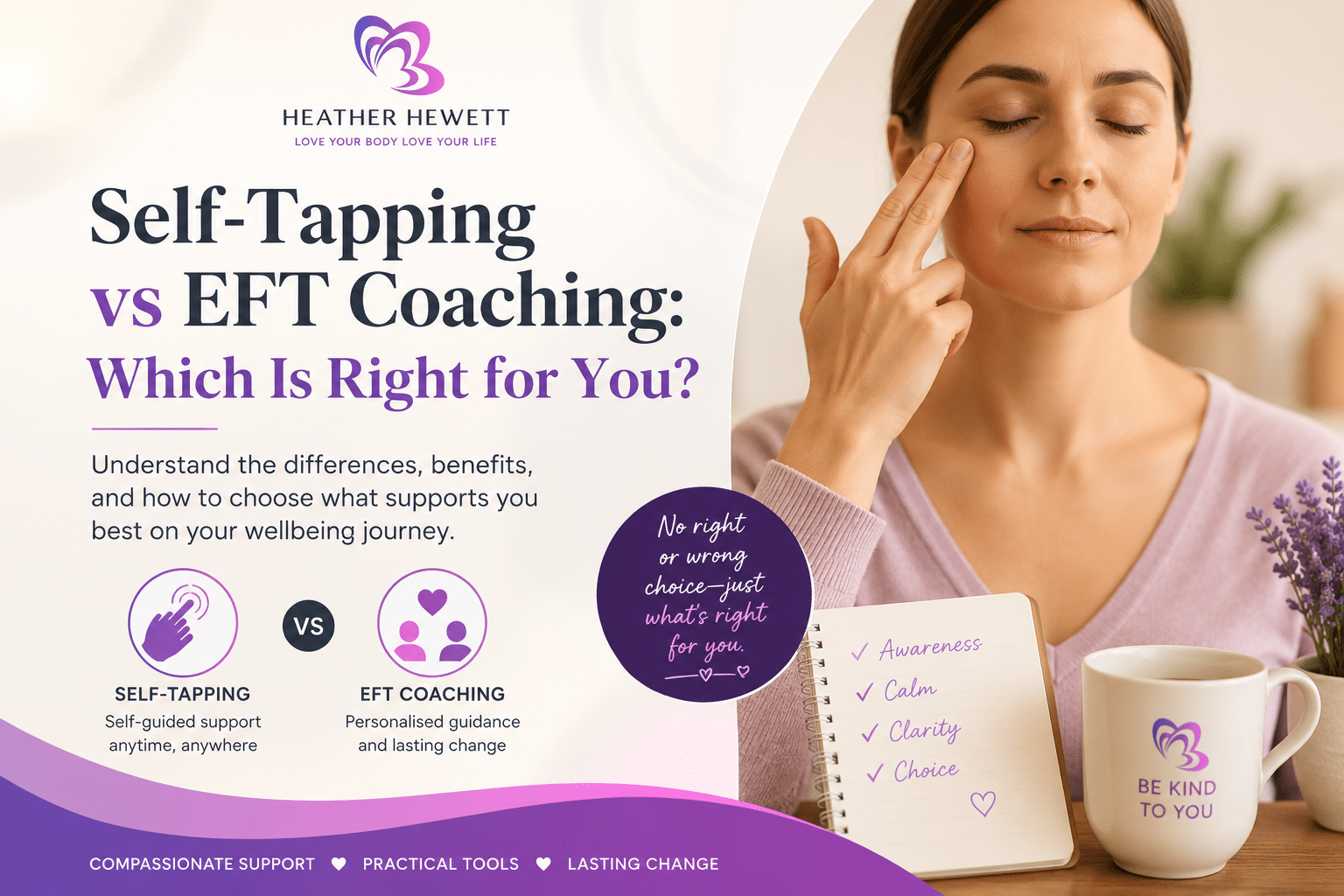
Self-tapping is a self-guided EFT practice that may be useful for familiar everyday stress, emotional check-ins, and mild cravings. EFT coaching offers personalised guidance, pacing, reflection, and accountability when emotional patterns feel harder to explore alone. Both can be valuable. The right choice depends on your needs, goals, emotional intensity, and preferred level of support.
Stress, overwhelm, emotional eating, and food cravings can make it hard to feel connected to yourself.
You may know that a particular habit is not helping you feel better in the long term. Still, when you are tired, lonely, pressured, frustrated, or emotionally drained, the urge can feel strong.
This is often why people become curious about Emotional Freedom Techniques, also known as EFT tapping.
You may be asking:
- Can I do EFT tapping on my own?
- Is self-tapping enough for stress or cravings?
- What does an EFT coach actually do?
- Is EFT coaching different from therapy?
- Can I use self-tapping and guided coaching together?
The answer is not the same for everyone.
Self-tapping can be a practical self-care tool for simple and familiar emotional experiences. EFT coaching may offer more personalised support when patterns feel repetitive, emotionally intense, or difficult to understand alone.
Neither option is automatically better. Both can have a place in a compassionate wellbeing routine.
What Is Self-Tapping?
Self-tapping, also called self-guided EFT, is the practice of using Emotional Freedom Techniques on your own.
EFT usually involves gently tapping with your fingertips on specific points on the hand, face, and upper body while focusing on a thought, feeling, craving, stressful situation, or body sensation.
You may use a simple setup statement or reminder phrase while tapping.
Examples of Self-Tapping Statements
You might say:
- “Even though I feel tense about this conversation, I can pause for a moment.”
- “This craving feels strong right now.”
- “Part of me wants comfort after a difficult day.”
- “I feel overwhelmed, and I am willing to notice what I need.”
- “I do not have to solve everything at this moment.”
The purpose is not to force yourself to feel positive.
Instead, self-tapping can help you slow down, notice your emotional state, and respond with more awareness and less judgment.
When People May Use Self-Tapping
Self-tapping may be useful for:
- Stress before a meeting, appointment, or phone call
- Feeling tense after a busy day
- Mild nervousness or self-doubt
- A familiar emotional trigger
- A manageable food craving
- A calming evening routine
- A brief pause before reacting automatically
Some people find that tapping helps them create a small gap between an emotion and their next action.
For example, instead of immediately reaching for food after a difficult day, you may pause, tap, and notice whether you are hungry, exhausted, lonely, overstimulated, or simply needing comfort.
For more information about tapping and cravings, read Can EFT Help Cravings?.
What Is EFT Coaching?
EFT coaching is personalised guidance that uses Emotional Freedom Techniques within a broader wellness-support conversation.
Instead of deciding what to tap on by yourself, you work with an EFT coach to identify a manageable focus, create tapping language that feels honest, notice emotional responses, and explore practical next steps.
What Happens During an EFT Coaching Session?
An EFT coaching session may include:
- Talking about what feels difficult right now
- Identifying a specific thought, craving, emotion, situation, or body response
- Exploring emotional triggers and repeating patterns
- Creating personalised tapping statements
- Tapping together at a manageable pace
- Pausing to notice thoughts, emotions, urges, and body sensations
- Discussing grounding tools and supportive next steps
A coach may help you notice patterns that are difficult to see when you are in the middle of them.
For example, you may believe that your evening cravings are only about food. Over time, you may notice that the cravings often appear after conflict, overwork, loneliness, lack of rest, or pressure to be perfect.
EFT coaching is not psychotherapy, diagnosis, trauma treatment, or medical care. It is wellness and personal-support guidance.
Heather’s online EFT coaching for stress, cravings, and emotional patterns provides personalised support for people who want guided tapping, emotional regulation tools, somatic awareness, and compassionate coaching.
Self-Tapping vs EFT Coaching: Key Differences
| Area | Self-Tapping | EFT Coaching |
| Who guides the process | You guide yourself. | A coach helps guide the process. |
| Best suited to | Familiar, everyday stressors and emotional check-ins. | Repeating patterns, confusion, cravings, overwhelm, or goals needing structure. |
| Personalisation | You choose your own words and focus. | Tapping language and pacing are adapted to your experience. |
| Flexibility | Can be practised anytime, often in a few minutes. | Sessions are scheduled and more structured. |
| Cost and access | Usually free after learning the basics. | Requires an investment in personalised support. |
| Accountability | Depends on your own consistency. | A coach may provide reflection, encouragement, and structure. |
| Emotional intensity | Often best for mild or familiar emotions. | May feel more supportive when emotions are repetitive, confusing, or layered. |
| Pattern identification | You notice patterns independently over time. | A coach may help identify emotional triggers and habit loops. |
| Boundaries and referrals | You decide when to pause or seek more support. | A responsible coach can clarify when therapy, medical care, or another professional may be more appropriate. |
| Role in self-care | Can become a regular wellbeing practice. | Can help you use self-tapping with more confidence between sessions. |
When Self-Tapping May Be a Good Starting Point
Self-tapping may be a helpful first step when your emotional experience feels familiar and manageable.
1. You Feel Stressed Before a Meeting
You may use a short tapping sequence before a presentation, important call, or difficult conversation.
A simple phrase could be:
“I feel nervous about this, and I can take one step at a time.”
2. You Feel Tense After a Difficult Day
Tapping may offer a gentle transition between work, responsibilities, and rest.
You do not need to explain or solve everything. You may simply notice:
“Today was a lot. I am allowed to pause.”
3. You Want a Simple Daily Wellbeing Ritual
Some people use self-tapping in the morning, before bed, or during a lunch break as part of mindful self-care.
4. You Are Practising a Familiar EFT Sequence
Once you know a sequence that feels supportive, self-guided tapping can become easier to use independently.
5. You Notice a Mild Craving
You may pause before acting on a craving and ask yourself:
- What am I feeling right now?
- What happened before this urge appeared?
- Is my body asking for food, rest, comfort, or a break?
- What would feel supportive in this moment?
6. You Want to Build Emotional Awareness
Self-tapping can become a regular practice for noticing emotional triggers, body sensations, and habitual responses without blaming yourself.
7. You Want Support Between Coaching Sessions
Many people use self-tapping between sessions to practise personalised phrases and reinforce what they are learning.
When EFT Coaching May Be More Supportive
EFT coaching may be worth considering when self-tapping feels too broad, inconsistent, or difficult to use alone.
1. You Keep Returning to the Same Emotional Eating Pattern
You may notice the same cycle repeating:
- Stress, loneliness, boredom, or pressure appears.
- A food craving becomes intense.
- Eating brings short-term relief.
- Guilt or self-criticism follows.
- The cycle repeats.
Understanding the emotional eating cycle can be a helpful first step.
2. Your Cravings Feel Connected to Stress or Overwhelm
Cravings are not always about hunger alone.
They may be connected to fatigue, stress, emotional overload, unmet needs, irregular eating, loneliness, or old habit loops.
If this feels familiar, emotional eating and food cravings coaching may offer more targeted support.
3. You Know the Trigger but Still Feel Stuck
It is possible to understand a pattern intellectually and still struggle in the moment.
A coach can help you work with the emotional experience beneath the habit rather than only trying to control the behaviour.
4. You Are Unsure What to Tap On
Many people know the tapping points but are uncertain about what to say.
Guided EFT can help you find language that feels more specific, honest, and manageable.
5. You Want More Structure and Accountability
A regular session can create space to reflect, practise, and return to your priorities.
Accountability does not need to be harsh. It can be gentle, supportive, and practical.
6. Your Emotional Responses Feel Repetitive or Confusing
You may notice that a small event creates a much stronger emotional response than expected.
A coach may help you slow down and explore the pattern with care, without assuming that there is something wrong with you.
7. Self-Tapping Feels Inconsistent
You may like tapping but forget to use it when you need it most.
Coaching can help you create a realistic, personalised practice that fits your routine.
8. You Want a More Personalised Approach
A personalized approach may include tapping, emotional awareness, nervous-system support, nutrition guidance, grounding practices, and practical coping tools.
Can You Use Self-Tapping and EFT Coaching Together?
Yes. Many people use both self-tapping and EFT coaching.
Coaching can help you build confidence with self-guided EFT. You may leave a session with personalized tapping phrases, a better understanding of your triggers, and a simple practice to use during stressful moments.
A Combined Approach May Look Like This
You might:
- Use self-tapping before a stressful event.
- Bring recurring emotional patterns into your next coaching session.
- Practice personalised phrases between sessions.
- Use guided coaching to understand why the same craving keeps returning.
- Pair tapping with rest, nourishment, movement, journaling, or grounding practices.
The purpose of coaching is not to make you dependent on a practitioner.
Supportive guidance can help you build emotional awareness, practical coping tools, and confidence in your own self-care.
For people who feel constantly overwhelmed or disconnected from their body, nervous-system regulation coaching may also be relevant.
How EFT May Relate to Emotional Eating and Food Cravings
Emotional eating is not a lack of discipline.
Food can become connected to comfort, reward, relief, distraction, grounding, or routine. When life feels demanding, food may be one of the fastest and most familiar ways to cope.
That does not mean food is the problem.
It may mean that your body and mind are looking for relief in a familiar way.
A Compassionate Approach to Cravings
A supportive approach may include:
- Recognising emotional triggers
- Noticing body sensations before eating
- Creating a pause before responding to an urge
- Exploring regular nourishment patterns
- Building additional coping tools
- Reducing all-or-nothing thinking
- Responding with curiosity instead of shame
You may also find it helpful to explore emotional eating solutions that actually work and how to break the cycle of emotional eating.
What Does Research Say About EFT?
Research on EFT is still developing.
Some studies and reviews suggest that EFT may support reduced anxiety symptoms and may have potential value for food cravings in some groups. However, research quality varies, participant experiences differ, and EFT should not be presented as a guaranteed solution for stress, cravings, or emotional eating.
EFT may be a supportive wellness tool for some people. It should be explored alongside appropriate medical, nutrition, and mental-health support when needed.
A Simple Decision Guide: Which Option May Fit You?
Self-Tapping May Be a Useful First Step When:
- You want a simple tool for everyday stress.
- You are practising a familiar tapping sequence.
- Your emotional intensity feels manageable.
- You want a daily self-care practice.
- You feel comfortable reflecting on your emotions independently.
- You are using EFT between sessions or alongside other support.
EFT Coaching May Be Worth Considering When:
- You feel stuck in the same emotional pattern.
- You are unsure what to tap on or how to begin.
- Cravings feel intense, repetitive, or emotionally confusing.
- You want accountability and personalised guidance.
- You want help identifying emotional triggers and habit loops.
- Self-tapping feels too general or difficult to maintain.
- You want a more structured approach to stress, cravings, or emotional eating.
Both options can have value.
If you are considering paid support, you can also review the EFT coaching cost and what to expect from a session.
You may begin with self-tapping and later explore coaching. You may work with a coach while continuing to use tapping independently. The best choice is the one that feels safe, supportive, and appropriate for your current needs.
EFT Coaching, Therapy, and Medical Care: Important Differences
EFT coaching is a wellness and personal-support service.
It may include tapping, emotional awareness, grounding, somatic reflection, nervous-system support, and practical wellbeing tools.
Therapy is different. Therapy is provided by appropriately licensed mental-health professionals and may be more appropriate if you need diagnosis, trauma treatment, eating-disorder treatment, or clinical mental-health care.
Medical care is appropriate for physical-health concerns, medication questions, diagnosis, and clinical assessment.
When to Seek Additional Professional Support
Please seek qualified professional help promptly if you are experiencing:
- Severe or worsening emotional distress
- Trauma symptoms that feel overwhelming
- Regular binge eating, purging, restrictive eating, or another eating-disorder concern
- Severe anxiety, depression, panic, or dissociation
- Thoughts of self-harm, suicide, or feeling unsafe
If you are in immediate danger or thinking about harming yourself, contact your local emergency service or crisis line immediately.
Please review Heather’s wellness coaching disclaimer for important service boundaries.
Bottom Line: Self-Tapping vs EFT Coaching
When comparing self-tapping vs EFT coaching, neither option is automatically better.
Self-tapping can be a useful everyday practice for familiar stress, emotional check-ins, and manageable cravings.
EFT coaching may offer more personalised support when emotional patterns feel repetitive, intense, or difficult to explore alone.
The best next step is one that feels safe, realistic, and supportive for where you are now.
Looking for More Personalised Support?
You do not have to figure out every emotional pattern alone.
If stress eating, cravings, overwhelm, or repeating emotional habits are taking up a lot of space in your life, personalized guidance may help you feel more supported and clear about your next steps.
Explore online EFT coaching to see whether Heather’s approach feels right for you.
You can also begin with Start Here to explore the support options that best fit your needs.
Helpful Resources and Next Steps
You may also find these resources helpful:
Disclaimer
This article is for educational and wellness-support purposes only. It is not medical advice, psychotherapy, diagnosis, or treatment. Consult an appropriately qualified healthcare or mental-health professional for individual medical, nutritional, or psychological needs.
Frequently Asked Questions
Is self-tapping the same as EFT coaching?
No. Self-tapping is when you use EFT independently. EFT coaching involves personalised guidance from a coach who can help you choose a focus, create relevant tapping language, notice patterns, and decide on supportive next steps.
Can I do EFT tapping on my own?
Yes. Many people use self-guided EFT for everyday stress, emotional check-ins, mild cravings, and calming routines. It may be most suitable when the issue feels familiar and emotionally manageable.
When is self-tapping enough?
Self-tapping may be enough when you are working with simple, familiar stressors and can remain grounded while practising. It can also be useful between coaching sessions or alongside other supportive care.
When should I consider working with an EFT coach?
Consider coaching when you feel stuck in recurring emotional patterns, want more accountability, are unsure what to tap on, or want personalised support for stress, cravings, overwhelm, or emotional eating.
Can I use self-tapping between EFT coaching sessions?
Yes. Many people use self-tapping between sessions to practise personalised phrases, pause during stressful moments, and become more confident using EFT independently.
Can EFT coaching help with emotional eating or cravings?
EFT coaching may support awareness of emotional triggers, stress-related cravings, habit loops, and self-critical thoughts. It is not a guaranteed solution, but some people find it helpful as part of a compassionate, non-diet wellbeing approach.
Is EFT coaching the same as therapy?
No. EFT coaching is not psychotherapy, diagnosis, trauma treatment, or medical care. Therapy is provided by appropriately licensed mental-health professionals.
What happens during an online EFT coaching session?
A session may include a focused conversation, choosing one manageable issue, guided tapping, noticing body sensations and emotions, and discussing practical next steps. You should remain in control of your pace and level of sharing.
What should I do if tapping brings up strong emotions?
Pause the practice. Ground yourself by noticing your surroundings, slowing your breathing, drinking water, or contacting a trusted person. Seek support from a licensed mental-health professional if emotions feel overwhelming, unsafe, or difficult to manage.
Do I need previous EFT experience before booking coaching?
No. Beginners can work with an EFT coach. A coach can explain basic tapping points, help you choose a manageable focus, and guide the process at a comfortable pace.