
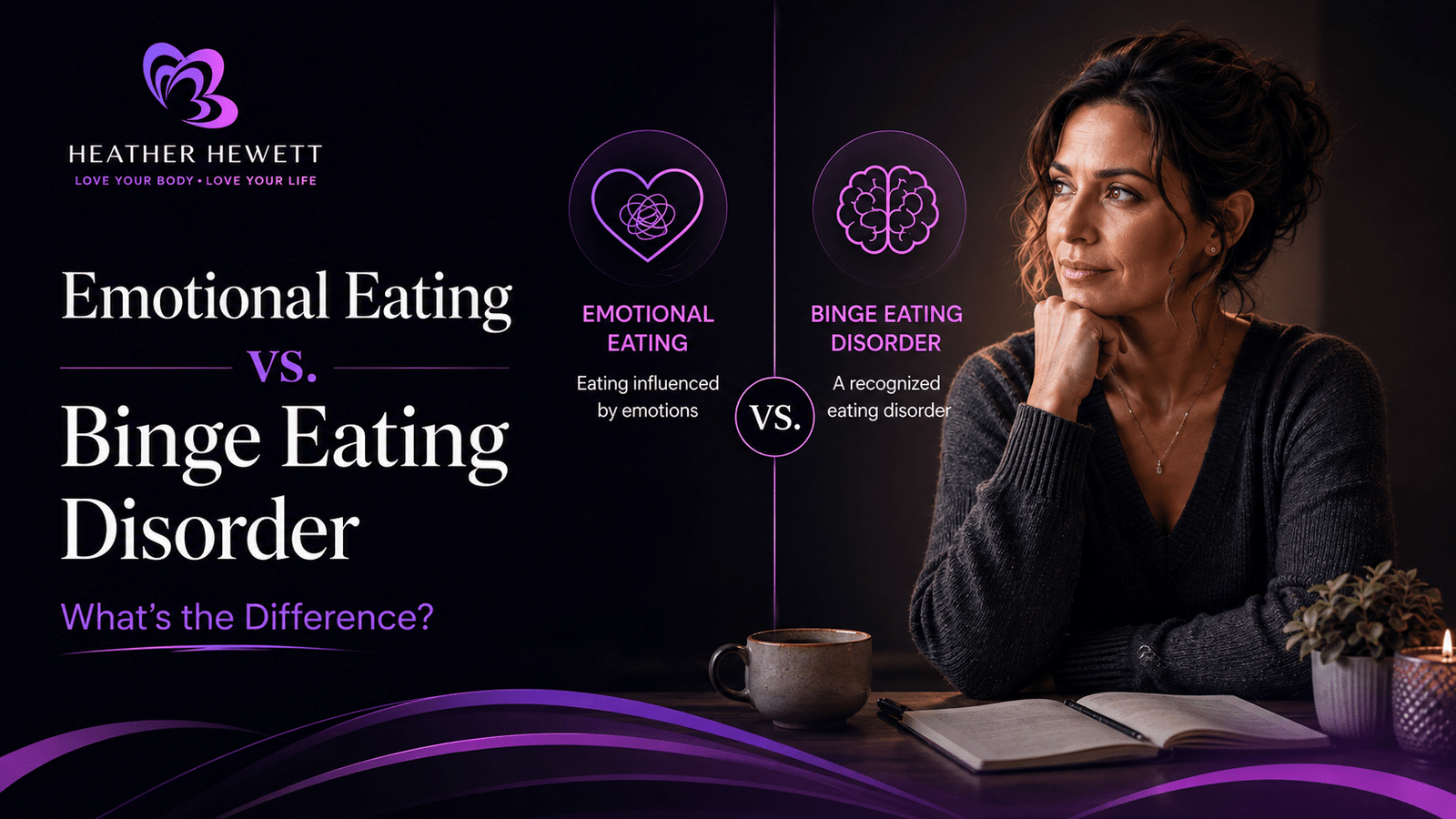
Emotional eating and binge eating disorder are not the same. Emotional eating means eating in response to emotions rather than physical hunger and is not itself a clinical diagnosis. Binge eating disorder, or BED, is a recognized eating disorder involving recurrent binge episodes, loss of control, marked distress, and other diagnostic criteria.
Both can involve stress, cravings, eating without physical hunger, and difficult feelings around food. The most important differences involve loss of control, recurrence, distress, amount eaten, and the broader clinical pattern.
If hunger itself feels difficult to interpret, learning the difference between emotional hunger and physical hunger can provide helpful context.
Emotional Eating vs. Binge Eating Disorder at a Glance
The table below summarizes the main differences between emotional eating and BED.
| Comparison Factor | Emotional Eating | Binge Eating Disorder |
| What it is | Eating influenced by emotions, stress, comfort, or coping | A recognized eating disorder involving recurrent binge episodes |
| Clinical diagnosis | No | Yes |
| Emotional triggers | Often present | Can occur, but are not required |
| Physical hunger required | No | No |
| Loss of control | May or may not occur | Central to binge episodes |
| Amount eaten | Can vary | Binge episodes involve an unusually large amount in context |
| Frequency | Can be occasional or recurring | A recurrent pattern is required |
| Marked distress | Not required | An important diagnostic feature |
| Eating rapidly | Can occur | May be an associated feature |
| Eating beyond fullness | Can occur | May be an associated feature |
| Eating privately | Can occur | May occur because of embarrassment or distress |
| Daily-life impact | Varies | Can significantly affect well-being and daily life |
| Compensatory behaviors | Not part of the definition | Recurrent compensatory behaviors typical of bulimia are not part of BED |
| Professional diagnosis | Not required | Requires professional assessment |
The American Psychiatric Association describes binge eating as consuming an unusually large amount of food within a relatively short period while experiencing a sense of loss of control.
Key Takeaway
The biggest difference is not simply how much food someone eats. Loss of control, recurrence, marked distress, associated symptoms, and diagnostic context provide a much clearer distinction between emotional eating and BED.
The Biggest Difference Between Emotional Eating and Binge Eating Disorder
Loss of control is one of the most important differences between emotional eating and binge eating disorder.
Someone experiencing emotional eating may eat for comfort, eat without clear physical hunger, or eat more than planned while still feeling aware of their choices and able to stop.
During a binge episode associated with BED, loss of control is a central feature. A person may feel unable to control what or how much they are eating during the episode.
This is why asking only, “How much did I eat?” does not provide enough information.
A fuller comparison considers:
- whether loss of control occurred
- whether the amount was unusually large for the situation
- whether episodes recur
- whether the eating causes marked distress
- whether associated symptoms are present
- whether another eating disorder better explains the pattern
Eating beyond comfortable fullness once, having a larger meal during a celebration, or using food for comfort after stress does not by itself establish BED.
Emotional Eating vs. Binge Eating Disorder: 6 Key Differences
1. Loss of Control
Emotional eating does not require loss of control, while binge episodes in BED do.
Someone may eat after a stressful day, choose food for comfort, or continue eating longer than planned while still feeling capable of stopping.
A binge episode involves a sense that eating is difficult or impossible to control during that period.
If you frequently notice yourself eating when you are not hungry, several factors may be involved, including emotions, stress, boredom, habits, cravings, and environmental cues.
Eating without physical hunger alone does not establish BED.
2. Amount of Food
Emotional eating can involve small or large amounts of food, while a binge episode involves an unusually large amount in context.
Emotional eating may involve a snack for comfort, an additional serving, or continuing to eat after physical hunger has decreased.
For BED, however, the amount eaten during a binge episode is considered together with loss of control and other diagnostic features.
Quantity alone cannot diagnose BED.
For example, someone may eat a larger meal after going many hours without adequate nourishment. That experience has a different context from a recurrent loss-of-control binge episode.
Learning to recognize true hunger signs may help clarify how physical hunger, cravings, habits, and emotional cues interact.
3. Emotional Triggers
Emotional triggers can occur in both emotional eating and binge eating disorder.
Stress, sadness, loneliness, anxiety, frustration, boredom, fatigue, and overwhelm can influence eating.
The guide to emotional eating triggers explores several common patterns that can contribute to emotionally influenced eating.
Emotions can also precede binge episodes in people with BED.
A peer-reviewed review in the Journal of Eating Disorders found overlap between emotional eating and BED in areas such as emotion regulation and inhibitory control.
The distinction is therefore not:
Emotional trigger = emotional eating
No emotional trigger = BED
Instead, emotional triggers may occur in both. BED is distinguished by the wider clinical pattern.
Stress can also influence appetite, cravings, emotional regulation, and coping. The guide on why stress can lead to binge-like eating patterns explores this connection in more detail.
4. Frequency and Recurrence
Emotional eating can be occasional or recurring, while BED requires a recurrent binge-eating pattern.
Someone may eat emotionally during an unusually stressful week without experiencing the same pattern regularly.
For others, repeated emotional eating can become part of a cycle in which difficult feelings lead to food, food provides temporary relief, and frustration afterward contributes to the next episode.
The guide to the emotional eating cycle explains how repeated patterns can develop.
BED requires recurrence as part of its diagnostic criteria.
The American Psychiatric Association describes BED as involving binge episodes that occur, on average, at least once a week for three months, along with additional diagnostic features.
That frequency should not be used as a self-diagnosis tool. A qualified professional considers the complete pattern.
5. Distress and Daily-Life Impact
Marked distress is part of BED, while emotional eating does not require significant distress.
Emotional eating may sometimes lead to frustration, disappointment, or regret.
Those feelings can matter, but they do not automatically indicate an eating disorder.
With BED, marked distress about recurrent binge eating is an important part of the clinical picture.
Eating concerns may also begin affecting:
- relationships
- mood
- concentration
- routines
- social activities
- thoughts about food
- overall quality of life
Someone can struggle with food without having BED. The guide on healing your relationship with food explores food guilt, cravings, hunger cues, restriction, and emotional eating from a broader wellness perspective.
6. Clinical Diagnosis
Emotional eating is not a standalone eating disorder diagnosis, while BED is.
Emotional eating describes an eating pattern or motivation. It may occur occasionally, frequently, with an eating disorder, or without one.
BED is diagnosed using a specific combination of symptoms and behavioral patterns.
The American Psychiatric Association identifies features such as recurrent binge episodes, loss of control, marked distress, associated symptoms, frequency, and the absence of recurrent compensatory behaviors characteristic of bulimia nervosa.
Online information can clarify these concepts, but it cannot diagnose BED.
What Do Emotional Eating and Binge Eating Disorder Have in Common?
Emotional eating and BED can share several features, even though they are not the same.
Both may involve:
- emotional triggers
- stress
- eating without clear physical hunger
- strong food cravings
- eating beyond fullness
- using food as a coping response
- difficulty regulating emotions
- uncomfortable feelings around eating
Research in the Journal of Eating Disorders has identified similarities involving emotion regulation and inhibitory control.
These similarities are important because emotional eating and BED should not be presented as completely unrelated.
At the same time, shared triggers do not make them clinically identical.
Emotional eating solutions explore strategies related to triggers, regular nourishment, mindful awareness, stress recovery, and self-compassion.
Key Takeaway
Emotional eating and BED may share triggers and coping patterns, but BED involves recurrent binge episodes with loss of control and marked distress.
Emotional Eating vs. Binge Eating: Simple Examples
Example 1: Emotional Eating
Someone has a stressful day and reaches for a favorite snack even though they are not physically hungry.
They eat more than originally planned but remain aware of their choices and feel able to stop.
This could illustrate emotional eating or overeating. It does not by itself describe BED.
The guide on how to approach emotional eating without restrictive dieting provides additional context for this type of pattern.
Example 2: Binge Eating Pattern
Someone repeatedly experiences episodes involving an unusually large amount of food within a relatively short period and feels unable to control their eating during the episode.
The pattern repeatedly causes significant distress.
These characteristics are closer to what professionals assess when considering BED.
The National Institute of Mental Health provides additional information about BED symptoms and eating disorder care.
Example 3: Why the Difference Is Not Always Obvious
Someone eats when overwhelmed, sometimes continues beyond fullness, occasionally feels that stopping is difficult, and experiences significant worry afterward.
That description alone cannot determine whether the pattern represents emotional eating, overeating, loss-of-control eating, BED, or another concern.
Examples can help explain patterns, but they cannot diagnose binge eating disorder.
Emotional Eating vs. Overeating vs. Binge Eating Disorder
Emotional eating, overeating, and BED describe different aspects of eating behavior.
| Factor | Emotional Eating | Overeating | Binge Eating Disorder |
| Main feature | Eating influenced by emotions | Eating more than intended or beyond comfortable fullness | Recurrent clinical binge episodes |
| Emotional trigger required | Yes, by definition | No | No |
| Loss of control required | No | No | Yes |
| Unusually large amount required | No | Not necessarily | Yes during a binge episode |
| Recurring pattern required | No | No | Yes |
| Marked distress required | No | No | Yes |
| Clinical diagnosis | No | No | Yes |
Emotional Eating
Emotional eating describes why eating is happening.
The motivation may involve stress, comfort, boredom, sadness, frustration, or another emotional state.
Overeating
Overeating describes how much was eaten relative to intention or comfort.
Someone may overeat during a celebration, restaurant meal, holiday, or after going too long without enough food.
Binge Eating Disorder
BED describes a diagnosable pattern involving recurrent binge episodes with loss of control, marked distress, and other clinical criteria.
One eating experience can contain elements of more than one category.
Is Emotional Eating an Eating Disorder?
No. Emotional eating is not itself an eating disorder.
Eating for comfort or in response to emotions can be part of normal human eating.
Food can serve emotional, cultural, social, and pleasurable roles in addition to meeting physical nutrition needs.
Emotional eating may deserve more attention when it becomes persistent, distressing, difficult to manage, or begins interfering with everyday life.
Even then, emotional eating alone does not establish an eating disorder diagnosis.
Readers who notice a connection between difficult experiences and eating may also find The Guide to trauma and emotional eating helpful.
Can Emotional Eating Turn Into Binge Eating Disorder?
Emotional eating does not automatically turn into binge eating disorder.
The two experiences can overlap, particularly in emotional regulation, stress, coping, and food-related urges.
However, current research does not establish that emotional eating inevitably develops into BED.
What Research Shows
A peer-reviewed Journal of Eating Disorders review examined whether emotional eating and BED might exist along a continuum.
The researchers found similarities between the two, especially in emotion regulation and inhibitory control, but the available research was not sufficient to confirm a simple continuum.
This means it would be inaccurate to say:
“Emotional eating is the first stage of BED.”
It would also be inaccurate to say:
“People who emotionally eat will eventually develop BED.”
Key Takeaway
Association does not mean inevitable progression.
Someone experiencing increasing loss of control, recurrent binge episodes, or significant distress may still benefit from professional evaluation.
Stress Eating vs. Binge Eating
Stress eating is emotionally influenced eating triggered by stress, while BED is a clinical eating disorder.
Stress eating may involve:
- comfort eating after a demanding day
- cravings during emotional pressure
- automatic snacking
- eating when physical hunger is unclear
- eating as a way to temporarily cope
Stress can also trigger binge episodes in people with BED.
The presence of stress therefore does not distinguish the two.
The more important distinction is whether recurrent binge episodes involve loss of control, marked distress, and other diagnostic features.
The resource on why stress can lead to binge-like eating patterns explores this relationship further.
Emotional Hunger vs. Physical Hunger
Emotional hunger is usually connected to feelings or circumstances, while physical hunger originates from the body’s need for nourishment.
Physical hunger often develops gradually and may include:
- stomach sensations
- reduced energy
- increasing interest in food
- difficulty concentrating
- physical feelings of emptiness
Emotional hunger may appear suddenly and may feel connected to:
- stress
- boredom
- sadness
- frustration
- loneliness
- comfort
- a specific craving
The distinction is not always perfect.
Someone can feel physically hungry and emotionally overwhelmed at the same time.
For more detail, see emotional hunger vs physical hunger and the guide to true hunger.
Binge Eating at Night vs. Binge Eating Disorder
Eating a large amount at night does not automatically mean someone has BED.
Nighttime eating can be influenced by:
- stress
- fatigue
- restrictive eating earlier in the day
- skipped meals
- inadequate nourishment
- habits
- emotional coping
BED depends on the overall pattern, particularly recurrent binge episodes involving loss of control and marked distress.
The guide to binge-like eating at night explores several factors that can contribute to evening eating.
Binge Eating Disorder vs. Bulimia Nervosa
BED and bulimia nervosa are different eating disorders, although both can involve binge eating.
A major distinction involves compensatory behaviors.
Bulimia nervosa involves recurrent behaviors intended to compensate after binge eating.
BED does not involve the recurring compensatory pattern characteristic of bulimia.
The American Psychiatric Association provides additional information about this distinction in its eating disorders overview.
Can Someone Have Binge Eating Disorder at Any Body Size?
Yes. BED can occur in people across body sizes.
Body weight or appearance cannot determine whether someone has BED.
The National Institute of Mental Health explains that eating disorders can affect people across body weights and that someone who appears physically healthy can still experience an eating disorder.
Professional assessment focuses on eating behavior, loss of control, recurrence, distress, and other diagnostic criteria rather than appearance.
When Might It Be Helpful to Talk With a Professional?
Professional support may be helpful when eating patterns repeatedly feel out of control, cause significant distress, or interfere with everyday life.
Concerns worth discussing may include:
- recurring loss of control while eating
- recurrent binge episodes
- persistent distress about eating
- secretive eating that causes concern
- food-related thoughts taking up substantial mental space
- repeated eating patterns that feel difficult to understand
- eating concerns interfering with relationships or daily activities
- concerns about a possible eating disorder
These experiences do not automatically mean someone has BED.
A qualified healthcare or mental health professional can assess the full pattern and help determine appropriate next steps.
How Emotional Eating and BED May Be Addressed Differently
Because emotional eating and BED are not the same, support may also look different.
Support for Emotional Eating
For emotional eating outside a diagnosed eating disorder, support may focus on:
- identifying emotional triggers
- developing additional coping strategies
- understanding hunger and fullness cues
- supporting regular nourishment
- reducing rigid thinking about food
- emotional awareness
- stress management
- nervous system regulation
- sustainable wellness habits
For readers interested in cravings and stress-related coping, also discusses EFT and cravings and EFT tapping for emotional eating.
Support for Binge Eating Disorder
BED is a recognized eating disorder and requires appropriate clinical assessment.
Treatment may involve qualified healthcare, mental health, nutrition, or eating disorder professionals depending on the individual’s needs.
Holistic health coaching does not replace diagnosis or treatment for BED.
Holistic Support for Emotional Eating, Cravings, and Stress
Heather M Hewett’s online work focuses on wellness topics including emotional eating patterns, cravings, stress-related eating, nutrition habits, nervous system regulation, and resilience.
Readers interested in nutrition can explore clinical nutrition coaching.
For stress and emotional regulation support, learn more about nervous system regulation coaching.
For emotional eating and cravings, explore emotional eating and food cravings coaching.
These services focus on holistic wellness and should remain separate from clinical eating disorder diagnosis or treatment.
Frequently Asked Questions
Is emotional eating the same as binge eating disorder?
No. Emotional eating is eating influenced by emotions, while BED is a recognized eating disorder involving recurrent binge episodes, loss of control, marked distress, and other clinical criteria.
Is emotional eating an eating disorder?
No. Emotional eating is not a standalone eating disorder diagnosis. It can occur with or without an eating disorder.
What is the biggest difference between emotional eating and binge eating?
Loss of control is one of the biggest differences. Emotional eating can occur while someone still feels able to stop, while binge episodes in BED involve loss of control.
Can emotional eating turn into binge eating disorder?
Not necessarily. Emotional eating and BED can overlap, but current research does not show that emotional eating inevitably progresses into BED.
Does emotional eating always involve overeating?
No. Emotional eating describes why someone is eating, not how much food they eat.
How is overeating different from binge eating disorder?
Overeating does not automatically involve loss of control or a recurrent clinical pattern. BED involves recurrent binge episodes with loss of control and marked distress.
Can emotional eating and BED happen together?
Yes. People with BED may also experience emotional or stress-related eating, but emotional triggers alone do not establish BED.
Does binge eating always happen because of emotions?
No. Emotional triggers can contribute to binge eating for some people, but they are not required for BED.
Can someone have BED at any body size?
Yes. BED can occur across body sizes, and appearance or weight cannot determine whether someone has the disorder.
Does binge eating disorder involve purging?
No, not as a recurring compensatory pattern. Recurrent compensatory behaviors are more characteristic of bulimia nervosa.
When should someone seek professional help for binge eating?
Professional support may be helpful when eating repeatedly feels out of control, causes significant distress, or interferes with everyday life.
Disclaimer
This article is for educational purposes only. It cannot diagnose binge eating disorder or another eating disorder and does not replace individualized medical, mental health, nutrition, or eating disorder care.