
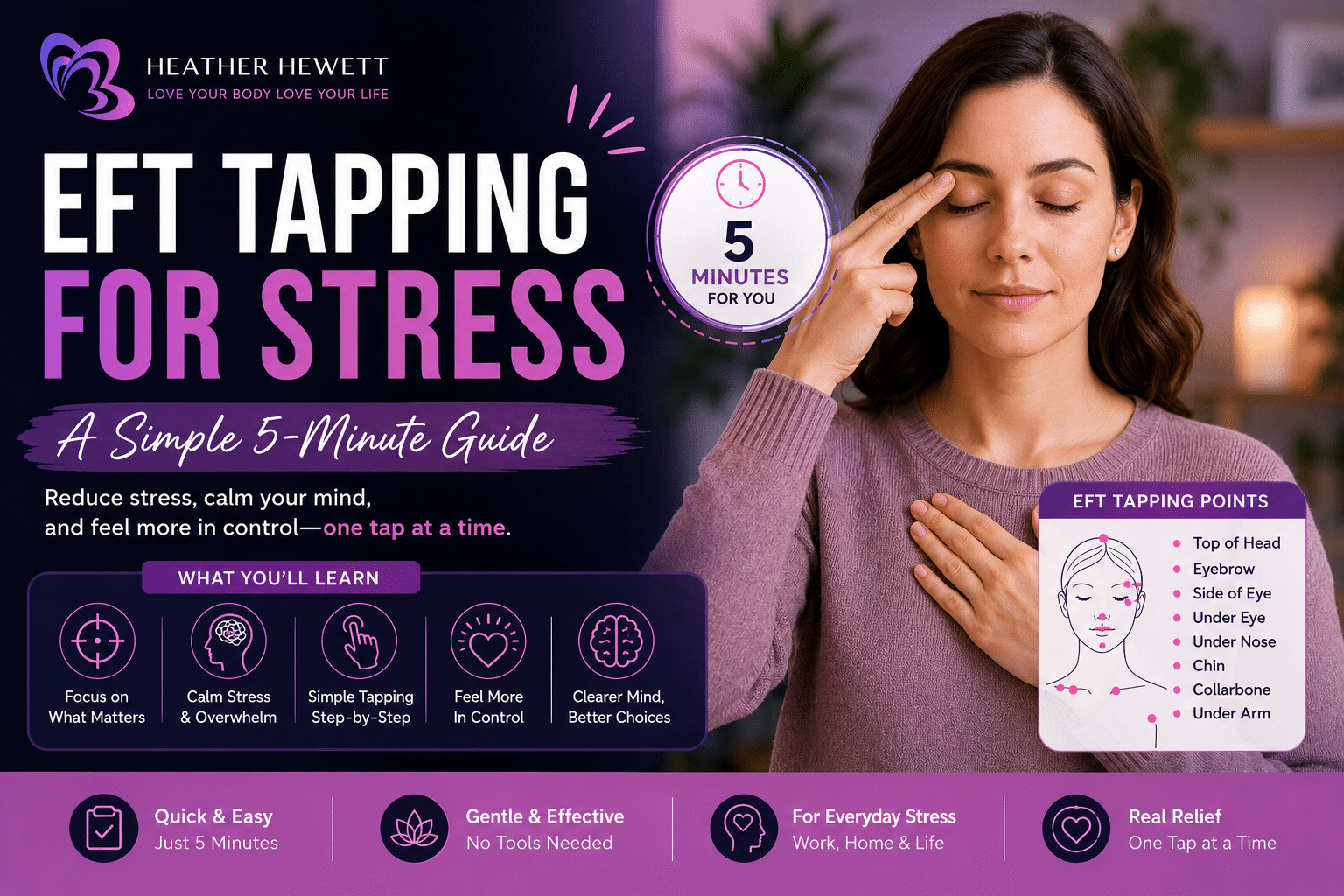
EFT tapping for stress is a simple self-guided practice that combines gentle fingertip tapping with attention to a current stressful thought, feeling, or body sensation. EFT stands for Emotional Freedom Techniques. Some people use it as a brief pause for everyday overwhelm, work pressure, racing thoughts, tension, or stress-related cravings. EFT does not involve needles, and it is different from acupuncture, psychotherapy, and Emotionally Focused Therapy. This guide explains how to try a five-minute routine, where to tap, what to say, and when to seek additional support.
Table of Contents
- What Is EFT Tapping for Stress?
- Can EFT Tapping Help With Stress?
- How to Do a 5-Minute EFT Tapping Routine for Stress
- EFT Tapping Points for Stress
- EFT Tapping Scripts for Different Types of Stress
- When EFT Tapping May Be Useful
- EFT Tapping vs Breathing, Meditation, Grounding, and Therapy
- Common EFT Tapping Mistakes to Avoid
- Is EFT Tapping Safe?
- When EFT Tapping May Not Be Enough
- 5-Minute EFT Tapping Checklist for Stress
- Frequently Asked Questions About EFT Tapping for Stress
What Is EFT Tapping for Stress?
EFT tapping is a mind-body practice that combines focused attention, verbal acknowledgment of a current feeling, and gentle tapping on selected points on the hands, face, and upper body.
Instead of forcing yourself to ignore stress or immediately think positively, EFT invites you to pause and notice what is happening. You may focus on a deadline, a difficult conversation, pressure at work, a tight feeling in your body, a racing mind, or an emotional eating urge.
The goal is not to make every difficult feeling disappear. For some people, EFT tapping may create a little more space between a stressful moment and their next reaction. That pause may make it easier to breathe, think more clearly, or choose one small supportive action.
EFT tapping is different from acupuncture because it does not involve needles. It is also different from Emotionally Focused Therapy, which is a form of psychotherapy delivered by trained mental-health professionals.
EFT tapping for stress is a self-guided practice that combines gentle tapping with honest attention to a stressful thought, feeling, or body sensation. Some people use it to pause during everyday overwhelm, tension, work pressure, or racing thoughts. It does not replace therapy, medical care, or licensed mental-health treatment.
For a deeper explanation of guided support, read What Is EFT Coaching? Benefits, Sessions & How It Works.
Can EFT Tapping Help With Stress?
Some people use EFT tapping because it may help them feel less emotionally intense, more present, or better able to pause before reacting. However, results vary, and EFT should not be presented as a guaranteed solution for stress, anxiety disorders, trauma, depression, panic symptoms, or medical conditions.
Research into EFT is still developing. A systematic review and meta-analysis published in PubMed found that EFT was associated with reduced anxiety scores across the studies included. However, anxiety and everyday stress are not identical, and research designs, participant groups, and EFT protocols varied.
A balanced approach is to view EFT as one possible complementary wellness tool. It may be used alongside sleep, movement, nutrition, supportive relationships, practical problem-solving, therapy, medical care, or other stress-management strategies.
You do not need to expect a dramatic shift. A more useful question may be:
“Does this practice help me feel even slightly more steady, present, or supported right now?”
To understand what personalized guidance may look like, explore What Happens in an EFT Session? Step-by-Step Guide.
How to Do a 5-Minute EFT Tapping Routine for Stress
This five-minute EFT tapping routine is designed for manageable, present-day stress. You do not need equipment or prior experience. You can use it at home, before a meeting, after a difficult conversation, or when your mind feels busy.
Step 1: Choose One Specific Stress Trigger
Choose one current issue that feels active right now.
Examples include:
- An upcoming deadline
- A difficult conversation
- A busy workday
- A long to-do list
- Stress before a presentation
- Racing thoughts before bed
- A stressful commute
- Feeling behind
- Feeling emotionally overloaded
- Stress-related cravings or emotional eating urges
Try not to tap on “everything in my life” at once. A specific focus usually feels more manageable.
For example:
“I feel stressed about tomorrow’s presentation.”
Or:
“I feel overwhelmed by the number of tasks waiting for me.”
Step 2: Rate Your Stress From 0 to 10
Ask yourself:
“On a scale from 0 to 10, how intense does this feel right now?”
This is a personal check-in, not a medical measurement.
For example:
“My stress about tomorrow’s presentation feels like an 8 out of 10.”
There is no right number. You are simply noticing your starting point.
Step 3: Begin With an EFT Setup Statement
Tap gently on the soft outer edge of one hand below the little finger. This is often called the side-of-the-hand point or karate chop point.
Repeat one setup statement three times.
- “Even though I feel overwhelmed by everything I need to do, I accept how I feel right now.”
- “Even though this deadline is making me tense, I am open to feeling a little calmer.”
- “Even though my mind keeps racing, I can pause and give myself a moment.”
- “Even though I cannot solve everything today, I can focus on the next small step.”
- “Even though I feel nervous before this meeting, I can stay present with myself.”
- “Even though stress is showing up in my body, I can slow down for one moment.”
You do not need to use these words exactly. Change every phrase until it feels honest, respectful, and natural for you.
Step 4: Tap Through the EFT Points
Using two or three fingertips, tap each point gently around five to seven times while repeating a short reminder phrase.
- Side of the hand: “This pressure I feel.”
- Eyebrow: “This tight feeling in my body.”
- Side of the eye: “So much to do.”
- Under the eye: “This racing mind.”
- Under the nose: “This stress right now.”
- Chin: “I can take one small pause.”
- Collarbone: “I do not have to solve everything at once.”
- Underarm: “I am open to feeling slightly calmer.”
- Top of the head: “I can meet this moment with more steadiness.”
Move at a comfortable pace. You can repeat the full sequence once or twice.
Step 5: Pause, Breathe, and Reassess
Stop tapping and take one slow, comfortable breath.
Ask yourself:
“Where is my stress number now?”
The goal is not always to move from an 8 to a 0. Moving from an 8 to a 6 may still give you enough breathing room to send an email, begin one task, rest, drink water, or respond more calmly.
If stress, cravings, emotional overwhelm, or repeated emotional patterns feel difficult to manage alone, Online EFT Coaching for Stress, Cravings, and Emotional Patterns offers personalized support for adults worldwide.
How Often Can You Use EFT Tapping for Stress?
There is no single schedule that everyone needs to follow for EFT tapping. For everyday stress, you can use a short tapping round when a specific stressful situation comes up, such as before a meeting, after a difficult conversation, or when you feel overwhelmed.
A short session of a few minutes may be enough to pause, notice what you are experiencing, and decide what you need next. You can repeat a round if it feels comfortable, but more tapping is not automatically better.
The most useful approach is to pay attention to how you respond. If tapping leaves you feeling more distressed, emotionally flooded, confused, or unsettled, stop and give yourself space. Persistent or severe stress that affects sleep, relationships, work, or daily life may need support beyond a self-guided practice.
Want More Personalized Support With Stress?
If stress feels persistent or difficult to manage with self-guided tools alone, personalized EFT or nervous system coaching can provide more structured support and help you explore an approach that fits your goals.
Explore Personalized EFT Coaching
Where to Tap During EFT Tapping
- Side of the hand: The soft outer edge of the hand below the little finger.
- Eyebrow: Near the beginning of the eyebrow, close to the bridge of the nose.
- Side of the eye: On the bone beside the outer corner of the eye.
- Under the eye: On the bone directly beneath the eye.
- Under the nose: Between the nose and upper lip.
- Chin: In the crease between the lower lip and chin.
- Collarbone: Just below the collarbone, near the upper chest.
- Underarm: On the side of the body, several inches below the armpit.
- Top of the head: The crown of the head.
You do not need to press hard. Gentle tapping is enough. If a point feels uncomfortable because of pain, skin sensitivity, or personal preference, skip it and continue with the next point.
EFT Tapping Scripts for Different Types of Stress
These scripts are flexible starting points. Use only the words that feel true. You can shorten, soften, or change any phrase.
EFT Tapping for Work Stress and Deadlines
Setup statement:
“Even though I feel pressured by everything on my plate, I can take this one step at a time.”
Reminder phrases:
- “This work pressure.”
- “So many tasks waiting.”
- “I feel behind.”
- “My body feels tense.”
- “I do not have to do everything at once.”
- “I can choose one next step.”
- “I can work with what is in front of me.”
- “A little more steadiness is enough for now.”
This script may be useful before opening your inbox, starting a difficult task, or returning from a stressful meeting.
EFT Tapping Before a Presentation, Interview, or Exam
Setup statement:
“Even though I feel nervous about being evaluated, I can stay present with myself.”
Reminder phrases:
- “These nerves.”
- “What if I make a mistake?”
- “I feel exposed.”
- “This pressure to do well.”
- “I can breathe through this moment.”
- “I do not need to be perfect.”
- “I can focus on one question at a time.”
- “I can bring my attention back to what matters.”
This script may be useful before a presentation, job interview, exam, public-speaking event, or important meeting.
EFT Tapping for Overwhelm and a Long To-Do List
Setup statement:
“Even though my mind feels crowded and I do not know where to start, I can choose one small step.”
Reminder phrases:
- “Too many things to think about.”
- “Too many decisions.”
- “I feel stuck.”
- “I do not know what to do first.”
- “I can pause before I push.”
- “I can make this smaller.”
- “One task is enough for now.”
- “I can begin where I am.”
This script may be helpful when your to-do list feels emotionally heavier than the tasks themselves.
EFT Tapping for Racing Thoughts Before Bed
Setup statement:
“Even though my mind keeps replaying the day, I can give myself permission to rest.”
Reminder phrases:
- “All these unfinished thoughts.”
- “I keep replaying everything.”
- “My body is tired.”
- “My mind is still working.”
- “I do not need to solve tomorrow tonight.”
- “I can let this day be complete enough.”
- “Rest is allowed.”
- “I can return to this tomorrow.”
Try this as part of a quiet bedtime routine. Keep the pace slow and gentle.
EFT Tapping After a Difficult Conversation
Setup statement:
“Even though that conversation left me feeling tense, I can give myself time before I decide what to do next.”
Reminder phrases:
- “This tension in my body.”
- “I feel misunderstood.”
- “I keep replaying what was said.”
- “A part of me feels upset.”
- “I do not need to respond immediately.”
- “I can make room for my feelings.”
- “I can come back to myself.”
- “I can choose my next step when I feel steadier.”
This script may be useful after a disagreement, workplace conflict, family tension, or difficult boundary-setting moment.
EFT Tapping for Stress-Related Cravings or Emotional Eating Urges
Setup statement:
“Even though this urge feels strong right now, I can pause and notice what I need.”
Reminder phrases:
- “This urge feels strong.”
- “A part of me wants comfort.”
- “I do not have to judge myself for this feeling.”
- “I can pause before I decide.”
- “I can notice what this moment is asking for.”
- “I can offer myself support.”
- “I can choose with more awareness.”
Stress-related cravings are not proof that you have failed. They may be a sign that something feels demanding, lonely, exhausting, or emotionally intense.
For a deeper discussion of tapping and cravings, read Can EFT Help Cravings? Science, Benefits & Tips.
When food-related patterns feel distressing, repetitive, or hard to manage, Emotional Eating & Food Cravings Coaching offers non-diet, shame-free wellness support.
When EFT Tapping May Be Useful
EFT tapping may be useful as a short pause in everyday situations, including:
- Before a meeting
- Before an interview or presentation
- During a busy workday
- Before responding to a difficult message
- When stress-related cravings appear
- When a to-do list feels overwhelming
- During a stressful commute
- When thoughts are racing before bed
- After a difficult conversation
- When you want a pause before reacting
EFT does not need to replace breathing, movement, rest, supportive relationships, therapy, medical care, or practical problem-solving. It can be one small part of a wider stress-management approach.
EFT Tapping vs Breathing, Meditation, Grounding, and Therapy
| Approach | What It Involves | May Be Helpful For | Typical Time | Professional Support |
| EFT tapping | Gentle tapping while focusing on a current thought, feeling, or stressor | Everyday tension, overwhelm, work pressure, emotional stress | 2 to 10 minutes | Optional for self-guided practice |
| Slow breathing | Slowing and lengthening the breath | A quick pause, physical tension, settling before a task | 1 to 5 minutes | Usually not required |
| Mindfulness meditation | Observing thoughts, breath, or sensations with attention | Present-moment awareness and mental clutter | 5 to 20 minutes | Optional |
| Grounding exercises | Bringing attention to the senses, surroundings, or physical contact with the environment | Feeling scattered, overwhelmed, or disconnected | 1 to 10 minutes | Usually not required |
| Therapy | Structured clinical support with a licensed professional | Persistent, severe, trauma-related, or life-disrupting distress | Varies | Provided by a licensed or qualified professional |
Is EFT Tapping the Same as Therapy?
No. EFT tapping is not the same as therapy. EFT may be used as a self-guided wellness practice or in a coaching setting. Therapy is clinical care provided by licensed mental-health professionals.
The American Psychological Association explains psychotherapy as professional psychological treatment that may help people address emotional, behavioral, and mental-health concerns.
For a more detailed comparison, read EFT Coaching vs Therapy: Which Is Right for You?.
Is EFT Tapping the Same as EMDR?
No. EFT tapping is not the same as EMDR.
EMDR is a structured psychotherapy approach often used for trauma-related concerns with trained clinical providers. The U.S. Department of Veterans Affairs overview of EMDR explains that it is a specific treatment approach for post-traumatic stress disorder.
EFT tapping is a separate wellness practice. It should not be treated as a replacement for trauma-focused therapy, licensed mental-health treatment, or emergency care.
Common EFT Tapping Mistakes to Avoid
You do not need to do EFT perfectly. These reminders can make the practice feel more useful and less pressured.
Trying to Address Every Problem at Once
Choose one manageable stressor. Tapping on “my whole life” can feel vague and overwhelming.
Using Words That Do Not Feel True
You do not have to repeat positive phrases that feel forced. Honest language usually feels more supportive.
Expecting Instant Results
Some people notice a shift quickly. Others do not. EFT is not a performance, and there is no correct emotional response.
Pushing Through Emotional Distress
Pause or stop if the practice becomes too intense. You do not need to force yourself through difficult emotions.
Treating EFT as a Replacement for Professional Care
EFT may be a complementary wellness practice, but it is not a replacement for medical care, psychotherapy, addiction treatment, eating-disorder treatment, or licensed mental-health support.
Ignoring Ongoing Symptoms
Persistent sleep problems, severe emotional overwhelm, panic-like symptoms, chronic stress, or distress that affects daily life may require more support than self-guided tapping alone.
Is EFT Tapping Safe?
EFT tapping is commonly presented as a gentle self-guided practice for manageable everyday stress. However, people respond differently to emotional practices.
Pause or stop if tapping makes you feel more distressed, confused, emotionally flooded, detached, or unable to settle. You do not need to push through discomfort to make progress.
Avoid using self-guided tapping to force yourself into intense memories or experiences. If stress feels persistent, severe, trauma-related, or difficult to manage, seek support from a licensed mental-health professional or other qualified healthcare provider.
Heather’s website disclaimer explains that coaching, nervous system support, somatic practices, and EFT are educational wellness services and are not substitutes for medical or mental-health treatment.
When EFT Tapping May Not Be Enough
There is nothing wrong with needing more than a self-guided tool.
Additional support may be helpful when:
- Stress continues for weeks or months
- Sleep, work, school, relationships, or daily responsibilities are affected
- Emotional overwhelm feels difficult to manage alone
- Stress is connected to trauma, panic symptoms, or ongoing mental-health concerns
- Emotional eating or cravings feel out of control
- You want more personalized pacing, guidance, and accountability
- You feel stuck despite trying different self-help tools
For ongoing stress, burnout, and emotional overwhelm, explore Nervous System Regulation Coaching.
For people who want a structured and paced pathway, the Nervous System Healing Roadmap may offer a useful next step.
5-Minute EFT Tapping Checklist for Stress
- Name one specific stressor.
- Rate its intensity from 0 to 10.
- Repeat a setup statement while tapping the side of your hand.
- Tap through the nine EFT points.
- Use short reminder phrases that feel true.
- Pause and take one slow breath.
- Rate the stress again.
- Choose one supportive next step.
Free Resources for Stress and Emotional Resilience
You do not need to use every tool at once. Choose the option that feels most supportive for your current situation.
- Visit Free Wellness Resources for guides, worksheets, and practical stress-support tools.
- Explore the Nervous System Reset Workshop for a guided educational option.
- Read the Emotional Health Blog for more resources on stress, cravings, emotional resilience, and body-aware wellbeing.
- Learn more about Heather’s approach on the About Heather Hewett page.
Final Thoughts on EFT Tapping for Stress
EFT tapping for stress can be a simple, low-cost self-guided practice for everyday pressure, emotional overwhelm, racing thoughts, and stress-related cravings. It may be most helpful when it allows you to pause, acknowledge what is happening, and choose a more supportive next step.
You do not need to feel perfectly calm for tapping to be worthwhile. Even a small shift may create enough space to think more clearly, rest, communicate more gently, or begin one manageable task.
If stress, cravings, emotional overwhelm, or repeated emotional patterns feel difficult to navigate alone, Heather offers trauma-informed online support for adults worldwide. You can book a free consultation call to explore whether EFT coaching, nervous system support, or nutrition coaching feels like a good fit.
Frequently Asked Questions About EFT Tapping for Stress
What Is EFT Tapping for Stress?
EFT tapping for stress is a self-guided practice that combines gentle fingertip tapping on selected points with attention to a stressful thought, feeling, or body sensation. People may use it for everyday overwhelm, work pressure, tension, or racing thoughts. EFT tapping does not use needles and does not replace therapy, medical care, or mental-health treatment.
How Do You Do EFT Tapping When You Feel Stressed?
To do EFT tapping for stress, choose one specific concern, rate its intensity from 0 to 10, and repeat a setup statement while tapping the side of your hand. Then tap through the face and upper-body points while using short, honest phrases. Pause afterward, take a slow breath, and reassess how you feel.
What Should You Say During EFT Tapping for Stress?
During EFT tapping for stress, use simple phrases that describe what feels difficult right now. Examples include, “This work pressure,” “My mind is racing,” “I feel overwhelmed,” or “This tight feeling in my body.” You may then add a supportive phrase, such as, “I can take one small pause.”
Where Are the EFT Tapping Points for Stress?
The main EFT tapping points are the side of the hand, eyebrow, side of the eye, under the eye, under the nose, chin, collarbone, underarm, and top of the head. Tap gently with two or three fingertips for several seconds at each point. The same sequence can be used for many everyday stress situations.
How Long Does EFT Tapping for Stress Take?
A basic EFT tapping routine for stress often takes two to five minutes. You can use one round before a meeting, after a difficult conversation, during a busy workday, or before bed. There is no required length of time. The purpose is to create a short pause and notice whether you feel more settled.
Can EFT Tapping Help With Work Stress?
EFT tapping may help some people pause during work stress, including deadline pressure, difficult emails, meeting nerves, or an overwhelming workload. It cannot remove workplace demands or solve every problem, but it may help you feel more grounded before choosing your next task. Focus on one specific work-related stressor during each tapping round.
Can EFT Tapping Help With Emotional Overwhelm?
EFT tapping may be helpful when emotional overwhelm makes it difficult to think clearly or decide what to do next. Focus on one manageable part of the experience, such as, “I do not know where to start” or “There are too many decisions.” The goal is to create enough space for one supportive next step.
Can EFT Tapping Help With Stress-Related Cravings?
EFT tapping may help create a pause when stress-related cravings or emotional eating urges feel strong. It can encourage you to notice what may be underneath the urge, such as exhaustion, pressure, loneliness, or a need for comfort. It is not a replacement for eating-disorder treatment, addiction treatment, or medical support when needed.
Is EFT Tapping the Same as Meditation?
EFT tapping is different from meditation. Meditation commonly involves observing the breath, thoughts, or body sensations, while EFT combines tapping with words about a current emotional experience. Both can support present-moment awareness, and some people use them together. The better option is the one that feels more accessible and supportive in the moment.
Is EFT Tapping the Same as EMDR?
EFT tapping is not the same as EMDR. EMDR is a structured psychotherapy approach delivered by trained clinical professionals, often for trauma-related concerns. EFT tapping is a separate self-guided or coaching-based wellness practice that some people use for everyday stress. It should not be used instead of trauma-focused therapy or mental-health treatment.
Is EFT Tapping the Same as Therapy?
EFT tapping is not the same as therapy. Self-guided tapping and EFT coaching may support awareness of everyday stress and emotional patterns, while therapy is clinical care provided by licensed mental-health professionals. Therapy may be more appropriate for persistent, severe, trauma-related, or life-disrupting stress that requires professional assessment or treatment.
Is EFT Tapping Safe for Stress?
EFT tapping is generally used as a gentle wellness practice for manageable everyday stress, but experiences vary. Stop or pause if tapping increases emotional intensity, distress, confusion, or detachment. Avoid forcing yourself into difficult memories alone. Seek licensed support for major trauma, persistent distress, panic symptoms, or serious mental-health concerns.
Can You Do EFT Tapping on Your Own?
You can try EFT tapping on your own for manageable everyday stress. Start with one current concern, use words that feel honest, and stop if the practice becomes overwhelming. Self-guided EFT tapping is a wellness tool that may support a pause and self-awareness. It does not replace psychotherapy, medical care, or emergency mental-health support.
Should You Use EFT Tapping Instead of Therapy?
No. EFT tapping may be used as a complementary self-regulation practice, but it should not replace therapy when stress is severe, persistent, trauma-related, or affecting daily life. A licensed therapist can assess mental-health concerns and provide treatment within a clinical scope that self-guided tapping and coaching cannot provide.
When Should You Consider Working With an EFT Coach?
Consider working with an EFT coach when you want personalized support for recurring stress, self-doubt, emotional overwhelm, cravings, or emotional eating patterns. Look for a coach who clearly explains their training, boundaries, pacing, and referral practices. EFT coaching can offer guidance and accountability, but it does not replace licensed psychotherapy or medical care.