
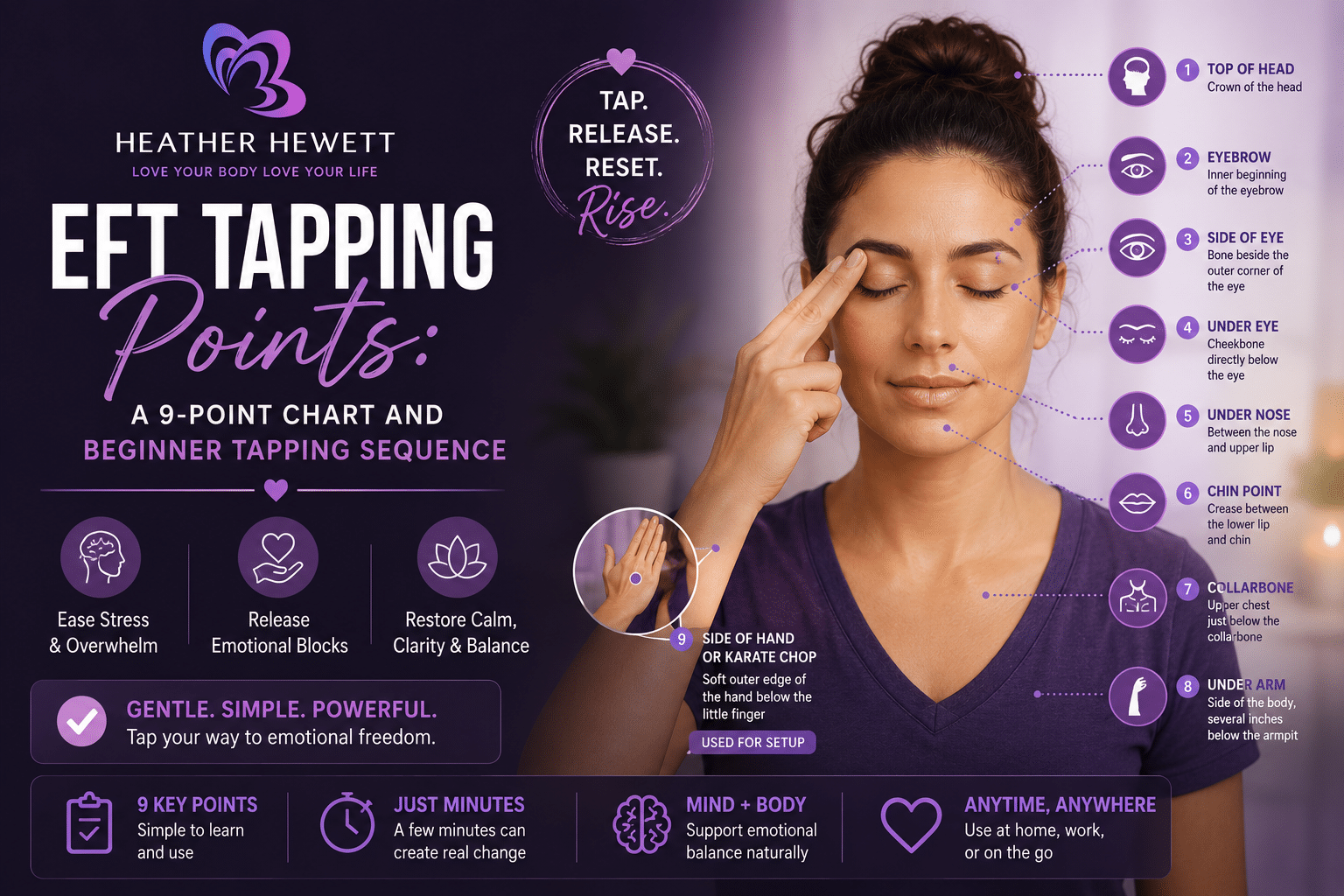
EFT tapping points are nine commonly used locations on the hand, head, face, and upper body that you tap gently while focusing on a current feeling, thought, craving, or stressful situation. The Side of Hand, also called the Karate Chop point, is commonly used for the setup statement. The remaining points are commonly used during a tapping round.
EFT may be used as a gentle self-guided practice for everyday stress, nervousness, overwhelm, and emotional awareness. It is a complementary wellness practice, not medical treatment, psychotherapy, crisis care, or a replacement for qualified healthcare or mental-health support.
Table of Contents
- What Are EFT Tapping Points?
- EFT Tapping Points Chart
- Why Some Guides Show 8 or 9 Points
- How to Do EFT Tapping for Beginners
- EFT Tapping Sequence Order
- What to Say While Tapping
- Safety and Professional Support
- Frequently Asked Questions
What Are EFT Tapping Points?
EFT stands for Emotional Freedom Techniques. It involves gently tapping selected points while focusing on a current thought, emotion, body sensation, craving, trigger, or stressful situation.
You may use EFT to create a supportive pause before reacting automatically. For example, you might focus on work pressure, nervousness before a conversation, a racing mind, or an emotional eating urge.
Some explanations connect EFT with acupressure, traditional Chinese medicine, and meridian points. These are traditional frameworks, not established medical facts. EFT is also different from Emotionally Focused Therapy, which is a separate form of psychotherapy.
To understand Heather’s whole-person approach, you can learn more about Heather’s approach.
What Are the EFT Tapping Points?
EFT tapping points are specific areas on the face and upper body that are commonly used during Emotional Freedom Techniques (EFT) tapping. A typical sequence includes points such as the side of the hand, eyebrow, side of the eye, under the eye, under the nose, chin, collarbone, under the arm, and top of the head.
These points are used while focusing attention on a specific thought, feeling, or concern. The exact sequence and wording can vary depending on the approach being used.
EFT Tapping Points Chart: The 9 Main Points
| EFT Tapping Point | Abbreviation | Exact Location | Setup or Main Sequence |
| Side of Hand or Karate Chop | SOH / KC | Soft outer edge of the hand below the little finger | Setup |
| Top of Head | TOH | Crown of the head | Main sequence |
| Eyebrow | EB | Inner beginning of the eyebrow near the bridge of the nose | Main sequence |
| Side of Eye | SE | Bone beside the outer corner of the eye | Main sequence |
| Under Eye | UE | Cheekbone directly below the eye | Main sequence |
| Under Nose | UN | Area between the nose and upper lip | Main sequence |
| Chin Point | CH | Crease between the lower lip and chin | Main sequence |
| Collarbone | CB | Upper chest just below the collarbone | Main sequence |
| Under Arm | UA | Side of the body, several inches below the armpit | Main sequence |
Use two or three fingertips and tap lightly. You do not need exact placement. Tap on the point area that feels most comfortable.
What Is the EFT Tapping Point Sequence?
A common EFT tapping sequence moves through a series of points on the face and upper body while you focus on a specific concern. The purpose of the sequence is to provide a structured self-guided tapping routine, rather than requiring a complicated technique or equipment.
Why Do Some EFT Guides Show 8 Points and Others Show 9?
Some guides show eight points because they count only the main tapping sequence. A nine-point chart includes the Side of Hand or Karate Chop point used during the setup statement.
Some EFT styles also omit the Under Arm point. The sequence can vary slightly, but you do not need to perform it perfectly. Choosing one manageable issue and tapping at a pace that feels safe matters more than following a rigid routine.
How to Do EFT Tapping for Beginners
Step 1: Choose One Specific Focus
Choose one current feeling, thought, situation, craving, or body sensation.
For example:
- “I feel nervous about tomorrow’s meeting.”
- “I feel overwhelmed by my to-do list.”
- “I feel a strong urge to snack after a stressful day.”
A specific focus is usually easier to work with than trying to tap on everything at once.
Step 2: Rate the Intensity From 0 to 10
Ask yourself how strong the feeling seems right now.
For example: “This nervousness feels like a 7 out of 10.”
This is a personal check-in, not a medical measurement.
Step 3: Create a Setup Statement
Use this simple formula:
“Even though I feel [a specific feeling] about [specific situation], I accept how I feel right now.”
Example:
“Even though I feel overwhelmed by everything I need to do, I accept how I feel right now.”
Step 4: Tap the Karate Chop Point
Tap gently on the Side of Hand while repeating your setup statement around three times.
Step 5: Tap Through the Main Sequence
Tap each point while using a short reminder phrase. You can say the same phrase at every point or slightly adjust it as you go.
Step 6: Pause and Notice
Stop tapping. Take one comfortable breath. Notice your thoughts, body sensations, emotions, or urge level without judging the result.
Step 7: Re-Rate the Intensity
Ask yourself whether the feeling changed, stayed the same, or became more noticeable.
You do not need to feel dramatically better after one round. Even a small shift may create more space for calm, awareness, and choice.
For a stress-focused routine, read EFT tapping for stress. For additional body-based support, explore nervous system regulation for anxiety and overwhelm.
Want Personalized Support With EFT?
If you understand the tapping points but want help applying EFT to recurring stress, emotional patterns, cravings, or other personal concerns, personalized EFT coaching can provide more structured support.
EFT Tapping Sequence Order
A common nine-point EFT tapping sequence is:
- Karate Chop Point
- Top of Head
- Eyebrow
- Side of Eye
- Under Eye
- Under Nose
- Chin
- Collarbone
- Under Arm
You can tap on your left side, right side, alternate sides, or use both sides if that feels comfortable. The sequence is a flexible guide, not a test.
How Many Times Should You Tap Each EFT Point?
A common starting point is around five to seven light taps per point. You do not need to count perfectly.
A tapping round often takes only a few minutes. Focus on a gentle pace, comfortable pressure, and what you notice afterward.
What Should You Say While Tapping?
Setup Statement Formula
Use this formula for the Side of Hand point:
“Even though I feel [emotion] about [a specific situation], I accept how I feel right now.”
Reminder Phrase Formula
Use a short phrase for the main tapping sequence:
- “This work stress”
- “This worried feeling”
- “This tension in my body”
- “This pressure”
- “This nervousness”
- “This craving”
- “This fear of getting it wrong”
Example: Work Stress
Setup statement:
“Even though I feel pressure about everything on my list, I accept how I feel right now.”
Reminder phrase:
“This work pressure.”
Example: Nervousness Before a Presentation
Setup statement:
“Even though I feel nervous about speaking in front of people, I accept how I feel right now.”
Reminder phrase:
“This fear of getting it wrong.”
Example: End-of-Day Overwhelm
Setup statement:
“Even though my mind feels crowded after today, I accept how I feel right now.”
Reminder phrase:
“This end-of-day overwhelm.”
Use honest language. You do not need to force a positive statement that does not feel believable.
Can EFT Tapping Help With Stress or Anxiety?
Some people use EFT tapping as a supportive practice for everyday stress, overwhelm, nervousness, and emotional intensity. Research is still developing, and results vary across studies and individuals.
The National Center for Complementary and Integrative Health notes that there is some evidence for anxiety-related benefits from acupoint tapping, while more research is needed. A systematic review indexed in PubMed also examined EFT for anxiety disorders.
EFT should not be described as a cure, guaranteed treatment, or replacement for therapy or medical care. For a balanced review, read Is EFT tapping evidence based?.
Is EFT Tapping Safe?
EFT tapping is generally a gentle, non-invasive practice for manageable everyday stress. However, focusing on difficult memories or emotions can sometimes bring up stronger feelings.
Pause or stop if you feel flooded, distressed, detached, confused, or unable to settle. You can switch to grounding by noticing objects around you, feeling your feet on the floor, drinking water, or choosing a less intense topic.
Self-tapping should not be your only support for severe distress, panic, trauma symptoms, active eating-disorder symptoms, suicidal thoughts, self-harm risk, or a medical or mental-health emergency. For urgent concerns, contact local emergency or crisis services. The National Institute of Mental Health help resources may also help readers identify appropriate support.
Review Heather’s disclaimer for clear information about the educational and wellness-focused scope of EFT coaching.
Common EFT Tapping Mistakes Beginners Make
Trying to Address Everything at Once
Choose one current issue rather than an entire life history or every stressful situation at once.
Tapping Too Hard
Tap lightly. EFT should not hurt or leave your skin sore.
Worrying About Perfect Placement
Close enough is usually enough. Use the general point area and stay comfortable.
Forcing Positive Statements
Use words that feel honest. You do not need to pretend everything is fine.
Ignoring Strong Emotional Reactions
Pause when needed. Do not push yourself through intense emotional distress alone.
Using EFT Instead of Needed Care
EFT can be a complementary practice. It does not replace medical care, psychotherapy, crisis support, or eating-disorder treatment.
EFT Tapping Tips for a More Supportive Practice
- Choose one manageable focus.
- Use gentle, specific, honest language.
- Tap lightly and breathe naturally.
- Re-rate your intensity after a round.
- Give yourself permission to stop.
- Combine tapping with rest, journaling, grounding, movement, or a supportive conversation.
- Seek qualified support for concerns that feel too intense to explore alone.
For stress-related eating patterns, read what emotional eating is, emotional eating solutions, and Can EFT help cravings?.
Self-Tapping vs. EFT Coaching
| Option | May Be Useful For | Important Limit |
| Self-tapping | Everyday stress, familiar feelings, and simple emotional check-ins | No personalized guidance or clinical support |
| EFT coaching | Recurring stress, cravings, self-doubt, and emotional patterns | Not psychotherapy, diagnosis, or medical treatment |
| Counseling or psychotherapy | Persistent, severe, trauma-related, or life-disrupting distress | Requires an appropriately licensed professional |
| Medical care | Diagnosis, physical symptoms, medication needs, and urgent health concerns | EFT does not replace medical assessment or treatment |
Read self-tapping versus EFT coaching and EFT coaching vs. therapy for a clearer comparison.
When Personalized EFT Coaching May Help
Personalized EFT coaching may help when you want support choosing a manageable focus, practicing consistently, or responding more intentionally to cravings, stress, nervousness, or self-doubt.
Heather’s approach is gentle, trauma-informed, nervous-system-aware, and designed to support adults at a pace that feels safe. Coaching is not psychotherapy, clinical treatment, diagnosis, or emergency support.
Read what EFT coaching is and how to choose an EFT coach. You can also explore personalized online EFT coaching and book a free, pressure-free consultation.
Final Thoughts on EFT Tapping Points
The nine common EFT tapping points include the Side of Hand, Top of Head, facial points, Collarbone, and Under Arm. The Karate Chop point is commonly used for the setup statement, while the remaining points are often used during the main tapping sequence.
Approach EFT tapping points with curiosity, not pressure. EFT may be a helpful complementary self-guided practice for everyday emotional awareness, but it is not a replacement for medical care, psychotherapy, prescribed medication, or crisis support.
Disclaimer
This article is for educational and wellness support purposes only. EFT tapping and coaching are not substitutes for medical advice, diagnosis, psychotherapy, crisis care, prescribed medication, or treatment from a qualified healthcare professional.
Frequently Asked Questions About EFT Tapping Points
What are the 9 EFT tapping points?
The nine EFT tapping points are the Side of Hand, Top of Head, Eyebrow, Side of Eye, Under Eye, Under Nose, Chin, Collarbone, and Under Arm.
Why do some EFT guides show 8 tapping points instead of 9?
Some guides count only the eight main sequence points. A nine-point chart includes the Side of Hand or Karate Chop point used during the setup statement.
Where is the Karate Chop tapping point?
The Karate Chop point is the soft outer edge of either hand below the little finger. It is usually tapped while repeating the setup statement.
Do I tap on the left or right side of my body?
You can tap on either side. Choose the side that feels most comfortable and easiest to reach.
Can I tap on both sides of my body?
Yes. You can tap on both sides, alternate sides, or use one side only. Comfort matters more than using a specific side.
How many times should I tap each EFT point?
Tap each point around five to seven times as a simple starting point. You do not need to count perfectly.
What do I say while doing EFT tapping?
Say a short, honest phrase about what feels active, such as “This work stress” or “This nervousness.” Start with a setup statement on the Side of Hand point.
Can beginners do EFT tapping by themselves?
Yes, beginners can try EFT for manageable everyday stress. Start with one specific issue and stop if the practice feels overwhelming.
Can EFT tapping help with stress?
EFT may help some people create a calming pause during everyday stress. It is not a guaranteed treatment and should not replace professional care.
Is EFT tapping safe?
EFT is generally a gentle practice for manageable stress. Stop if it increases distress, emotional flooding, or disconnection.
What happens if I feel emotional while tapping?
Pause if you feel emotional. Ground yourself, choose a less intense focus, or seek qualified support if the feelings feel too strong to manage alone.
How long does an EFT tapping session take?
A basic EFT tapping round usually takes two to five minutes. You may repeat another round if you still feel comfortable.
Can I use EFT tapping before sleep?
Yes, you can use gentle EFT tapping before sleep for everyday racing thoughts or tension. Avoid exploring intense memories alone at bedtime.
Do I need an EFT practitioner to start tapping?
No. You can begin with self-tapping for manageable stress. A coach may help with pacing, wording, and recurring emotional patterns.
Can EFT tapping replace therapy?
No. EFT tapping does not replace psychotherapy, medical care, trauma treatment, prescribed medication, or crisis support.
Is EFT the same as Emotionally Focused Therapy?
No. EFT here means Emotional Freedom Techniques. Emotionally Focused Therapy is a separate type of psychotherapy.
Can I use EFT tapping for emotional eating or cravings?
Yes, you can use EFT as a supportive pause around cravings or emotional eating urges. It is not a treatment for eating disorders, binge eating, or addiction.
What should I do if tapping feels overwhelming?
Stop tapping and use grounding. Seek support from a licensed professional if distress feels severe, persistent, or unsafe.