
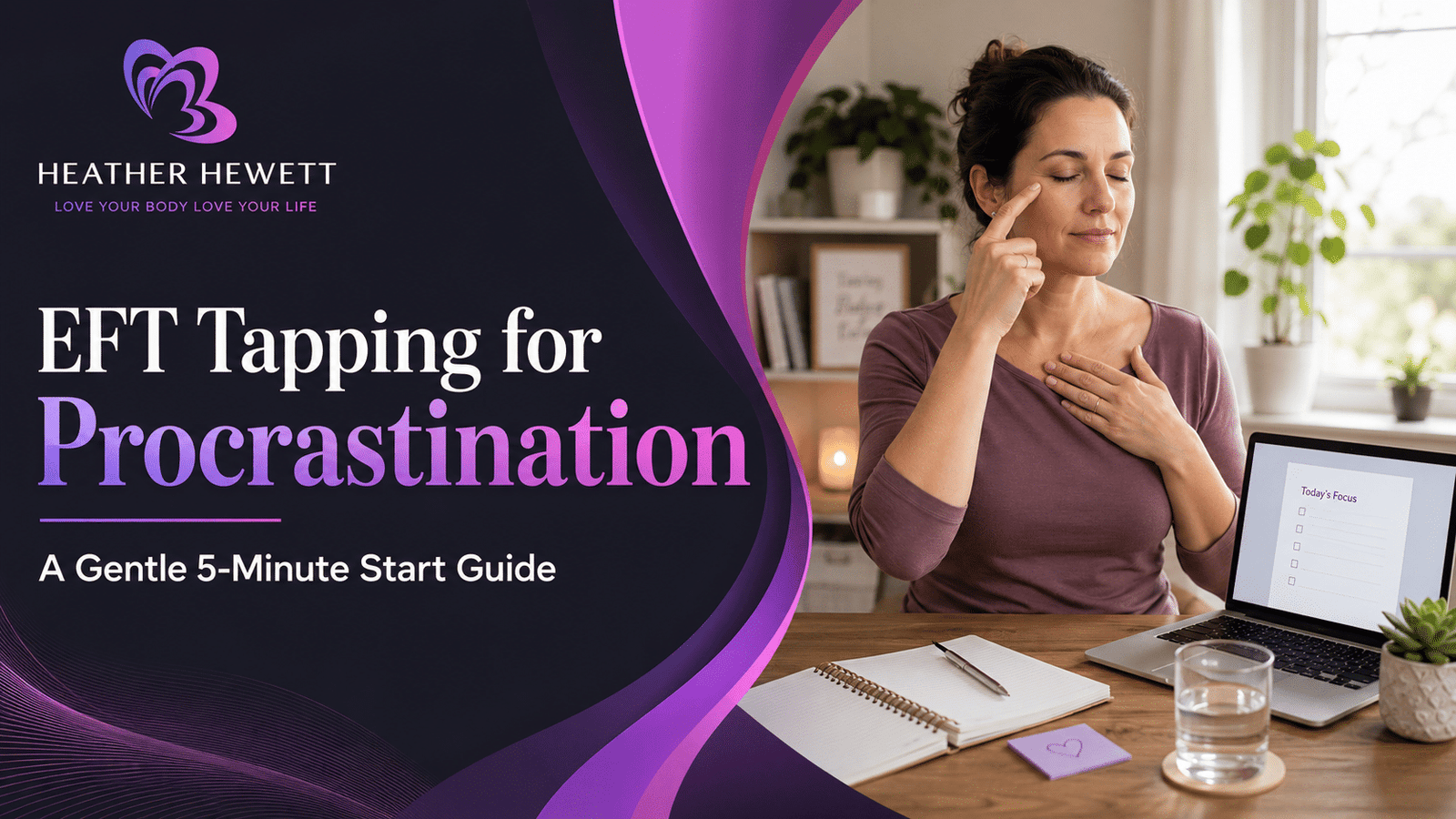
EFT tapping for procrastination may help some people reduce the overwhelm, pressure, anxiety, or emotional resistance they feel before starting a task. It is not a proven cure for procrastination, but it can be a supportive self-regulation practice before one manageable next action.
Procrastination is often more emotional than logical. You may know exactly what needs to happen and still find yourself scrolling, researching, organizing, or waiting until you feel more ready. That does not mean you are lazy. It may mean that the task brings up discomfort, uncertainty, fear, or pressure.
You do not have to fix everything today. This guide will help you pause, tap, and start with one small action.
Table of Contents
- What Is EFT Tapping for Procrastination?
- Can EFT Tapping Help With Procrastination?
- Why Procrastination Can Feel So Hard
- Before You Tap: Choose One Specific Task
- Rate Your Resistance Before Tapping
- What Is Blocking You?
- EFT Tapping Points for Procrastination
- A Gentle 5-Minute EFT Tapping Routine
- EFT Mini Scripts for Common Procrastination Patterns
- The Action Bridge: Pause, Tap, Start
- EFT Procrastination Reset Worksheet
- When EFT Tapping May Not Be Enough
- Frequently Asked Questions
What Is EFT Tapping for Procrastination?
EFT means Emotional Freedom Techniques. It is also called EFT tapping or simply tapping. The practice involves gently tapping selected points on the face and upper body while focusing on a present thought, emotion, body sensation, or stressful situation.
For procrastination, the focus should be specific. Instead of tapping on “I need to stop procrastinating,” you might focus on:
- “I am afraid to open this email.”
- “I feel pressure to do this perfectly.”
- “I do not know where to begin.”
- “This assignment feels too big.”
- “I am worried I will disappoint someone.”
EFT tapping is not acupuncture because it does not use needles. It is also not Emotionally Focused Therapy and is not psychotherapy. It can be used as a self-guided wellness practice or as part of coaching support.
Learn more about what EFT coaching involves and how it may be used alongside practical self-care, emotional awareness, and supportive habits.
Can EFT Tapping Help With Procrastination?
EFT tapping may help some people pause before an automatic avoidance response and feel less emotionally overwhelmed by a task. It may create enough space to take one small step, even when motivation is low.
Procrastination is often connected to short-term mood repair. When a task feels boring, uncertain, stressful, or emotionally uncomfortable, avoiding it can bring temporary relief. A peer-reviewed review of procrastination describes how stressful contexts can increase the urge to delay tasks because avoidance may briefly reduce unpleasant emotions. Read the review on procrastination and stress.
Research on EFT is still developing. Most available research is more relevant to anxiety, stress, cravings, and emotional distress than procrastination specifically. The National Center for Complementary and Integrative Health notes that EFT may reduce anxiety for some people, while also emphasizing the need for stronger research comparing it with standard care. Read the NCCIH overview of anxiety and complementary health approaches.
EFT is not proven to cure procrastination, create instant motivation, or work the same way for everyone. It may be most useful as one part of a wider support plan that includes rest, nutrition, task planning, boundaries, therapy, medical care, movement, and practical problem-solving.
For a balanced explanation of research limits and potential benefits, read what current research says about EFT tapping.
Why Procrastination Can Feel So Hard
Procrastination is not always a lack of discipline. Sometimes it is a protective response to pressure, fear, uncertainty, exhaustion, or emotional discomfort.
A task may feel difficult because it brings up:
- Fear of failure
- Fear of criticism or judgment
- Perfectionistic thinking
- Low confidence
- Imposter syndrome
- Overwhelm
- Mental fatigue
- Decision fatigue
- Fear of success
- Burnout
- Feeling behind
- Pressure from deadlines
- Unclear next steps
- Fear of making mistakes
Sometimes the nervous system experiences a task as pressure, exposure, possible failure, or too much demand. Avoiding the task may bring temporary relief, even when it creates more stress later.
You are not broken. Your procrastination may be showing you that something about the task feels emotionally difficult right now.
For more support with stress, shutdown, overwhelm, or emotional activation, explore EFT tapping for nervous system regulation.
Before You Tap: Choose One Specific Task
“I need to stop procrastinating” is too broad for an EFT tapping round.
Choose one task that is small, concrete, and visible. This gives your mind and body something clear to work with.
Examples include:
- Open the assignment document.
- Write the first sentence.
- Reply to one email.
- Make one phone call.
- Review the first page of notes.
- Add one slide to a presentation.
- Fold five pieces of laundry.
- Pay one bill.
- Schedule one appointment.
- Send one rough draft.
- Start a five-minute timer.
The goal is not to finish everything. The goal is to make the beginning feel safer and more manageable.
Rate Your Resistance Before Tapping
Before tapping, ask yourself:
“How much resistance do I feel toward this task right now?”
Use a scale from 0 to 10.
| Resistance score | What it may feel like |
| 0 to 2 | Mild hesitation |
| 3 to 4 | Noticeable resistance |
| 5 to 6 | Strong urge to avoid |
| 7 to 8 | Overwhelm, anxiety, or shutdown |
| 9 to 10 | Intense distress or panic; pause and seek appropriate support |
This is not a test. It is simply a way to notice whether anything shifts after tapping.
What Is Blocking You? Find Your Procrastination Pattern
| Main blocker | What it may sound like internally | A gentle EFT focus | A two-minute next step |
| Fear of failure | “What if I get this wrong?” | Fear of mistakes | Write one rough sentence |
| Perfectionism | “It has to be excellent.” | Pressure to get it right | Make a messy outline |
| Fear of criticism | “People will judge me.” | Fear of being seen | Draft without sending |
| Overwhelm | “There is too much to do.” | The task feels too large | List the first three steps |
| Unclear first step | “I do not know where to begin.” | Confusion and uncertainty | Open the document |
| Fear of success | “What if this creates more pressure?” | Increased responsibility | Complete one small part |
| Low confidence | “I am not capable enough.” | Self-doubt | Review one helpful note |
| Task paralysis | “I cannot move.” | Feeling frozen | Open the file and stand up |
| Burnout or fatigue | “I have nothing left.” | Exhaustion and pressure | Set a two-minute timer |
| Boredom or resentment | “I do not want to do this.” | Frustration and resistance | Do the least unpleasant part |
| Decision fatigue | “I cannot choose.” | Too many options | Choose the next obvious action |
| Deadline stress | “It is already too late.” | Panic about time | Write the working title |
EFT Tapping Points for Procrastination
The standard EFT tapping sequence includes these points:
- Karate chop point
- Eyebrow
- Side of the eye
- Under the eye
- Under the nose
- Chin
- Collarbone
- Under the arm
- Top of the head
Tap gently with two or three fingertips. Exact placement does not need to be perfect. Comfort and present-moment awareness matter more than precision.
Use Heather’s full EFT tapping-points chart for beginners for a visual guide.
A Gentle 5-Minute EFT Tapping Routine for Procrastination
Step 1: Name the Task and the Feeling
Start by naming the task you are avoiding and what feels difficult about it.
Examples:
- “I am avoiding this email because I am afraid I will say the wrong thing.”
- “I am avoiding this assignment because I do not know where to begin.”
- “I am avoiding this project because I feel pressure to do it perfectly.”
- “I am avoiding this phone call because I am worried about the conversation.”
Try to be honest rather than positive. You do not need to convince yourself that the task is easy. You only need to acknowledge what is true right now.
Step 2: Rate Your Resistance
Rate your resistance from 0 to 10.
Notice whether you feel the resistance as tension in your chest, heaviness in your body, racing thoughts, a tight jaw, a sinking feeling, or an urge to do something else.
Step 3: Use a Setup Statement
Tap gently on the karate chop point while repeating one setup statement three times.
- “Even though I feel resistance to starting this task, I can acknowledge that this feels difficult right now.”
- “Even though part of me wants to avoid this, I am open to taking one small step.”
- “Even though this task feels heavy, I do not have to complete everything at once.”
Honest language often works better than forced positive thinking. For more adaptable phrases, see EFT setup-statement examples you can personalize.
Step 4: Round One: Acknowledge the Resistance
Tap through the points while saying short reminder phrases.
- “This resistance.”
- “This pressure to get it right.”
- “Part of me wants to avoid this.”
- “This task feels bigger than it is.”
- “I am afraid I will fail.”
- “I feel stuck right now.”
- “This feels heavy.”
- “I can acknowledge that this is hard.”
Step 5: Round Two: Reduce the Pressure
Tap through the same points again.
- “I do not need to do everything today.”
- “I can start before I feel fully ready.”
- “I can make this task smaller.”
- “I can be kind to myself while I begin.”
- “One imperfect step is still movement.”
- “I can do the next useful thing.”
- “I can let this be manageable.”
Step 6: Round Three: Create a Starting Action
Tap through the points one more time.
- “I can open the document.”
- “I can write one imperfect sentence.”
- “I can work for two minutes.”
- “I can begin without finishing.”
- “I can let the first step be small.”
- “I can choose progress over pressure.”
- “I can start here.”
Step 7: Re-Rate and Begin
Pause and take one slow breath. Re-rate your resistance.
You do not need your number to reach zero. A shift from an 8 to a 6 may be enough to help you begin.
Move directly into a two-minute action. Do this before checking your phone, researching more, reorganizing your desk, or waiting to feel fully motivated.
EFT Mini Scripts for Common Procrastination Patterns
EFT Tapping for Fear of Failure
Setup statement: “Even though I am afraid I will fail, I can acknowledge that trying feels vulnerable.”
Reminder phrases:
- “This fear of getting it wrong.”
- “This pressure to prove myself.”
- “What if I fail?”
- “I can let this be a first attempt.”
- “I do not need a perfect outcome.”
Two-minute action: Write one rough sentence without editing it.
Compassionate reminder: Progress does not require certainty. Explore EFT tapping for confidence and self-doubt for additional support.
EFT Tapping for Perfectionism
Setup statement: “Even though I want this to be perfect, I am open to letting it begin imperfectly.”
Reminder phrases:
- “This perfection pressure.”
- “This fear of mistakes.”
- “A rough draft is allowed.”
- “I can begin before it is perfect.”
- “One imperfect step is enough.”
Two-minute action: Create a messy three-point outline.
Compassionate reminder: Your first attempt is not your final verdict. If self-doubt is part of the pattern, EFT support for limiting beliefs may be helpful.
EFT Tapping for Overwhelm
Setup statement: “Even though this feels like too much, I can focus on one small part.”
Reminder phrases:
- “This is a lot.”
- “My mind feels crowded.”
- “I do not have to solve everything.”
- “I can make this smaller.”
- “One piece at a time.”
Two-minute action: Write down only the first physical step.
Compassionate reminder: A small pause can create more choice. You may also try a gentle EFT tapping routine for stress.
EFT Tapping for Fear of Criticism
Setup statement: “Even though I am worried about being judged, I can give myself permission to begin privately.”
Reminder phrases:
- “This fear of judgment.”
- “This fear of being seen.”
- “I do not need everyone’s approval.”
- “I can create a private first draft.”
- “I can learn as I go.”
Two-minute action: Draft the message without sending it.
Compassionate reminder: You can create before deciding whether to share.
EFT Tapping for Study Procrastination
Setup statement: “Even though studying feels difficult right now, I can begin with one small page.”
Reminder phrases:
- “This academic pressure.”
- “This fear of falling behind.”
- “I do not need to know everything today.”
- “I can read one paragraph.”
- “I can study for two minutes.”
Two-minute action: Open your notes and write the heading of one topic.
Compassionate reminder: Starting small is still studying.
EFT Tapping for Work Procrastination
Setup statement: “Even though this work task feels uncomfortable, I can choose one useful action.”
Reminder phrases:
- “This work pressure.”
- “This fear of doing it wrong.”
- “This email feels heavier than it is.”
- “I can write the first line.”
- “I can make a simple start.”
Two-minute action: Write the greeting and first sentence of the email.
Compassionate reminder: You do not have to force yourself through this.
EFT Tapping for Task Paralysis
Setup statement: “Even though I feel frozen, I can notice that I am here and take one small action.”
Reminder phrases:
- “I feel stuck.”
- “My body feels heavy.”
- “I do not know where to begin.”
- “I can choose one movement.”
- “I can start here.”
Two-minute action: Open the task, stand up, and set a two-minute timer.
Compassionate reminder: Task paralysis is not a character flaw.
EFT Tapping for Anxiety Before a Deadline
Setup statement: “Even though I feel anxious about this deadline, I can focus on what is possible in this moment.”
Reminder phrases:
- “This deadline stress.”
- “This fear of not finishing.”
- “I feel behind.”
- “I can do the next useful thing.”
- “I can begin now.”
Two-minute action: Write the working title, first bullet, or first sentence.
Compassionate reminder: You do not have to solve everything right now.
The Action Bridge: Pause, Tap, Start
Tapping can create a pause. The action bridge helps you turn that pause into movement.
Pause
Notice the task, your resistance score, the strongest emotion, and any body sensations.
Ask yourself: “What feels hardest about starting?”
Tap
Use one short tapping round focused on the feeling that is most active. It may be fear, pressure, perfectionism, uncertainty, self-doubt, resentment, or overwhelm.
Start
Do one physical two-minute action before checking your phone, researching more, planning more, or waiting to feel fully motivated.
Examples:
- Students: Open the document and write the working title.
- Professionals: Draft the first line of the email.
- Freelancers: Send one follow-up message.
- Creators: Open the project file or write one rough idea.
- Entrepreneurs: Choose one revenue-supporting task.
- Home tasks: Wash five dishes or sort one small area.
- Difficult conversations: Write one sentence you want to say.
You do not need to feel completely confident before you begin. You only need enough space to take the next gentle action.
If procrastination is connected to recurring stress, self-doubt, emotional overwhelm, or deeper emotional patterns, guided support may help you explore those patterns at a pace that feels safer and more personal. Learn more about online EFT coaching for stress and emotional patterns.
EFT Procrastination Reset Worksheet
Copy this into a notebook, journal, or notes app.
- The task I am avoiding:
- What feels difficult about it:
- My resistance score before tapping:
- My strongest emotion:
- My main procrastination pattern:
- My setup statement:
- My short reminder phrase:
- My two-minute starting action:
- My resistance score after tapping:
- What changed, even slightly:
- My next small action:
The goal is not perfection. A gentle next step is still a real step.
When EFT Tapping May Not Be Enough
Self-guided EFT may not be enough when procrastination is connected to severe anxiety, panic symptoms, persistent low mood, trauma memories, flashbacks, emotional flooding, chronic burnout, ongoing sleep disruption, or significant difficulty functioning at work, school, home, or in relationships.
Pause self-guided tapping and seek qualified support if you feel increasingly distressed while tapping, feel unsafe, or notice that attention and executive-function concerns significantly affect daily life.
EFT is not a replacement for therapy, ADHD assessment or treatment, medication, medical care, trauma treatment, or emergency support. The National Institute of Mental Health advises seeking help when stress or mental-health symptoms persist, interfere with everyday life, or lead to avoidance. Read NIMH guidance on caring for your mental health.
Reaching out for support is not a failure of self-regulation. It can be a meaningful form of care.
A Gentle Next Step
Procrastination does not always need more pressure. Sometimes it needs honesty, self-compassion, a smaller task, and a calm enough moment to begin.
Try the Pause, Tap, Start approach once today. Choose one task. Name what feels difficult. Tap for a few minutes. Then complete one two-minute action.
If you are tired of feeling stuck in the same stress-and-avoidance cycle, you do not have to navigate it alone. Heather’s online coaching offers compassionate, nervous-system-aware support for stress, emotional patterns, confidence, and self-regulation. You can book a free consultation to explore what support may fit your needs.
Disclaimer
This article is for general educational and wellness-support purposes only. EFT tapping is not a substitute for medical care, mental-health treatment, psychotherapy, diagnosis, medication, or emergency support. If you are experiencing severe, persistent, trauma-related, or life-disrupting symptoms, seek support from a qualified healthcare or mental-health professional.
Frequently Asked Questions
Can EFT Tapping Really Help With Procrastination?
It may help some people. EFT can create a pause around overwhelm, anxiety, perfectionism, or resistance, making one small action feel more manageable.
What Do I Say While Tapping for Procrastination?
Use honest, simple phrases. Try: “This pressure,” “I feel stuck,” “I am afraid I will fail,” or “I can take one small step.”
How Many Rounds of EFT Tapping Should I Do Before Starting Work?
One to three short rounds is usually enough. The goal is not to feel perfect. The goal is to create enough space for a two-minute next action.
Can EFT Tapping Help With Procrastination Caused by Anxiety?
It may help with everyday task anxiety. It is not a replacement for professional support when anxiety is severe, persistent, or disrupts daily life.
Can EFT Tapping Help With Perfectionism and Fear of Failure?
It may help you soften the pressure around mistakes. Pair tapping with an imperfect action, such as writing a rough sentence or creating a messy outline.
Can I Use EFT Tapping for Study Procrastination?
Yes. Use it before opening notes, starting an assignment, reviewing one page, or beginning exam preparation.
Can I Use EFT Tapping Before a Deadline or Presentation?
Yes. Use a short round to focus on the next immediate action, such as writing the first bullet point or reviewing the opening slide.
What Should I Do Immediately After Tapping?
Take one physical two-minute action. Open the document, write one sentence, send one message, or complete the smallest useful step.
What If I Still Cannot Start After EFT Tapping?
Make the task even smaller. Try a 30-second action, remove one distraction, ask for clarification, or get practical support.
Is EFT Tapping a Replacement for Therapy or ADHD Treatment?
No. EFT tapping is a wellness practice, not a replacement for psychotherapy, diagnosis, medication, ADHD treatment, or medical care.
Can EFT Tapping Make Emotions Feel Stronger?
Yes, sometimes. Stop tapping if you feel emotionally flooded or increasingly distressed, then ground yourself and seek qualified support if needed.
When Should I Seek Professional Support Instead of Using Self-Guided EFT?
Seek support when symptoms are severe, persistent, trauma-related, or disruptive to daily life. Get urgent help if you feel unsafe or have thoughts of self-harm.