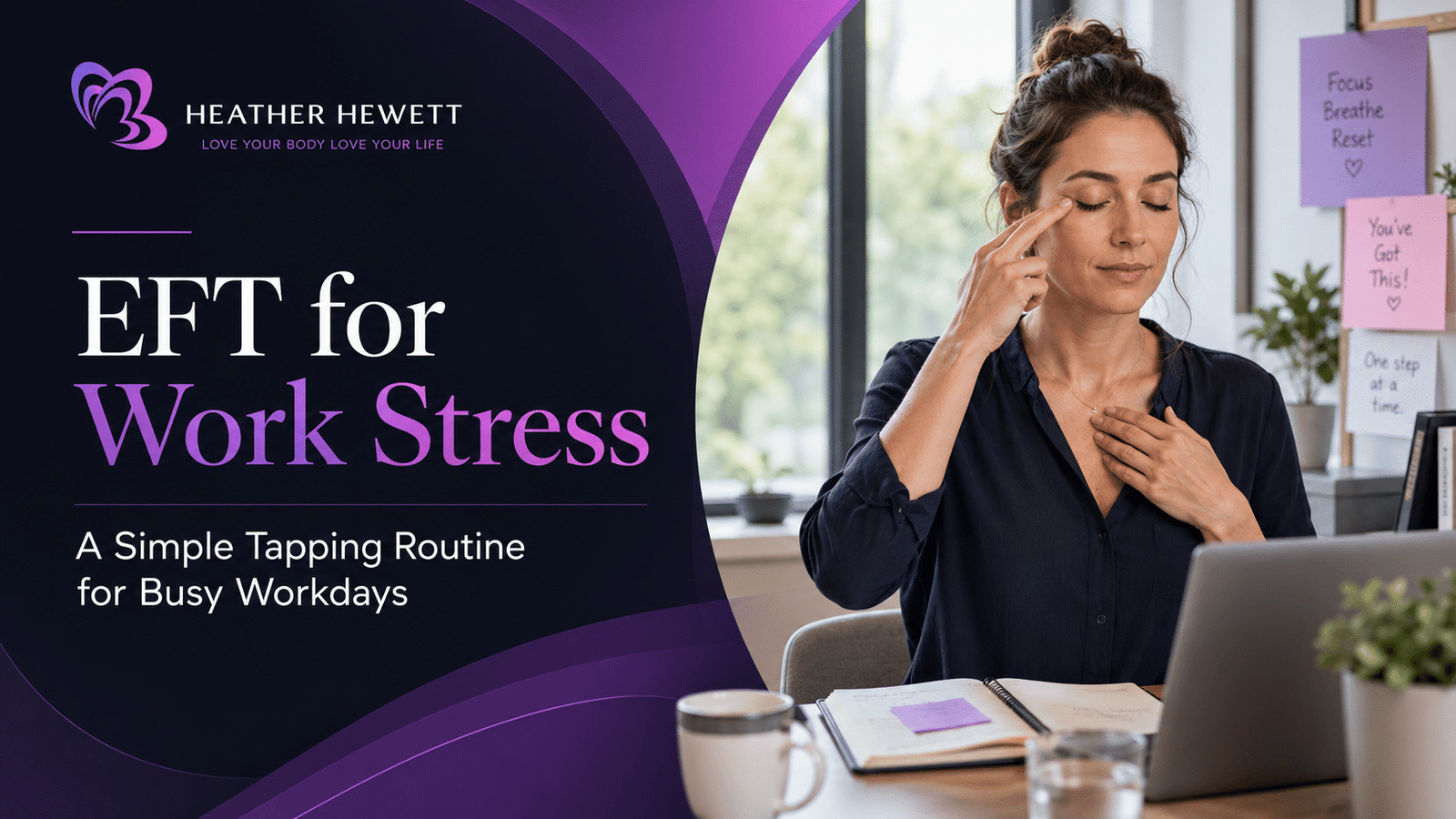
You open your inbox and see an urgent message. Your chest tightens before a meeting. A deadline is approaching, but you cannot focus. Or you leave work and keep replaying a difficult conversation in your mind.
In this article, EFT means Emotional Freedom Techniques, also known as EFT tapping. It does not mean electronic funds transfer or Emotionally Focused Therapy. EFT tapping is a short self-help practice that combines attention to a stressful thought with gentle tapping on selected points of the body.
Some people find that EFT for work stress helps them pause, lower emotional intensity, and choose a clearer next step. It is not a replacement for therapy, medical advice, crisis support, or necessary changes to an unhealthy workload.
EFT tapping for work stress is a short practice where you focus on one workplace pressure, tap through a sequence of points, and use realistic calming phrases. It may help you feel more settled before a meeting, deadline, presentation, or difficult conversation.
Table of Contents
- What Is EFT for Work Stress?
- When Can EFT Tapping Help at Work?
- A 5-Minute EFT Tapping Routine for Work Stress
- EFT Tapping Points for Work Stress
- EFT Scripts for Common Workplace Stress Situations
- Does EFT Tapping Work for Stress?
- EFT vs Other Workplace Stress Relief Techniques
- What to Do After EFT Tapping
- When EFT Is Not Enough
- Frequently Asked Questions
What Is EFT for Work Stress?
EFT tapping is a mind-body practice that combines focused attention, a short statement about what you are feeling, and gentle tapping on points on the hands, face, and upper body.
For workplace stress, it helps to focus on one exact issue instead of a vague feeling such as “I hate my job.”
Examples include:
- “I am anxious about my presentation.”
- “I feel overwhelmed by this deadline.”
- “That email made me feel criticised.”
- “I am afraid to speak to my manager.”
- “I cannot stop thinking about work after hours.”
The aim is not to force yourself to feel positive. It is to acknowledge the pressure you are under and create enough emotional space to take a practical next step.
For a broader beginner guide, readers can explore EFT tapping for stress. For people who feel physically tense, emotionally overwhelmed, or stuck in a stress response, EFT tapping for nervous system regulation may also be useful.
When Can EFT Tapping Help at Work?
EFT tapping may be useful during common workplace stress moments, especially when you need a short pause before reacting.
Before a Meeting
Use EFT before a meeting when you feel nervous, unprepared, or worried about speaking up.
A short tapping round can help you move from “I will say the wrong thing” to “I can share one clear point.”
Before a Presentation
Presentation anxiety can include racing thoughts, a fast heartbeat, fear of forgetting your words, or worrying that others will judge you.
EFT tapping may help you settle before presenting. For additional confidence support, link to EFT tapping for confidence.
During Deadline Pressure
When a project feels too large, your stress response may make it harder to begin.
Tapping can help you shift attention from the entire workload to one small next action, such as opening the document, writing a heading, or sending a clarification message.
After a Difficult Email
A stressful email can trigger frustration, shame, fear, or defensiveness.
Before replying, use one short tapping round. Then reread the email and identify the actual request instead of responding to your first emotional reaction.
Before a Difficult Conversation
Tapping can be useful before speaking to a manager, client, coworker, or team member about workload, boundaries, feedback, or conflict.
The aim is not to avoid the conversation. It is to enter it with more clarity and less reactivity.
After Work When You Cannot Switch Off
Work-related overthinking can continue long after the workday ends.
Use EFT at the end of the day, then write down tomorrow’s first task and close your work apps. This creates a clearer boundary between work time and recovery time.
A 5-Minute EFT Tapping Routine for Work Stress
This simple EFT tapping routine for work stress can be used before a meeting, during deadline pressure, after a difficult email, or before a presentation.
Step 1: Identify the Exact Stressor
Choose one current concern.
Examples:
- “I am behind on this report.”
- “I am worried about my performance review.”
- “I feel overwhelmed by my inbox.”
- “I am nervous about presenting.”
- “I am afraid to ask for help.”
Step 2: Rate Your Stress Level
Ask yourself:
“How intense does this feel right now, from 0 to 10?”
This is not a clinical test. It is simply a quick way to notice whether your stress level changes after tapping.
Step 3: Use a Setup Statement
Tap the side of your hand, below the little finger, while repeating your statement three times.
Try:
“Even though I feel overwhelmed by this deadline, I can pause and take one step at a time.”
Other examples include:
“Even though I feel anxious about this meeting, I can focus on what I can control.”
“Even though this email upset me, I can respond when I feel clearer.”
“Even though I am nervous about speaking up, I can be calm and direct.”
Step 4: Tap Through the Basic EFT Points
Tap gently five to seven times on each point while repeating a short phrase.
- Eyebrow: “This work pressure.”
- Side of eye: “I have too much to do.”
- Under eye: “Part of me feels stuck.”
- Under nose: “I do not want to get this wrong.”
- Chin: “This is a lot right now.”
- Collarbone: “I can slow down.”
- Under arm: “One step at a time.”
- Top of head: “I can begin where I am.”
Step 5: Add Realistic Calming Phrases
Complete another round using phrases that feel believable.
- “I can focus on one task.”
- “I do not need to solve everything now.”
- “I can ask for clarification.”
- “I can pause before replying.”
- “I can communicate one clear point.”
- “I can take the next helpful step.”
Step 6: Re-Rate Your Stress Level
Ask yourself again:
“How intense does this feel now, from 0 to 10?”
You may feel calmer, clearer, less reactive, or simply more ready to act.
Step 7: Choose One Small Work Action
After tapping, choose one action that takes less than ten minutes.
Examples include:
- Write the first paragraph.
- Make a short task list.
- Send a clarification email.
- Prepare three meeting points.
- Ask for help.
- Take a short break before returning to work.
EFT Tapping Points for Work Stress
The common EFT tapping points are:
- Side of hand
- Inner eyebrow
- Side of eye
- Under eye
- Under nose
- Chin crease
- Collarbone
- Under arm
- Top of head
Use gentle pressure and tap wherever feels comfortable. You can tap on either side of the body.
EFT Scripts for Common Workplace Stress Situations
EFT Script for Deadline Stress
Stressful thought: “I am behind and I will not finish.”
Setup statement:
“Even though this deadline feels huge, I can focus on the next part instead of the whole project.”
Reminder phrases:
- “This deadline pressure.”
- “I am afraid of falling behind.”
- “There is too much to do.”
- “I do not have to do everything now.”
- “What is the next visible step?”
- “I can begin with one task.”
Practical next step: Set a ten-minute timer and complete the smallest useful task.
EFT Script After a Stressful Email
Stressful thought: “They think I have failed.”
Setup statement:
“Even though this email feels personal, I can pause before deciding what it means.”
Reminder phrases:
- “This sting in my chest.”
- “I want to defend myself.”
- “I feel criticised.”
- “I may not have the full picture.”
- “I can respond with facts.”
- “I can take a breath before replying.”
Practical next step: Highlight the actual request, draft a calm reply, and reread it before sending.
EFT Script for Presentation Anxiety
Stressful thought: “I will freeze and look unprepared.”
Setup statement:
“Even though I feel nervous about presenting, I can share one useful idea at a time.”
Reminder phrases:
- “These presentation nerves.”
- “I do not like being watched.”
- “I might forget what to say.”
- “I can start with one sentence.”
- “I can pause and use my notes.”
- “I can speak at my own pace.”
Practical next step: Rehearse your first 30 seconds and keep three cue words beside your slides.
EFT Script for Imposter Syndrome at Work
Stressful thought: “Everyone else is more capable than I am.”
Setup statement:
“Even though I am doubting myself right now, I can recognise the skills and effort I bring.”
Reminder phrases:
- “This self-doubt.”
- “I feel like I do not belong.”
- “Everyone else seems more confident.”
- “I am allowed to keep learning.”
- “I have experience and value.”
- “I can contribute one useful thing.”
Practical next step: Write down one fact that supports your capability, such as positive feedback, a completed project, or a skill you have developed.
EFT Script Before Speaking to a Manager
Stressful thought: “They will think I am difficult or incapable.”
Setup statement:
“Even though this conversation feels uncomfortable, I can be clear, respectful, and specific.”
Reminder phrases:
- “I am bracing for conflict.”
- “I do not want to disappoint anyone.”
- “I am afraid to ask for support.”
- “I can explain the facts.”
- “I can make one reasonable request.”
- “I can speak with respect.”
Practical next step: Prepare one sentence using this structure:
“When ___ happens, it affects ___. Could we ___?”
Does EFT Tapping Work for Stress?
Research suggests that EFT may help reduce anxiety and stress symptoms for some people. However, results vary, study methods differ, and EFT should not be presented as a guaranteed solution for workplace burnout, trauma, depression, anxiety disorders, or harmful working conditions.
A systematic review and meta-analysis on EFT for anxiety found reductions in anxiety scores across the included studies. This is encouraging, but it does not mean that EFT works equally well for every person or every situation.
For a fuller evidence-aware discussion, readers can visit Is EFT tapping evidence based?.
EFT can be a useful self-help tool, but it cannot fix chronic understaffing, workplace bullying, unrealistic deadlines, job insecurity, or a poor management culture.
The World Health Organization’s guidance on mental health at work highlights the importance of organizational action, supportive work environments, and effective workplace mental-health support.
EFT vs Other Workplace Stress Relief Techniques
| Technique | Best For | Time Needed | Can You Do It at Work? | Best Next Step |
| EFT tapping | Specific stress triggers, such as deadlines or difficult emails | 2 to 5 minutes | Usually | Take one clear action |
| Box breathing | Fast physical reset before meetings | 1 to 3 minutes | Yes | Return to the task slowly |
| Mindfulness | Overthinking and racing thoughts | 2 to 10 minutes | Yes | Focus on one task |
| Short walk | Screen fatigue, tension, or frustration | 5 to 15 minutes | Often | Re-enter with a plan |
| Journaling | Clarifying thoughts before a difficult conversation | 5 to 10 minutes | Sometimes | Identify facts and requests |
| Therapy | Persistent anxiety, burnout, trauma, or panic | Ongoing | Privately | Create a personal support plan |
For familiar everyday stress, self-tapping may be enough. When emotional patterns feel more persistent or complicated, compare self-tapping versus EFT coaching.
What to Do After EFT Tapping
The goal of EFT tapping is not only to feel calmer. It is to help you make a more useful decision after the stress response settles.
After tapping, try one of these actions:
- Break a large task into a smaller first step.
- Ask a manager for priorities or clarification.
- Send a calm, factual email.
- Write down your top three tasks.
- Take a five-minute break away from your screen.
- Set a boundary around work hours.
- Log off when the workday ends.
- Schedule a conversation about workload support.
When stress becomes long-term exhaustion, it may help to understand the difference between nervous system regulation and stress management.
For extra tools, readers can also access the site’s free wellness resources, including grounding practices, burnout support, stress recovery resources, and boundary exercises.
When EFT Is Not Enough
EFT is not a replacement for therapy, medical treatment, crisis support, workplace accommodations, or necessary workplace changes.
Seek support from a licensed therapist, psychologist, doctor, employee assistance programme, or another qualified mental-health professional if you experience:
- Persistent anxiety that does not improve.
- Panic attacks.
- Severe burnout or emotional exhaustion.
- Sleep problems lasting weeks.
- Trauma-related distress.
- Difficulty functioning at work or home.
- Increased alcohol or substance use to cope.
- Thoughts of self-harm or feeling unable to stay safe.
The National Institute of Mental Health stress guidance offers practical information about recognising stress, anxiety, and when additional support may be helpful.
For non-clinical guidance around everyday stress patterns, readers can learn more about what EFT coaching involves, online EFT coaching, and the difference between EFT coaching and therapy.
Those who feel stuck in chronic overwhelm may also explore nervous system regulation coaching or read about nervous system regulation for anxiety and overwhelm.
Final Thoughts on EFT for Work Stress
EFT for work stress may be a useful five-minute tool when a deadline, difficult email, meeting, presentation, or workplace conversation leaves you feeling overwhelmed.
Use it to name the pressure, create a pause, and take one manageable next step. It works best alongside realistic workload planning, healthy boundaries, rest, support, and professional help when stress is ongoing.
For organizations that want to support healthier workplace habits, consider nervous system and resilience workshops for teams.
Medical Disclaimer
This article is for general educational purposes only. It is not medical advice, therapy, diagnosis, or treatment. EFT tapping should not replace support from a qualified mental-health professional, doctor, emergency service, or crisis service.
Frequently Asked Questions
Can EFT Tapping Help With Work Stress?
Yes. EFT tapping may help some people feel calmer and more focused during stressful work moments. It can be useful before meetings, presentations, difficult emails, or deadlines, but it does not replace therapy, medical care, or workplace changes.
How Long Does EFT Tapping Take?
Most EFT tapping rounds take two to five minutes. A short routine can be enough to reduce immediate stress and help you decide what to do next.
Can I Do EFT Tapping at My Desk?
Yes. You can tap discreetly at your desk using your fingertips, side of hand, collarbone, or other common EFT points. Use a private space if you feel more comfortable.
What Should I Say While Tapping for Work Stress?
Use simple, honest words. Try: “Even though I feel overwhelmed by this deadline, I can take one step at a time.” Keep phrases realistic and connected to the exact stressor.
Is EFT Better Than Breathing Exercises?
No. EFT and breathing exercises can both help with stress. Use breathing for a fast physical reset and EFT when a specific thought, emotion, or workplace situation feels overwhelming.
Can EFT Help With Burnout?
Not by itself. EFT may help with an immediate stress response, but burnout usually needs rest, workload changes, boundaries, support, and sometimes professional care.
How Often Can I Use EFT Tapping for Work Stress?
You can use EFT whenever a familiar stress trigger appears, such as before a meeting or after a difficult email. Stop or reduce it if tapping feels overwhelming or unhelpful.
Is EFT Tapping Safe for Anxiety?
For many people, gentle tapping is low risk. However, it can bring up difficult emotions. Stop if you feel worse, overwhelmed, dizzy, or disconnected, and seek professional support if anxiety feels severe.
Can EFT Help Before a Presentation?
Yes. EFT may help reduce presentation nerves and make it easier to focus on your opening, key points, and breathing. Use it shortly before presenting, then rehearse your first sentence.
When Should I Seek Professional Help for Work Stress?
Seek professional help when stress affects your sleep, concentration, relationships, work performance, or ability to function. Get urgent support if you have thoughts of self-harm or feel unable to stay safe.