
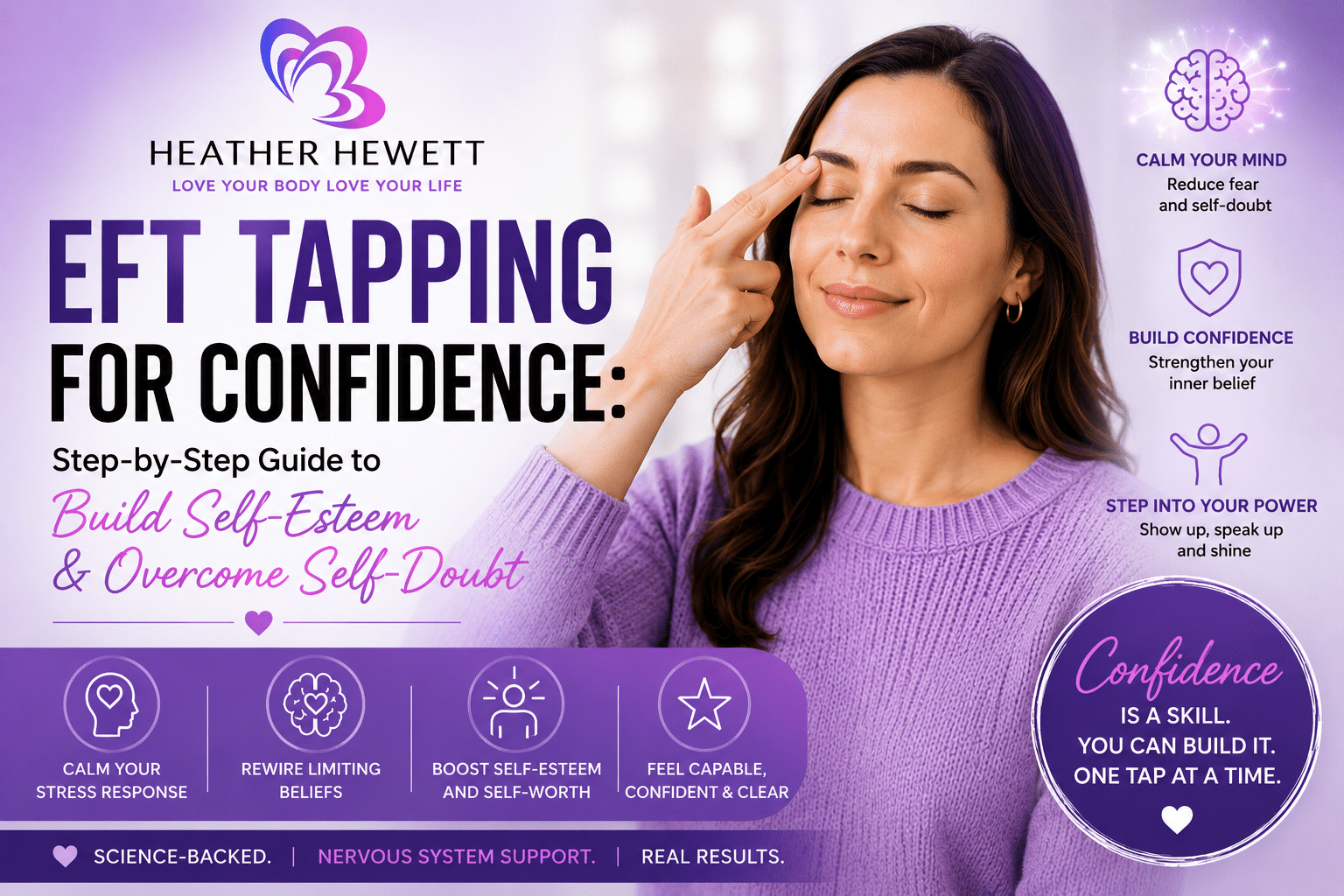
Have you ever stood outside a meeting room, heart pounding, rehearsing what you will say, only to walk in and feel your mind go blank? Or scrolled through social media wishing you felt as confident as everyone else seemed? Self-doubt, fear of judgment, and performance anxiety are not character flaws. They are deeply wired emotional patterns, and they can be rewired.
EFT tapping for confidence is one of the most accessible, evidence-informed tools available for doing exactly that. It requires no equipment, no appointment, and no prior experience. In just a few minutes of focused tapping, most people notice a measurable shift in how they feel: calmer, clearer, and more capable.
This guide explains how EFT works, walks you through the tapping points, and gives you a complete EFT tapping script for confidence, including specialized versions for job interviews, public speaking, social anxiety, and low self-esteem.
Disclaimer: EFT tapping is a complementary self-help technique and is not a substitute for professional medical or psychological treatment. If you are experiencing severe anxiety, depression, or trauma, please consult a licensed mental health professional.
Table of Contents
- What Is EFT Tapping for Confidence?
- Why Does EFT Tapping Work for Confidence?
- EFT Tapping Points: A Clear Visual Guide
- Step-by-Step EFT Tapping Script for Confidence
- Quick 3-Minute EFT Confidence Routine
- Real-Life Use Cases for EFT Tapping and Confidence
- Common Mistakes That Reduce EFT Effectiveness
- Frequently Asked Questions
- Building Lasting Confidence with EFT
What Is EFT Tapping for Confidence?
Emotional Freedom Techniques (EFT), commonly called tapping, is a mind-body intervention developed by Gary Craig in the 1990s, based on earlier work by psychologist Roger Callahan. It combines elements of cognitive reframing with physical stimulation of acupressure points on the face and body.
The basic idea is simple. While holding a specific emotional issue in mind, such as fear of judgment or low self-worth, you gently tap a sequence of acupressure points with your fingertips. This combination of focused attention and physical stimulation appears to send calming signals to the brain, helping to reduce the emotional charge attached to a belief or memory.
EFT is often described as psychological acupressure: a meeting point between Eastern energy medicine and Western cognitive psychology. It belongs to the broader field of energy psychology and is increasingly studied in clinical settings. If you would like to explore what a guided session actually looks like, read What Happens in an EFT Session: Step-by-Step Guide.
Key Facts About EFT Tapping
- Developed by Gary Craig in the 1990s
- Based on the body’s meridian energy system from traditional Chinese medicine
- Combines verbal affirmation with fingertip tapping on acupressure points
- Used for anxiety, trauma, phobias, confidence, and performance enhancement
- Recognized as an evidence-based practice for anxiety, depression, phobias, and PTSD by a 2022 systematic review in Frontiers in Psychology
Want to understand EFT coaching more deeply before diving in? Read What Is EFT Coaching? A Simple Guide and What Does an EFT Coach Do?
Why Does EFT Tapping Work for Confidence?
To understand why tapping works, it helps to understand what is happening in your brain when you feel unconfident.
The Amygdala and the Fear Response
Your amygdala, the brain’s fear detection center, cannot always distinguish between physical danger and social threat. When you fear public speaking or worry about being judged, your amygdala fires as if you are in real danger. This triggers the release of cortisol, the stress hormone, which floods your body with tension, narrows your thinking, and makes you want to freeze or flee.
EFT tapping appears to interrupt this stress response. A landmark randomized controlled trial published in the Journal of Nervous and Mental Disease found that a single hour of EFT produced a 24% reduction in cortisol levels, significantly more than talk therapy or rest alone. A 2025 mechanisms review in Frontiers in Psychology synthesizing over 200 clinical trials confirmed that tapping generates electrochemical signals that directly downregulate limbic and amygdala activation, sometimes within seconds.
How EFT Supports Nervous System Regulation
EFT engages the parasympathetic nervous system, your rest-and-digest system, which counteracts the fight-or-flight response. This is similar in mechanism to deep breathing, progressive muscle relaxation, and mindfulness meditation, but EFT tends to work faster for specific emotional triggers.
To understand how your nervous system drives emotional experiences like confidence and anxiety, see How Does the Nervous System Work?
The polyvagal theory, developed by neuroscientist Stephen Porges, helps explain this further. Our nervous system is constantly scanning for safety signals. The rhythmic, gentle sensation of tapping appears to function as one such signal, shifting the body from a threat-alert state into a connected, grounded state. If your nervous system frequently feels stuck in high alert, Nervous System Regulation Coaching can provide additional support alongside self-directed EFT.
Cognitive Reframing and Self-Efficacy
EFT also functions as a Cognitive Behavioral Therapy (CBT)-adjacent technique. The verbal component, speaking aloud your fears and then reframing them, mirrors the cognitive restructuring used in CBT. Over time, this rewires the subconscious belief patterns that underpin low confidence.
Psychologist Albert Bandura’s self-efficacy theory tells us that confidence is not a fixed trait. It is built through small, repeated experiences of mastery and positive self-talk. EFT accelerates this process by pairing affirmations with nervous system calming, helping the brain accept positive beliefs it might otherwise resist.
Curious whether EFT is backed by science? Read Is EFT Tapping Evidence Based? What Research Really Says
EFT Tapping Points: A Clear Visual Guide
Before you use a tapping script, you need to know where to tap. Each point corresponds to the end of a meridian channel in traditional Chinese medicine. You tap each point with two fingers, usually the index and middle finger, with gentle but firm pressure of about 5 to 7 taps per point.
The 8 Core EFT Tapping Points Explained
- Karate Chop Point (KC)
- Location: The fleshy outer edge of your hand, between the base of the little finger and the wrist
- Used for: The setup statement, establishing the issue and acceptance
- Eyebrow Point (EB)
- Location: The inner edge of the eyebrow, just above the bridge of the nose
- Used for: Fear, worry, trauma, frustration
- Side of Eye (SE)
- Location: The outer corner of the eye socket, on the bone, not the temple
- Used for: Anxiety, feeling stuck, resistance
- Under Eye (UE)
- Location: Directly under the center of the eye, on the top of the cheekbone
- Used for: Fear, nervousness, self-doubt
- Under Nose (UN)
- Location: The groove between the bottom of the nose and the upper lip
- Used for: Shame, embarrassment, self-criticism
- Chin Point (CH)
- Location: The crease between the bottom lip and the chin
- Used for: Confusion, self-doubt, negative self-talk
- Collarbone Point (CB)
- Location: Just below and to the side of where your collarbones meet at the sternum
- Used for: Anxiety, insecurity, fear of failure
- Top of Head (TH)
- Location: The crown of the skull, at the very top
- Used for: Clarity, integration, groundedness
Pro tip: You can tap either side of the body because the meridians are mirrored. You can also switch sides mid-session, or use both hands simultaneously.
Step-by-Step EFT Tapping Script for Confidence
This is the core of this guide. The following script is structured in three phases.
- Phase 1: Setup – Acknowledging the problem while accepting yourself
- Phase 2: Release – Tapping through the negative emotions
- Phase 3: Build – Reinforcing positive beliefs and confidence
Each full round means tapping through all 8 points once. A complete session is typically 3 to 5 rounds.
Phase 1: The Setup Statement (Karate Chop Point)
Tap continuously on the Karate Chop Point and repeat the following setup statement three times aloud:
“Even though I struggle with confidence and I doubt myself, I deeply and completely accept myself.”
You can personalize the first half of the statement:
- “Even though I am terrified of being judged…”
- “Even though I feel like I am not good enough…”
- “Even though I panic in social situations…”
The second half, “I deeply and completely accept myself,” stays the same. This is called the acceptance phrase and it is critical. It does not mean you agree with the problem. It means you accept that you are having this experience without fighting it.
Phase 2: The Release Round (Negative Reminder Phrases)
Tap each point 5 to 7 times while saying the reminder phrase, a short statement that keeps you focused on the negative feeling you are releasing.
| Tapping Point | Reminder Phrase |
| Eyebrow | “This fear of judgment” |
| Side of Eye | “I am afraid they will think less of me” |
| Under Eye | “All this anxiety and self-doubt” |
| Under Nose | “I do not feel good enough” |
| Chin | “I am scared of being seen” |
| Collarbone | “This deep lack of confidence” |
| Top of Head | “All this fear and self-doubt” |
Take a breath after completing the round. Notice how you feel. Most people find their anxiety drops noticeably after just one round.
Phase 3: The Confidence-Building Round (Positive Affirmations)
Tap through the same points again, this time with positive reframes:
| Tapping Point | Affirmation Phrase |
| Eyebrow | “What if I could feel calm and confident?” |
| Side of Eye | “I am learning to trust myself” |
| Under Eye | “I have value and something to offer” |
| Under Nose | “I am enough, exactly as I am” |
| Chin | “I can face this with courage” |
| Collarbone | “I am safe to be seen and heard” |
| Top of Head | “I choose confidence. I am capable.” |
Scenario-Specific EFT Tapping Scripts
Different confidence challenges require different scripts. Use the version below that matches your situation.
EFT Tapping Script for Job Interview Confidence
Setup Statement (Karate Chop):
“Even though I am terrified of this interview and I am afraid I will freeze up, I choose to trust myself and my preparation.”
Release Round Reminder Phrases:
- “Afraid of blanking out”
- “What if I say the wrong thing”
- “They might think I am not qualified”
- “This performance anxiety”
- “Fear of rejection”
- “All this interview stress”
- “Fear of not being good enough”
Build Round Affirmations:
- “I am well-prepared for this”
- “I can speak clearly and authentically”
- “I bring real value to this conversation”
- “I have handled challenges before”
- “I trust myself in the moment”
- “I am calm, focused, and ready”
- “I walk in confident and grounded”
EFT Tapping Script for Public Speaking Anxiety
Setup Statement (Karate Chop):
“Even though I dread standing up in front of people and my heart pounds just thinking about it, I accept myself and I am open to feeling calm.”
Release Round Reminder Phrases:
- “Fear of being watched”
- “Mind going blank”
- “Voice shaking”
- “Everyone judging me”
- “I just want to disappear”
- “All this public speaking fear”
- “I am terrified of embarrassing myself”
Build Round Affirmations:
- “I can speak with clarity”
- “My voice is steady”
- “I know this material”
- “They want me to succeed”
- “I am capable of this”
- “Each word comes easily”
- “I am present and powerful”
EFT Tapping Script for Social Anxiety and Fear of Judgment
Setup Statement (Karate Chop):
“Even though I feel anxious around other people and I am always afraid of being judged, I deeply and completely accept myself.”
Release Round Reminder Phrases:
- “Afraid of what they think”
- “Shrinking to stay safe”
- “Not worthy of their attention”
- “Fear of rejection”
- “I do not belong here”
- “All this social anxiety”
- “I am not interesting enough”
Build Round Affirmations:
- “I can be at ease in social situations”
- “People respond warmly to me”
- “I am interesting and engaging”
- “I can relax and be myself”
- “I belong wherever I choose to be”
- “I am safe in this moment”
- “I enjoy connecting with others”
EFT Tapping Script for Low Self-Esteem and Negative Self-Talk
Setup Statement (Karate Chop):
“Even though I have been telling myself I am not good enough for a long time, I choose to open up to a new way of seeing myself.”
Release Round Reminder Phrases:
- “I am not smart enough”
- “Not attractive enough”
- “Not successful enough”
- “I compare myself to everyone”
- “I never measure up”
- “This pattern of self-criticism”
- “Years of not feeling enough”
Build Round Affirmations:
- “I am more than my insecurities”
- “I have qualities worth recognizing”
- “I can learn to be kind to myself”
- “I release old beliefs that no longer serve me”
- “My worth is not up for debate”
- “I am enough right now”
- “I choose to see my value”
If negative self-talk feels connected to deeper belief patterns, you can also explore EFT for limiting beliefs.
Working with deeper layers of negative self-talk often benefits from professional guidance. Explore Online EFT Coaching for Stress, Cravings, and Emotional Patterns to see how Heather works with clients one-on-one.
Quick 3-Minute EFT Confidence Routine
Short on time? Use this fast emotional reset before any challenging situation such as a meeting, a date, a difficult conversation, or an exam.
Step 1: Identify the Feeling (30 Seconds)
Name the specific fear or doubt you are experiencing. Rate its intensity from 0 to 10. This is called a SUDS score, which stands for Subjective Units of Distress Scale.
Step 2: Setup Phrase on the Karate Chop Point (30 Seconds)
Repeat three times:
“Even though I feel this anxiety and fear, I deeply and completely accept myself.”
Step 3: Tap Through All 8 Points (90 Seconds)
Say one short phrase per point that describes what you are feeling. Do not overthink the words. Stay focused on the feeling as you tap.
Step 4: Breathe and Re-Rate (30 Seconds)
Take 3 slow, deep breaths. Re-rate the intensity from 0 to 10. Repeat the cycle if the number is still above a 4.
Most people bring a 7 or 8 down to a 2 or 3 in a single 3-minute session. This is also a powerful tool for releasing stress from the body quickly and without needing any special equipment.
Real-Life Use Cases for EFT Tapping and Confidence
Using EFT for Fear of Judgment
Tap before entering social situations where you feel scrutinized, such as parties, meetings, or presentations. Focus the script on the specific fear, for example: “What if they think I am boring or awkward?” EFT is especially effective for letting go of emotional baggage tied to past experiences of criticism or rejection.
Using EFT for Social Anxiety
Use the social anxiety script above daily, even when you are not in a stressful situation. Regular subconscious belief clearing through tapping can gradually reduce baseline anxiety over weeks. If you often feel dysregulated in social situations, read Why So Many People Feel Dysregulated Today to understand what is happening in your nervous system.
Using EFT for Exam Stress and Academic Confidence
Tap the morning of an exam and again during any study block where you feel panic rising. Focus on “fear of failing” in the release round, and “I recall information clearly” in the build round.
Using EFT for Performance Anxiety
EFT tapping for performance anxiety works by calming the pre-performance adrenaline spike whether you are an athlete, musician, or public performer. Use the quick 3-minute routine 10 to 15 minutes before you go on. Also read EFT Tapping for Stress: A Simple 5-Minute Guide for a parallel quick-reset technique.
Using EFT for Workplace Confidence
Tap for “fear of speaking up in meetings,” “fear of being wrong,” or “fear of being overlooked.” Building workplace confidence through EFT is cumulative and daily tapping adds up. Chronic workplace stress can also dysregulate the nervous system over time, so explore Nervous System Regulation for Burnout if you are running on empty.
Using EFT for Confidence-Related Emotional Eating
Many people turn to food when they feel socially inadequate or emotionally exposed. EFT is one of the most effective tools for addressing the emotional roots of this pattern. Learn how EFT can help reduce cravings and explore How to Break the Cycle of Emotional Eating for a fuller picture.
Common Mistakes That Reduce EFT Effectiveness
Mistake 1: Rushing Through the Sequence
EFT is not a race. Tapping too fast prevents the nervous system from settling. Tap slowly and deliberately with at least 5 solid taps per point.
Mistake 2: Not Connecting to the Emotion
If you tap while distracted or emotionally disengaged, results will be minimal. You need to feel the emotion while tapping. This is called tuning in and is the most important part of the entire process.
Mistake 3: Skipping the Setup Phrase
Many beginners jump straight to tapping the sequence. The Karate Chop setup phrase is not optional. It establishes the issue and the acceptance paradox that makes EFT work. Never skip it.
Mistake 4: Using Vague Language
“I feel bad” is too vague. “I am terrified they will laugh at me when I present” gives the brain a specific target. The more precise your language, the more effective the tapping session will be.
Mistake 5: Inconsistent Practice
A single session can produce noticeable relief, but lasting confidence change requires consistent practice. Aim for 5 to 10 minutes of tapping daily for at least two weeks when working on a recurring issue. Read How Many EFT Tapping Sessions Do I Need? A Realistic Guide for detailed guidance.
Mistake 6: Always Going It Alone When Patterns Run Deep
Self-tapping is powerful for everyday stress and mild confidence blocks. But for long-standing beliefs rooted in early experiences, working with a trained practitioner produces faster and deeper results. Read Self-Tapping vs EFT Coaching: Which Is Right for You? to find out which approach fits your situation best.
Building Lasting Confidence with EFT: The Bigger Picture
EFT tapping is not about faking confidence. It is about removing the emotional debris, including old fears, old criticisms, and old rejections, that block the confidence that was always there. Every person has inherent capability. What differs is the amount of psychological noise layered on top of it.
Think of EFT as a combination of nervous system calming, trauma release tapping, and mindset shift work all in one practice. It does not add confidence artificially. It clears the interference patterns that suppress it.
This is also why EFT pairs so powerfully with Nervous System Regulation Coaching. Both approaches work at the body level, not just the cognitive level.
What to Combine with EFT for Deeper Confidence Work
- EFT Tapping for Nervous System Regulation is a natural companion practice for calming chronic anxiety alongside confidence work
- Journaling and mindset work help you surface specific beliefs to tap on and track your progress over time
- How to Reset Your Nervous System Naturally provides science-backed techniques to use alongside tapping sessions
- The Emotional Resilience Group is a supportive group program for those who want community and accountability in their healing
- Online EFT Coaching offers one-on-one sessions for complex or deeply rooted confidence issues
You can explore Heather’s full range of support options through Work With Me or book a free consultation call to find the right fit for where you are right now.
Final Thoughts on EFT Tapping for Confidence
Self-doubt and fear are not signs that you are broken. They are signals that your nervous system learned to play it safe, probably for very good reasons at the time. EFT tapping for confidence works by helping your body learn that it is safe to be seen, to try, to speak, and to be fully yourself.
The script is here. The steps are simple. The only thing required is a few minutes and a willingness to begin.
Tap for yourself today. Your most confident self is not somewhere you are trying to get to. It is something you are learning to stop blocking.
Frequently Asked Questions About EFT Tapping for Confidence
Does EFT Tapping Really Work for Confidence?
Yes. Both research and widespread clinical use support EFT as an effective tool for reducing anxiety and building confidence. A 2022 systematic review in Frontiers in Psychology identified 56 randomized controlled trials of Clinical EFT and confirmed it meets APA criteria as an evidence-based practice. It reliably reduces the emotional charge attached to fear-based beliefs, which is the core block to genuine confidence.
How Long Does EFT Take to Improve Confidence?
Many people notice a meaningful shift within a single session, for example from a 7 out of 10 anxiety level down to a 3 out of 10. For lasting changes to deep-seated confidence issues, consistent daily practice over 2 to 8 weeks is recommended.
Can EFT Help Social Anxiety?
Yes. EFT is particularly effective for social anxiety because it directly targets the amygdala’s fear response while allowing cognitive reframing to occur at the same time. If your social anxiety is connected to broader nervous system dysregulation, explore Nervous System Regulation for Anxiety and Trauma for complementary strategies.
What Are the Main EFT Tapping Points?
The 8 primary EFT tapping points are the Karate Chop on the side of the hand, Eyebrow, Side of Eye, Under Eye, Under Nose, Chin, Collarbone, and Top of Head. These correspond to endpoints of the body’s meridian channels as used in traditional Chinese medicine.
Can EFT Replace Therapy?
EFT is a complementary technique, not a replacement for professional therapy. For mild to moderate anxiety, stress, and confidence issues, EFT can be highly effective as a standalone self-help tool. For a clear breakdown of the differences.
Is EFT Tapping Safe?
EFT is considered safe for most people when used as a self-help tool. It is non-invasive, has no known side effects, and can be stopped at any time. Occasionally, people experience a temporary emotional release such as tears, yawning, or a feeling of processing. This is a normal sign the technique is working. If you have a history of trauma, work with a certified practitioner.
How Often Should I Do EFT Tapping for Confidence?
For best results, tap daily, even for just 5 to 10 minutes. Morning tapping sessions can set a confident tone for the day. Situational tapping before an interview, presentation, or social event can be done as needed using the 3-minute routine above. For cost and format options when working with a practitioner, see How Much Does EFT Coaching Cost?
“This article is for educational and self-help purposes only. EFT tapping is a complementary technique and is not intended to diagnose, treat, or cure any medical or psychological condition. Please consult a licensed professional if you are experiencing significant mental health concerns. Full disclaimer here.”